
Women enter already aligned. There is no scene of persuasion, no montage of hesitation, no gradual awakening. In Lysistrata, the decisive act has occurred before the audience is invited to notice it. The women gather not to debate whether refusal is justified, but to coordinate how it will be sustained. What matters is not passion, nor even protest, but timing — who withdraws, when, and together with whom. The play’s power begins here, in this quiet consensus: an understanding that participation has weight, and that withholding it reshapes the world faster than argument ever could. Everything that follows is consequence, not conflict.
Silence as Choreography
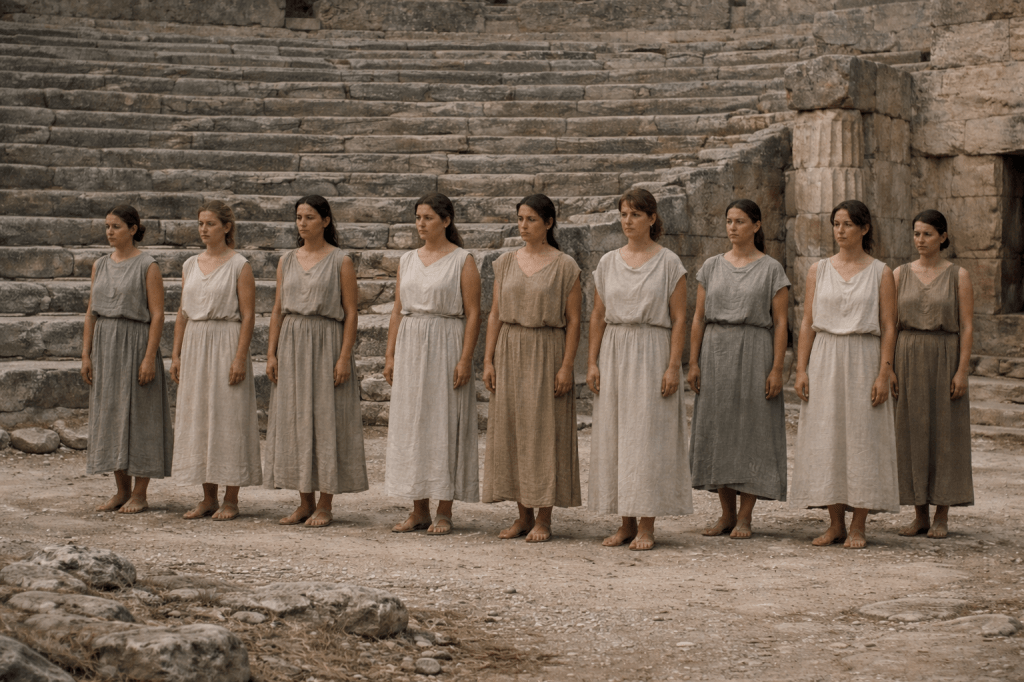
What unfolds next is not argument but waiting. The women do not advance the plot through speeches or confrontation; they hold their positions. Silence becomes a practiced discipline rather than a void. Each pause is deliberate, each refusal sustained by the knowledge that it is shared. In Lysistrata, this waiting functions like choreography: bodies arranged, entrances delayed, exits denied. Nothing appears to happen, and yet pressure accumulates. The longer the women remain still, the more unstable the surrounding world becomes.
This is where the play quietly inverts theatrical expectation. Comedy usually relies on escalation — louder voices, faster timing, visible chaos. Here, escalation occurs through restraint. The women do not chase outcomes; they let time do the work. Their power lies in understanding that endurance outlasts urgency, that systems dependent on constant participation cannot withstand sustained absence. Waiting is not passivity but labor: an ongoing, collective act requiring trust, discipline, and refusal to break formation.
Seen this way, Lysistrata is less a performance of rebellion than a study in collective stillness. The women’s bodies mark time differently. They move slowly, speak sparingly, and allow impatience to bloom elsewhere. Silence becomes the measure of control. The choreography succeeds precisely because it looks like nothing — because it denies the spectacle that would re-center attention away from the women who are, simply, not moving.
Only once this silence has been held long enough to become structural do its effects register — not as persuasion achieved, but as systems faltering under the weight of sustained absence.
When Waiting Ends
When the waiting finally ends, it does not feel like triumph. There is no release, no celebratory reversal, no sense of conquest. The women do not surge forward to claim recognition; they simply stop withholding. The shift is almost imperceptible — a loosening rather than a rupture. What has changed is not the women, but the structure around them, now reshaped by the time it spent under strain. In Lysistrata, resolution arrives as inevitability: the quiet outcome of sustained coordination rather than dramatic victory. The play ends not with applause for cleverness, but with the unsettling realization that nothing about this outcome required persuasion — only patience, alignment, and the willingness to wait longer than the world expected.
What lingers is not the outcome, but the knowledge that nothing stopped the women sooner — except their own decision to participate again.
 Scott Bryant
You must be logged in to post a comment.