
Poirot: The Murder of Roger Ackroyd
Lakewood Theatre Company — January 31st, 2026
Headlee Mainstage, Lake Oswego, Oregon
Directed by David Sikking
Adapted for the stage by Rick Robertson
Based on the mystery The Murder of Roger Ackroyd by Agatha Christie
Before the Lights Went Down
The play had already begun, though most of the audience did not yet know it.
The lights were still up. Programs rustled. People settled into their seats, adjusting coats, murmuring. And then a woman walked onto the stage barefoot, dressed in deep teal silk, carrying herself with a quiet, unmistakable sadness.
There was no announcement. No cue. No curtain.
She sat, accepted a drink from two maids, placed pills into the cup, and drank. She placed them with the same care one might add sugar.
Only after she died did the audience understand they were already watching.
That choice—to let the story begin before permission was granted—defined the intelligence of Lakewood Theatre Company’s staging of Agatha Christie’s The Murder of Roger Ackroyd. From its first moments, this production asked the audience not simply to follow a mystery, but to reckon with how attention, authority, and trust are constructed.
The Chair
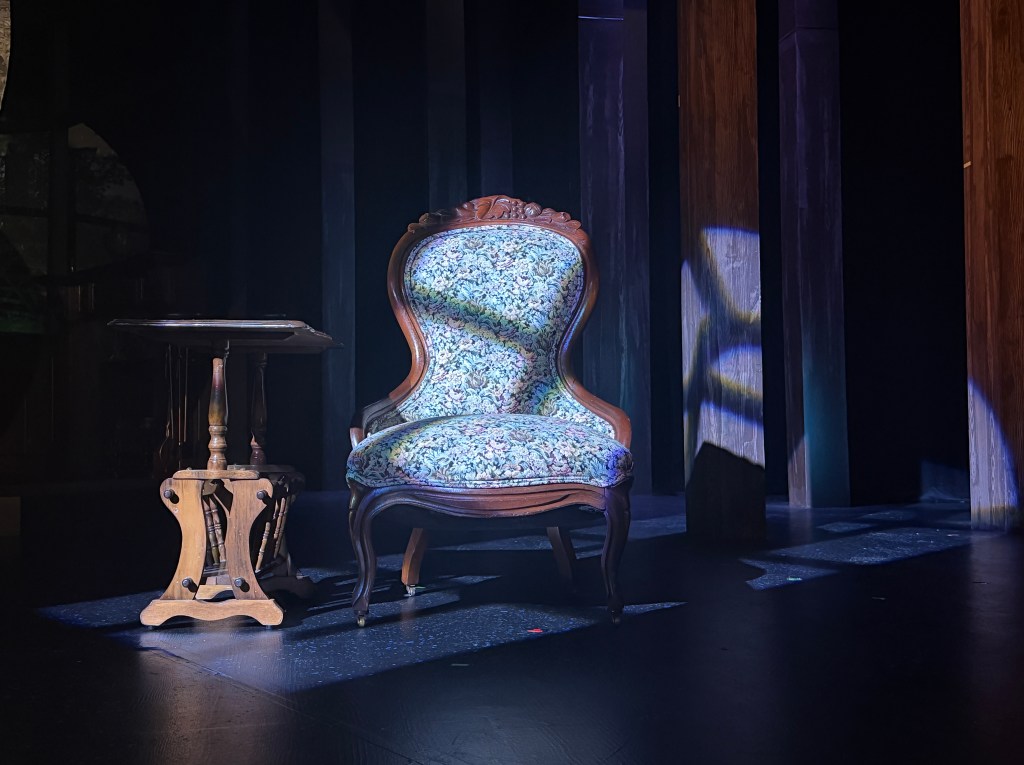
At center stage sat a chair.
Upholstered in pale blue floral fabric, framed in carved wood, slightly elevated by the pool of light that held it apart from the rest of the set, the chair appeared unremarkable at first glance—the sort of genteel furnishing that blends into period drama without calling attention to itself.
But this was the place where Mrs. Ferrars (played by Lucy Paschall) had died.
After the opening moments, the chair remained just long enough to matter. It did not become symbolic through overt emphasis. Instead, it stayed fixed in place as the space reset around it, accumulating meaning simply by having been there at all. Absence clung to it. The body was gone, but the imprint of the act remained.
This was where the production’s visual intelligence revealed itself most clearly.
The chair functioned as a quiet witness—not only to Mrs. Ferrars’s death, but to the way domestic spaces so often contain, manage, and erase women’s suffering. It was not a dramatic prop. It was furniture. And that was precisely the point. The act did not take place in a dark alley or a grand confrontation, but in a sitting room, in a place designed for rest and decorum.
Once the chair had taught us how to look, the story could proceed—confident that we would miss what it wanted us to miss.
Women, Labor, and the Machinery of Care
From its opening moments, the production made a quiet but unmistakable choice: women did not merely populate the world of The Murder of Roger Ackroyd—they sustained it.
Mrs. Ferrars’s death was not staged as spectacle. It was domestic, contained, and unsettling precisely because of its familiarity. She entered barefoot, dressed not for public display but for private endurance. The pills were taken calmly. The chair received her body without protest. And then, briefly, as if refusing to relinquish narrative control, she spoke once more—a disembodied voice delivering the theater’s opening address, presiding over an evening she would never see.
That decision reframed the story immediately. Death did not silence her entirely; it allowed her one final act of address. Labor did not end with her body.
Throughout the play, women moved through the space performing the invisible work that makes society function: serving drinks, managing households, smoothing social friction, absorbing emotional fallout. The maids were not ornamental; they were first responders. Their scream did not merely announce a death—it punctured the illusion that this was a world held together by polite conversation.
Even Mrs. Ackroyd’s presence carried weight beyond her role in the plot. Her stillness, her watchfulness, her composure in moments of revelation suggested a woman long accustomed to being adjacent to power without being afforded it. She observed. She endured. She remembered.
What stood out was how often women absorbed the emotional consequences of men’s actions while being denied narrative authority. Secrets passed through their hands. Grief lingered in their bodies. Yet the story — at least on the surface — belonged to male voices: the Doctor’s narration, Poirot’s deductions, the structures of logic that framed the crime as an intellectual exercise.
And yet, the production resisted allowing women to fade into the background. Their labor remained visible. Their presence lingered even when the narrative tried to move past them. The chair where Mrs. Ferrars died was never neutral again. It became an object charged with memory, a reminder that care, silence, and service are not passive states, but imposed ones.
In this staging, women were not simply victims or witnesses. They were the connective tissue of the world—the machinery of care that kept King’s Abbot functioning even as it failed them.
The Village as Witness
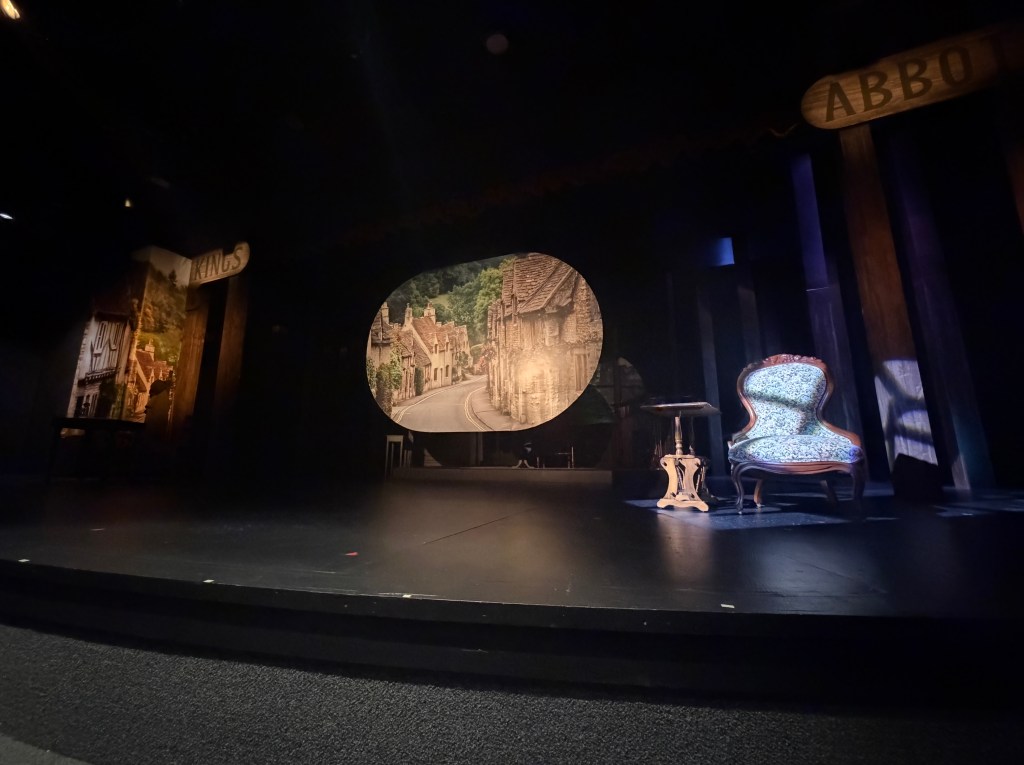
King’s Abbot was not presented as a neutral backdrop. It was a living organism—observant, suspicious, and quietly complicit.
The set design reinforced this from the beginning. Signposts bearing the village’s name framed the space, while projected images of narrow streets and stone houses suggested a place where privacy is a fiction. Windows looked inward. Doors implied listening ears. The village did not need to speak loudly to be present — it was already watching.
This sense of collective observation was heightened during the staged “photographs” following the initial death. As the lights flashed and the actors froze into posed tableaux, the effect was chilling. These were not memories. They were reconstructions — curated versions of truth designed to be consumed. The audible camera clicks transformed the audience into witnesses, complicit in the act of documentation.
The choice to simulate early crime photography was especially effective. It reminded us that evidence is never neutral; it is framed, selected, and often staged after the fact. The village, like the camera, preserves what it chooses to see.
King’s Abbot believed it knew itself—believed it was too small, too orderly, too polite for real darkness. That assumption proved fatal.
The villagers’ reactions, their polite evasions, their rehearsed concern all reinforced the idea that communal identity can be a shield—one that protects perpetrators as effectively as it marginalizes the vulnerable. The village did not commit the murder, but it created the conditions in which it could occur without immediate suspicion.
In the end, King’s Abbot stood revealed not as an innocent setting, but as an active witness—one that saw everything and understood very little.
In a place where everyone watches, authority rarely draws attention to itself.
Sound, Light, and the Illusion of Evidence
Much of the production’s intelligence lived in elements that rarely draw attention to themselves unless mishandled.
Sound and lighting were used sparingly, but with surgical precision. The most striking example came early, when the aftermath of Mrs. Ferrars’s death was rendered not through frantic motion, but through stillness. Actors froze mid-reaction as simulated camera shutters clicked and flashes cut through the darkness. Grief, shock, and composure were reduced to posed fragments—moments selected, preserved, and stripped of context.
It was a reminder that evidence is not truth, but an artifact.
The lighting design reinforced this idea throughout the play. Pools of illumination isolated figures just long enough to suggest importance, then receded, allowing doubt to re-enter. Shadows crossed faces and furniture without theatrical flourish, subtly shifting emphasis from person to object, from action to consequence.
Sound followed a similar logic. Silence was allowed to linger. When noise arrived — a scream, a click, clock chimes, a line delivered directly to the audience — it carried weight because it was rare. Nothing was underscored. Nothing insisted. The production trusted restraint.
Near the end of the first half, Poirot declares that everyone in the room has something to hide. The statement itself is not shocking. The staging that follows is.
At the sound of a clock chime, a spotlight isolates each character in turn. As the light lands, a disembodied voice emerges, not dialogue spoken in the room, but interior thought made audible. Suspicion becomes rhythmic, procedural, almost bureaucratic. One by one, secrets are suggested, framed, and preserved.
What matters is not the content of these admissions, but the mechanism by which they are delivered. Light selects. Sound punctuates. Voice detaches from body. The audience is trained, again, to accept presentation as proof.
Like the staged photographs earlier in the play, this sequence reminds us that evidence is not discovered so much as arranged, and that authority often speaks most convincingly when it appears methodical.
Together, these choices framed the investigation as something mediated rather than discovered. Truth did not emerge fully formed; it was assembled from fragments, shaped by what could be seen, heard, and preserved.
Conclusion: What Remains After the Reveal
What lingered after the final moments was not cleverness, but unease.
The chair where Mrs. Ferrars died remained vivid in memory — empty, upholstered, unremarkable, and charged. The sound of camera shutters echoed longer than expected.
This production did not ask the audience to marvel at how well the puzzle fit together. It asked something quieter, and more difficult: to reflect on how easily attention can be misdirected, how authority is granted without examination, and how much labor—particularly women’s labor—goes unseen in maintaining the appearance of order.
That this staging came from Lakewood Theatre Company, described in the playbill by its executive director as the oldest continuously producing theatre company in the Portland area, felt significant. It was not innovation for its own sake, but stewardship: a confidence born of experience, restraint, and trust in craft.
By the end, The Murder of Roger Ackroyd no longer felt like a story about a single crime. It felt like a meditation on belief itself: who earns it, who assumes it, and what happens when it is finally withdrawn.
Some chairs, once occupied, never truly empty.
Archival Meta Note: I’m not a professional archivist, but I approach these productions with an archivist’s care. These notes are my way of preserving not only what I saw on stage, but why it mattered — as memory, as culture, and as a record of care. In that choice, the archive becomes not just a record of art, but a record of care.
 Scott Bryant
You must be logged in to post a comment.