

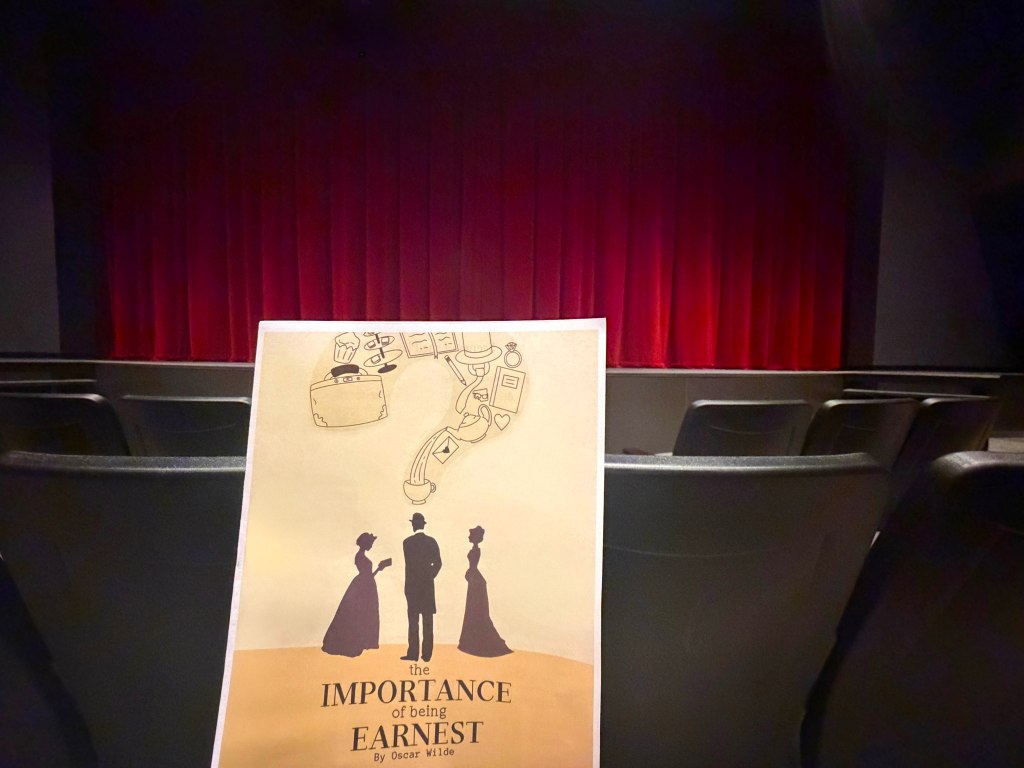
The Importance of Being Earnest
Sherwood High School Bowmen Theatre — February 14th, 2026
SHS Auditorium, Sherwood, Oregon
Directed by Joe Dalton
By Oscar Wilde
There are worse ways to spend Valentine’s Day than in a high school auditorium watching Oscar Wilde dismantle Victorian seriousness with cucumber sandwiches and social artillery.
The afternoon began quietly — light grey trench coat, maroon polo, dark heathered trousers, a short drive into Sherwood. A sporting event occupied part of the campus. Cars filtered in. The air held that February uncertainty between rain and restraint. Inside: programs, polite chatter, and the gentle hum of pre-show anticipation.
Then Wilde.
From its first exchanges, the production leaned into elegance rather than chaos. The opening scenes between Jack and Algernon felt almost restrained — conversational fencing more than farce. It carried a faint echo of classic theatrical stylings: a Vincent Price dryness here, a whisper of cultivated absurdity there. The wit wasn’t shouted. It was placed carefully.
And then Lady Bracknell entered.
As she must.
Her interrogation of Jack remains one of the great comic examinations in theatre — income first, naturally. Parents second. And upon learning that he has lost both:
“Both? … That seems like carelessness.”
The line landed exactly as Wilde intended — not merely as humor, but as satire sharpened to a social blade. Loss becomes impropriety. Birth becomes paperwork. A man may be moral, solvent, and earnest in every sense — but if he originates from a handbag in a railway cloakroom, society trembles.
Lady Bracknell’s speeches are not jokes; they are indictments delivered in silk gloves.
“I do not approve of anything that tampers with natural ignorance,” she proclaims — that education, if it actually worked, might threaten the upper classes. The audience laughed, as they should. But the line still carries a modern chill.
The afternoon found its fullest rhythm in Act II.
The garden scene — July roses in theory, February in reality — became a battlefield of diaries and polite annihilation. Gwendolen and Cecily, initially sweetness itself, transformed into precision instruments of social warfare. What begins as friendship curdles into competition with breathtaking civility.
Even Miss Prism, champion of improvement and discipline, cannot resist her own sharp verdicts — reminding us that in Wilde’s world, moral seriousness is rarely immune from satire.
The tea sequence remains one of Wilde’s most exquisite constructions.
Sugar requested? No. Four lumps added anyway.
Bread and butter asked for? Cake delivered instead.
Every gesture weaponized under the watchful neutrality of the servants.
The brilliance of the scene lies in its restraint. The fury never breaks decorum. The insults are wrapped in etiquette. It is warfare conducted with teaspoons.
And the diaries — of course the diaries. Engagements timestamped to the minute. Proposals pre-recorded before they occur. Cecily admitting Ernest proposed “exactly ten minutes ago.” Gwendolen certain of her “prior claim.” It is romantic absurdity elevated into paperwork.
Even in Act I, love is calibrated to syllables. Gwendolen’s devotion rests not in character but in cadence — the name “Ernest” carrying, as she insists, a music of its own. Identity becomes acoustic. Marriage becomes branding.
If Act II belonged to the women’s duel, Act III belonged to Lady Bracknell’s dominion.
Her arrival silences the room — and rearranges it.
Engagements multiply. Fortunes are evaluated. Social possibilities are assessed through profile alone. The chin must be worn correctly. Society must not be spoken of disrespectfully. Consent may be granted — but only when capital aligns.
And then, of course, the handbag.
Few theatrical reveals are as delightfully preposterous as the confession of a misplaced infant. Manuscript in the pram. Baby in the handbag. Deposited at Victoria Station. The absurdity compounds until identity folds in on itself — Jack discovering he has always been Ernest after all.
The closing line lands as both punchline and thesis:
“I’ve now realized for the first time in my life the vital Importance of Being Earnest.”
It is a joke about names. About truth. About performance. And in a culture obsessed with lineage and appearance, performance becomes survival.
Identity, in Wilde’s world, is always theatrical.
Perhaps that is why the play felt especially fitting on Valentine’s Day.
Love, here, is not sentimental. It is negotiated, evaluated, defended, staged. Engagements are strategic. Affection is announced with precision.
The young cast approached Wilde’s language with admirable restraint, resisting the temptation to rush the wit and allowing the satire to breathe.
There was something quietly satisfying about spending the afternoon in solo company, watching Victorian society collapse under its own politeness. Water and cookies served at intermission. A trace of perfume lingering a little too confidently in the row ahead. Light sprinkles outside. A campus auditorium briefly transformed into Hertfordshire.
No grand gestures. No declarations. Just language — beautifully structured, precisely delivered, and still razor sharp more than a century later.
On a quiet February afternoon in Sherwood, earnestness was not merely a virtue.
It was a performance.
And a very good one.
 Scott Bryant
You must be logged in to post a comment.