
I discovered Jane Austen’s Period Drama almost by accident — first through Kanopy, then again when one of its writer/directors, Julia Aks, made the entire short freely available online. It is thirteen minutes long. It looks, at first glance, like a faithful Regency adaptation: pastoral countryside, restrained interiors, soft window light, careful posture, and dialogue delivered in hushed, measured tones.
It has the aesthetic discipline of prestige period drama.
And then it pivots.
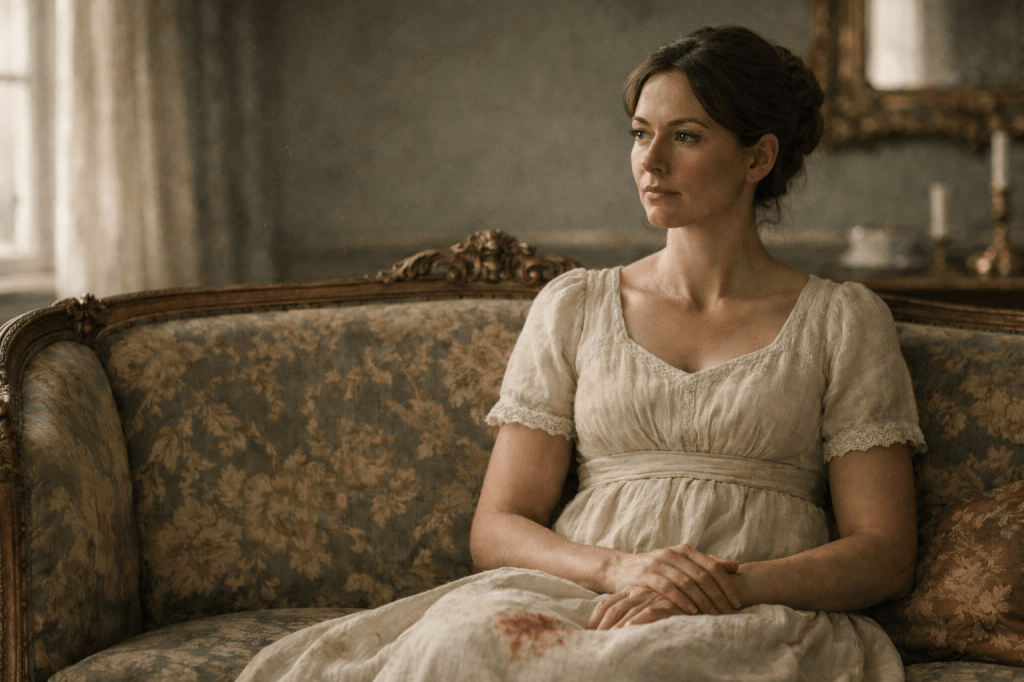
The premise is simple: during a long-anticipated marriage proposal, Miss Estrogenia Talbot begins her monthly cycle. Her suitor, Mr. Dickley — earnest, concerned, and catastrophically uninformed — assumes she has suffered a mortal wound. What follows is not crude comedy but tonal escalation. The film never breaks its world. It does not parody Austen by distorting her style; it inhabits the genre completely and inserts biological reality where euphemism once lived.
That fidelity is the engine of the joke.
The countryside remains lush. The corsets remain immaculate. The drawing room is framed with painterly restraint. Within that composure, the women begin strategizing. Should they fabricate a thorn injury? Should they stage a more dramatic wound? Should poultry be sacrificed to satisfy expectations of visible trauma? Each suggestion is delivered with alarming civility, as though they were discussing tea service rather than blood.
The absurdity escalates, but the lighting never changes.
At one point, when Estrogenia suggests she might simply tell her suitor the truth, decorum fractures. The response is immediate and profane — not for shock value, but as a crack in the genre itself. Truth, in this world, is far more dangerous than blood. It is “best to play the wounded lamb.” Marriageability must be preserved. Explanations must be palatable. Ignorance must be accommodated.
The satire sharpens without shouting.
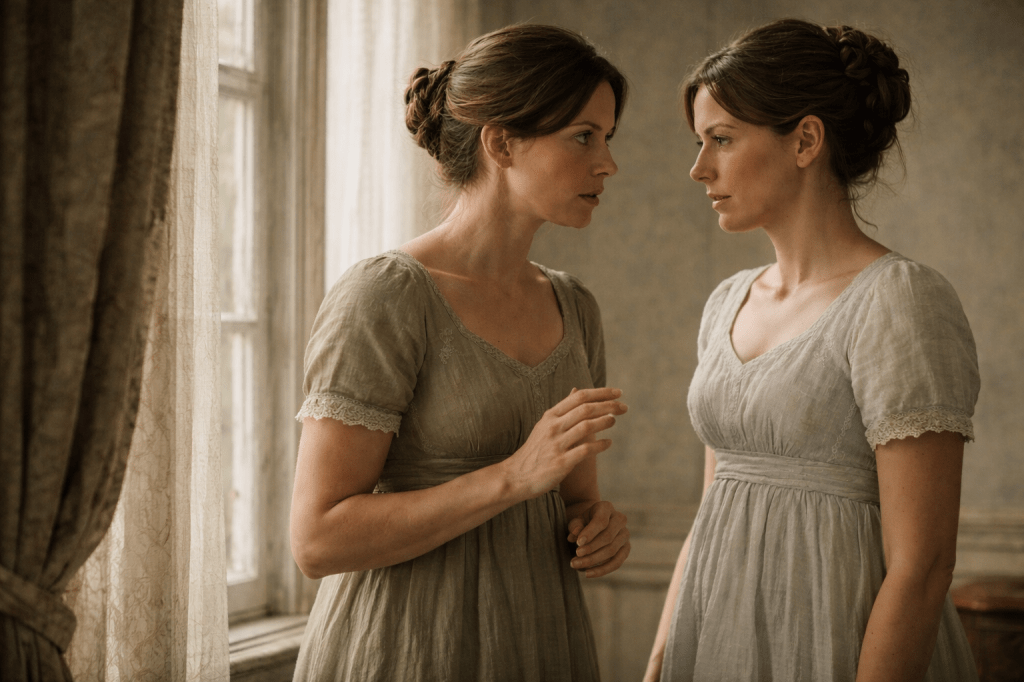
What elevates the short is its precision. The blood is not exaggerated. It is simply present — framed with the same solemn gravity as any tragic revelation in a drawing room. The women’s panic is not hysteria but strategy. The men’s misunderstanding is not villainous but structural. When the word “cervix” is introduced, it is misheard as the name of a rival gentleman. Biology becomes betrayal. A duel is nearly conjured from a syllable.

The joke lands not because menstruation is inherently comedic, but because period drama has historically erased women’s physical realities in favor of aesthetic myth.
Even the closing credits sustain the tone, assigning formal roles with straight-faced absurdity. Nothing winks. Nothing apologizes. The film trusts the audience to recognize the collision between velvet restraint and corporeal fact.
It would have been easy for this premise to collapse into sketch comedy. Instead, it maintains composure. The performances are committed. The cinematography is respectful of the genre it borrows from. The humor is built through escalation rather than exaggeration.
What remains after the laughter is something quieter.
Period dramas often romanticize fragility while obscuring the labor and inconvenience that accompany it. They elevate fainting couches and empire waistlines but rarely acknowledge the mundane, cyclical realities of embodiment. This short does not attack that tradition; it gently ruptures it. It allows the drawing room to absorb what it has historically omitted.
The result is satire that feels corrective rather than combative.
At thirteen minutes, it says exactly what it needs to say and exits before the premise grows thin. It does not linger on shock. It does not sermonize. It stages an absurd misunderstanding with full aesthetic sincerity and lets the logic unravel on its own.
In the end, the most scandalous element is not blood but ignorance. That is the sharpest inversion of all.
Embedded below is the official public release of the film via writer/director Julia Aks’s YouTube Channel.
 Scott Bryant
You must be logged in to post a comment.