
The Hand She Never Plays
(她从不打出的那一手)
Archival Attribution
Primary subject identified as Suyin Tang.
Origin logged between Monte Carlo and Singapore.
Narrative source unconfirmed; authorship withheld.
Archive Note — Her Stories, Her World
Entrusted, not submitted.
Retained as received.
Visual Record
Associated images preserved as part of the original record.
No alterations made.
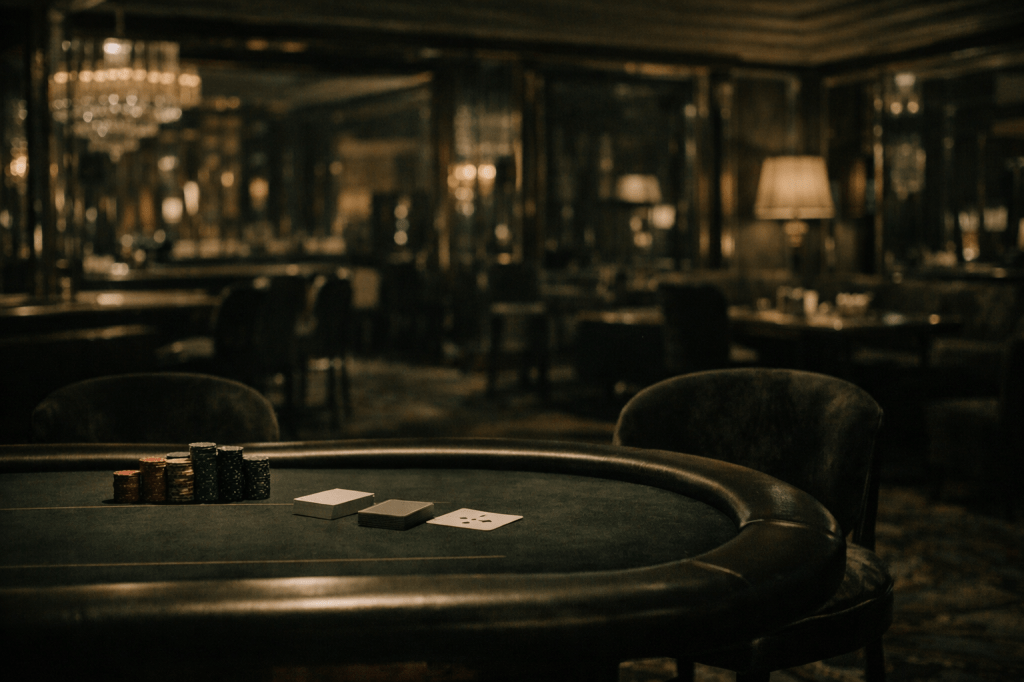
Monte Carlo
The room is quieter than it should be, not empty, but arranged in a way that suggests noise has been deliberately removed. Glass, velvet, and the soft, unspoken weight of money shape the space, everything placed with enough distance to imply privacy and just enough proximity to remind you it isn’t entirely real.
I have played in rooms like this since leaving Singapore, long enough to know the game is rarely about the cards. It is the kind of instinct you learn early, growing up where everything is observed, and very little is said outright. There are rooms where women like us are expected to be quieter than we are.
Monte Carlo has no interest in that kind of performance. Here, everything is reduced and refined to the point where what remains cannot be disguised. The game is cleaner, but the tells are not.
I take my seat without announcing it, letting the moment settle before I acknowledge anyone else at the table. There is a rhythm to arrival, something unspoken but understood, and the first mistake is often made by the person who disrupts it. Chips are stacked, glasses filled, and no one speaks, not out of politeness but because nothing useful has been said yet.
When I let my gaze move, it does so without urgency. A woman to my left holds herself in a kind of stillness that suggests discipline rather than ease. Across from me, someone younger tries carefully not to appear uncertain, which only makes the effort visible. These are small things, but small things tend to matter.
The shift, when it comes, is almost imperceptible. It is not a sound or movement but something quieter, a recalibration that settles into the edges of the room rather than announcing itself. It takes shape before I consciously name it, and by the time I do, I already know.
I do not look immediately. There is no advantage in confirming something too quickly.
The dealer steps forward, cards prepared, the table aligning itself into the familiar structure of the game. I rest my fingers lightly against the felt, smooth and unmarked, though I know better than to assume it carries no history. Very little in rooms like this ever does.
Only then do I allow myself to look.
She is already seated.
Of course she is.
I do not remember seeing her arrive.
No one ever does.

Suyin Tang does not arrive in the way other people do. She appears fully placed, as if the room had been waiting to arrange itself around her rather than the other way around. There is nothing overt about her presence, which is precisely what makes it effective. People expect sharpness, something visible, something they can identify and respond to. Suyin has never needed that. Control, when it is complete, rarely announces itself.
Her posture is unchanged from what I remember, economical and deliberate, the kind of stillness that reads as absence if you do not know what you are looking at.
I do.
She has not looked at me, or she has and chosen not to make it visible, which would be more like her.
The cards begin to move, hands forming in silence as the table settles into its rhythm. I do not check mine immediately.
Neither does she.
It is a small thing, almost nothing, but it is enough.
Singapore

The room in Singapore had been all glass and height, reflections folding into each other until it was difficult to tell which version of the space you were standing in. The city below felt too precise, too carefully arranged to be entirely real, as if it existed more as an idea than a place.
She had been standing near the edge, not looking out at the skyline but at the room itself, watching the way people moved when they believed they were not being observed.
There had been no introduction.
None was necessary.
The Table
I glance down at my cards. They are playable, nothing more.
An opening bet is placed, modest enough to pass as polite, and I match it after a measured pause. The table responds in kind, each movement deliberate, each decision carrying just enough weight to matter.
When Suyin moves, she calls without hesitation, clean and uncommitted, exactly what I expect. Across the table, someone shifts slightly, a fraction too early for nerves but not late enough to hide them. It is the kind of mistake people do not realize they are making until it is already part of the hand.
I let the play continue just long enough to confirm what I already feel, and then I fold, not because of the cards but because the shape of the room has changed in a way the others have not yet noticed. I have learned to trust that instinct, and it has saved me more often than any winning hand.
The dealer clears the table without comment, and no one questions the decision.
The next hand begins with a similar rhythm, but the room does not return to what it was. The others adjust without naming it, moving more carefully, as if they sense that the balance has shifted but cannot identify how.
The woman across from me is the first to test it. Her bet comes too early, not large but deliberate in a way that draws attention. It is not the amount that matters, but the timing, and for a moment the table pauses around her decision.
She believes she is setting the pace.
She is not.
The others respond cautiously, folding or calling without commitment, waiting to see how the hand resolves. When the turn comes, she doubles her bet, and this time the movement feels forced, as though she is correcting something she does not realize she has already revealed.
I stay in the hand, not to win, but to see how far she intends to take it.
When Suyin reaches for her chips, the motion is unhurried and precise. She raises just enough to redefine the hand without overwhelming it, and the effect is immediate. One player folds, another follows, and the uncertainty at the table becomes visible.
Across from me, the woman hesitates, and then she pushes everything forward.
It is not reckless, but it is wrong.
I could intervene in small ways, introduce doubt where there is none, give her a moment to reconsider.
I do not.
Suyin matches the all-in without comment, as if the decision had been made long before the chips moved. The table settles into a stillness that carries more weight than silence, and when the cards are revealed, the outcome passes through the room without significance.
The woman across from me exhales as the realization settles in, while Suyin gathers her chips with the same measured precision she has applied to everything else.
For her, it was never about the hand.
The next round reduces the table again, not through any dramatic shift but through a series of small decisions that leave only the two of us in the hand. No one remarks on it, but the change is understood.
I raise, not to command the table, but to direct the question where it belongs.
Suyin responds in kind, her movement aligned with mine rather than the others. The hand narrows, the structure holding while the meaning beneath it shifts, and when the final card is dealt, the rest of the table withdraws without needing to be told.
For a moment, she looks at me directly.
It is the first time.
There is no question in it, only recognition, clean and undistorted.
I return the look without altering my expression and raise again, the gesture exact and unambiguous. The decision is not about the cards, and it never has been.
She matches it, and the hand completes itself without drawing attention from anyone who is not already aware of what has changed.
The Hand
The table resets.
Conversation resumes at the edges, drinks are replaced, and the familiar patterns return, but something lingers beneath it all, a quiet awareness that does not dissipate.
Across from me, Suyin remains unchanged in posture and presence, yet the difference is clear. She has already chosen to engage, and that choice alters everything that follows.
For a moment, our attention meets again, not in passing, but in a way that holds just long enough to confirm that neither of us is pretending otherwise.
In Singapore, the distance had narrowed without acknowledgment until it became impossible to ignore, and then it had been restored with deliberate precision.
Here, the distance remains, but it is no longer enforced. It is maintained.
The distinction matters.
The final hand settles into place without announcement, the table narrowing once more until only the two of us remain. The dealer continues with the same neutral efficiency, the structure holding even as the meaning beneath it shifts.
I look at my cards as they arrive. They are strong enough to invite engagement, not strong enough to rely on without question.
The first round passes quietly. I check, and she does the same. There is no need to force the pace.
When the turn comes, it alters the structure just enough to matter. I let the change settle before I act, then raise with the same measured precision I have used throughout the night.
The movement is directed at her.
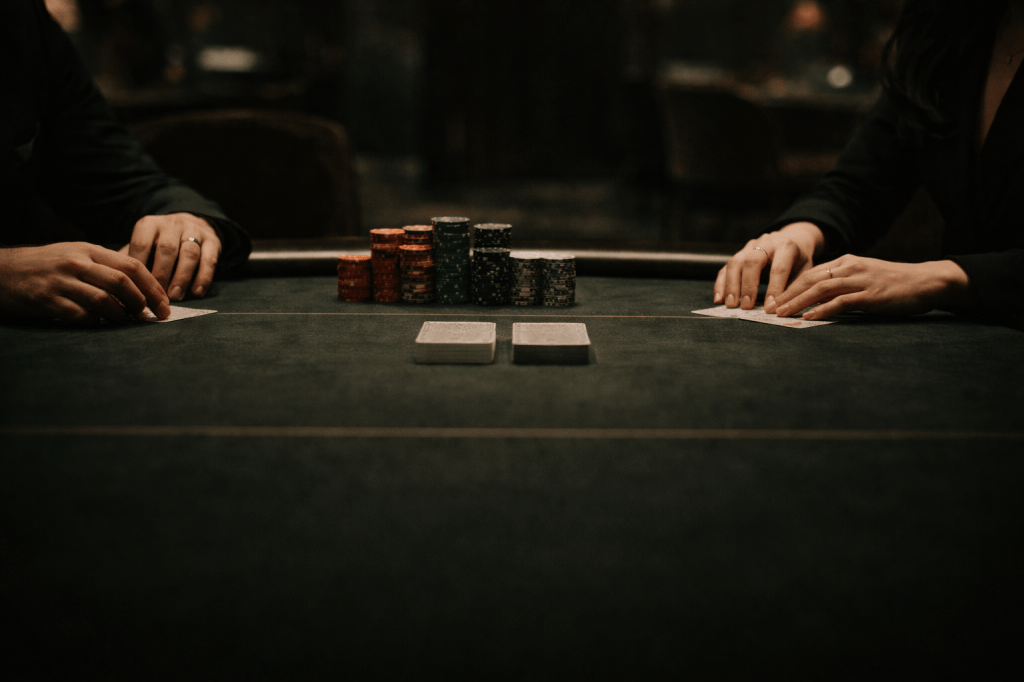
The room continues around us, but at the center, everything stills.
She considers for a moment, then raises in return, aligning her decision with mine rather than escalating beyond it. The shift is subtle but unmistakable, and I feel it not in the cards, but in the space between us.
I match her raise.
Not to win.
To remain.
The final card is dealt, and while I register its effect, the outcome has already moved beyond it.
In Singapore, she had stepped back before anything could take form, restoring the distance with a precision that left no room for misinterpretation.
Here, she does not.
The realization settles quietly, altering the shape of the moment without drawing attention to itself. She holds where she once withdrew, allowing the space between us to remain unresolved.
The hand completes, the result passing through the table without significance. Chips are gathered, cards are cleared, and the game continues as if nothing has changed.
But it has.
I release my cards, aware of the distinction between letting go and discarding, and when I look up, her attention meets mine again.
This time it does not pass.
It holds, uninterrupted, without question or invitation, only the quiet certainty of recognition.
I do not look away.
The dealer calls for the next hand, and the table resumes its rhythm, but nothing returns to what it was.
Neither of us moves to restore it.
 Scott Bryant
You must be logged in to post a comment.