
Titanic: The Artifact Exhibition
Oregon Museum of Science and Industry (OMSI) – Portland, Oregon
March 21, 2026
⟡
Two cups are placed side by side, identical in shape, material, and design—expanded polystyrene, light and filled with air. One remains unchanged, while the other is smaller, denser, compressed into itself by forces not visible here.
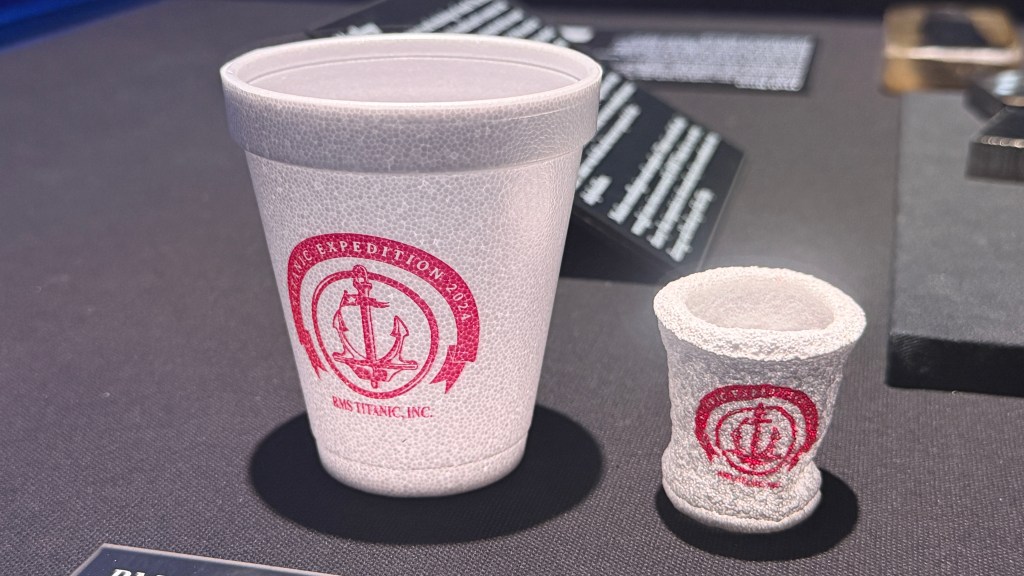
The explanation is given plainly. One of these cups was lowered 12,470 feet into the Atlantic Ocean to the wreck of the RMS Titanic during a 2024 expedition. At the surface, pressure measures 14.7 pounds per square inch; at depth, it exceeds 6,000. As the cup descends, the increasing pressure collapses the air within it, reducing its volume without altering its overall form.
The change is precise, with no tearing or distortion—only a shift in scale that reveals what has been removed.
What appears at first to be damage is not damage at all, but transformation: pressure made visible through absence. The air is gone, but the structure remains.
It is an object people recognize immediately, disposable and used without attention, something handled and discarded without consequence. Here, it becomes a measurement—not of the ship, but of the environment in which it now rests.
The wreck is not only distant; it exists within a space defined by compression, weight, and force sustained without release. The cup does not suggest the past; it demonstrates the present.
 Scott Bryant
You must be logged in to post a comment.