
Walk with Emma — Aurora Colony
Aurora, Oregon
March 22, 2026
Tracing the Aurora Colony through memory, place, and quiet presence
Arrival
Aurora does not announce itself loudly.
The transition is subtle—highway to smaller road, movement to stillness—until the town begins to settle into view as something preserved rather than constructed. Not staged, not overly restored, but held in place. The kind of place where the past has not been recreated so much as allowed to remain.
It feels less like arriving somewhere new, and more like stepping into something that has continued without you.
Before the Walk
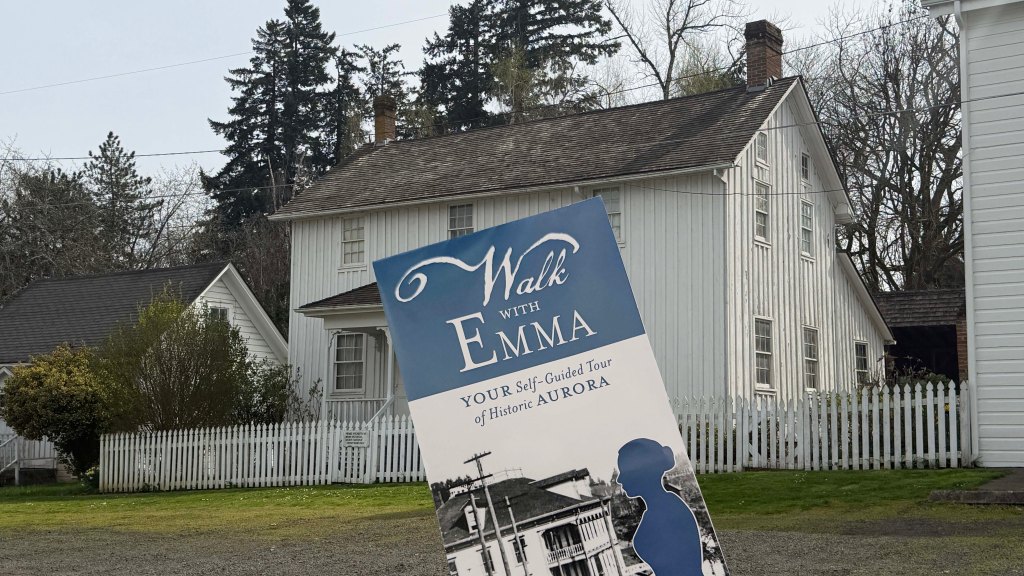
The walk begins before the first step.
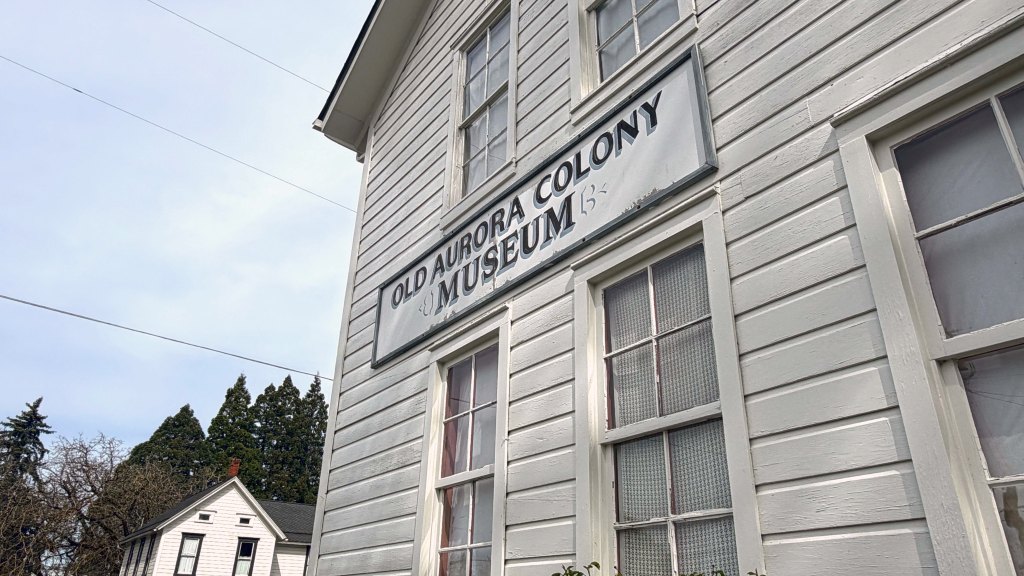
Not at Emma’s house, not at a marked stop, nor the Old Aurora Colony Museum, but in the act of holding the brochure itself—paper, folded, designed to guide. A nineteenth-century life translated into something portable—something you can carry.
And sometimes, if you’re aware of it, you can hold both at once—the story you’ve been given, and the place it is trying to explain.
— ❦ —
Emma’s House —
Where the Walk Actually Begins
The walk does not begin with a screen.
It begins with a house.
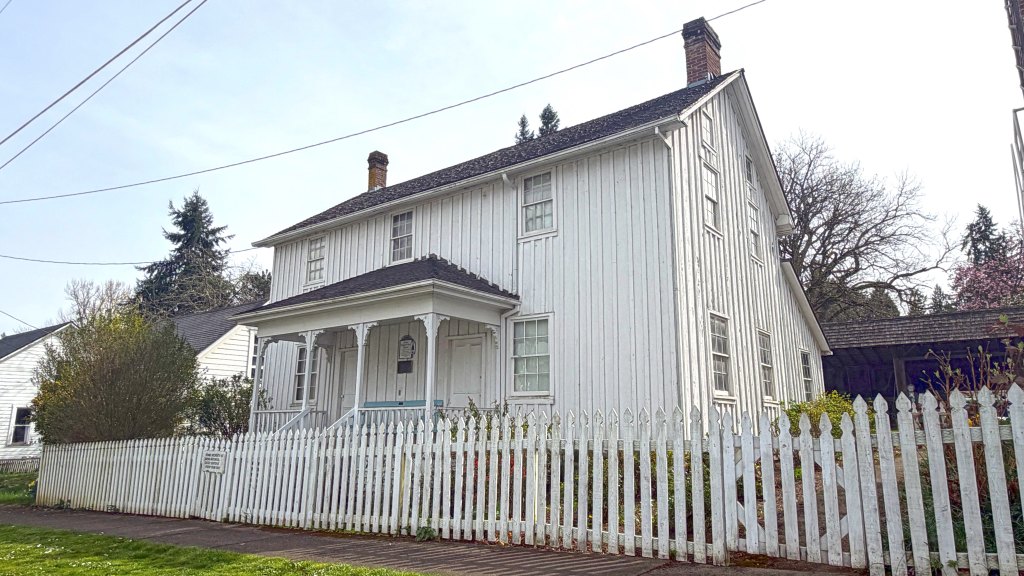
White siding, a simple porch, a fence that suggests both boundary and familiarity. Nothing about it feels monumental, and yet it carries the weight of origin—the place where Emma Wagner Giesy lived, where daily life unfolded in ways that would not have seemed historic at the time.
There is no performance here.
No dramatization. Just a structure that has endured quietly—holding the shape of a life that later became narrative. The brochure names it plainly, almost modestly, but standing in front of it, the experience is less informational than spatial.
You are not being told where Emma lived.
You are standing where she did.
And from that point forward, the walk is no longer theoretical.
— ❦ —
The Post Office —
A Letter Sent Forward
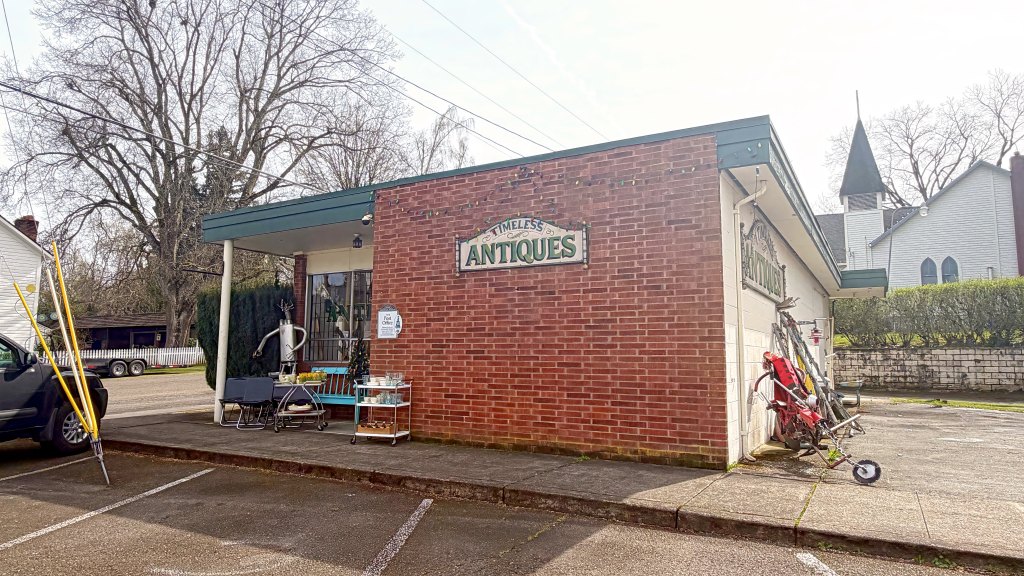
The building does not announce its past.
A low structure, now occupied by an antiques shop. Brick, practical, almost easy to overlook. But the brochure reframes it with a single line:
“From the post office I sent that famous letter of June 10, 1862 asking my parents to come to Aurora.”
– Emma Giesey
A letter sent outward.
A moment of decision carried across distance—one that would ripple forward into the shaping of a community still visible today.
Inside, the function has changed.
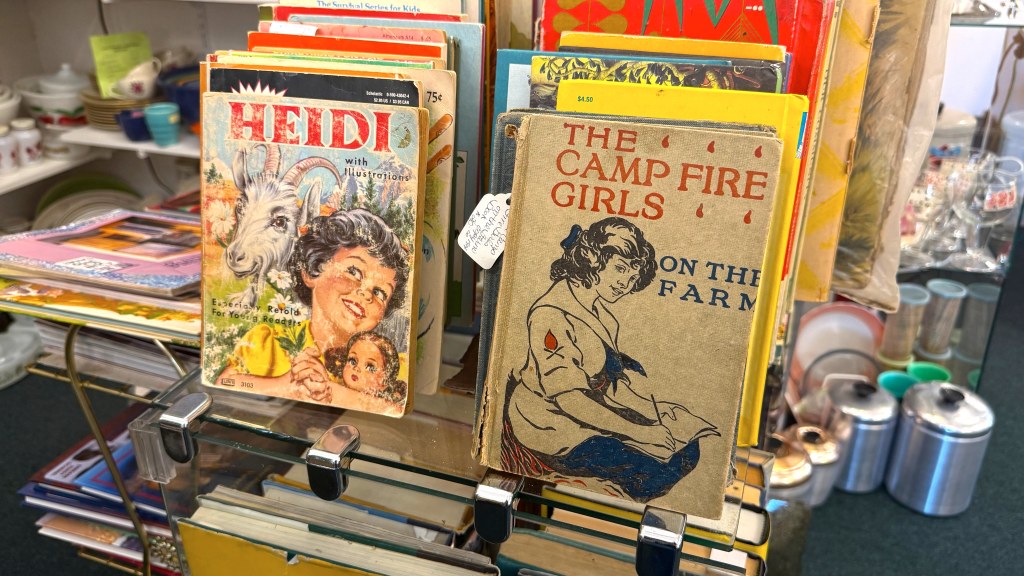
Shelves of objects. Books worn by time. Heidi. The Camp Fire Girls on the Farm. Stories of rural life, moral instruction, quiet endurance—echoes, unintentionally, of the values that defined the colony itself.
The space has reversed direction.
Where once it sent futures outward, it now gathers the past inward.
And standing within it, the distinction between communication and preservation becomes less clear.
— ❦ —
A Voice Introduced
After scanning a QR code, the walk introduces itself through a screen.
A brief set of instructions, a framing device: Emma Wagner Giesy, guiding the experience through “personal” commentary. The promise is simple—history made accessible, a blending of old and new, a relaxed day shaped by a nineteenth-century communal life.
It is presented as a guided experience.
But once underway, the guidance recedes.
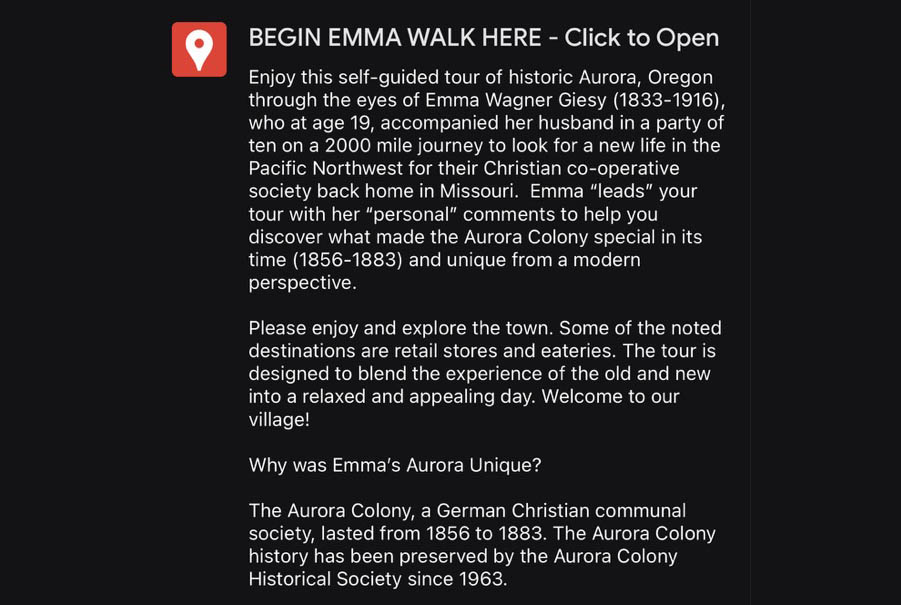
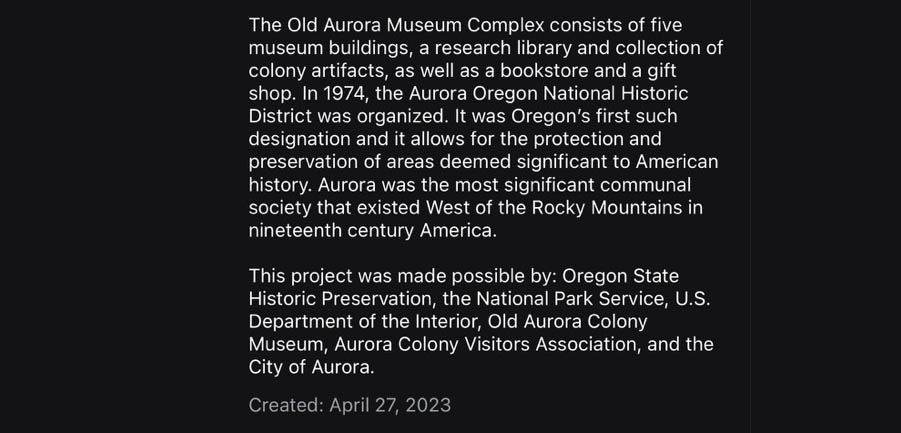
The structure is there—numbered stops, mapped paths, written voice—but it does not insist on itself. The town does not feel narrated so much as accompanied. Emma’s presence is implied, not imposed.
And in that quiet, something shifts.
You begin to walk not with Emma, but alongside the space she once occupied.
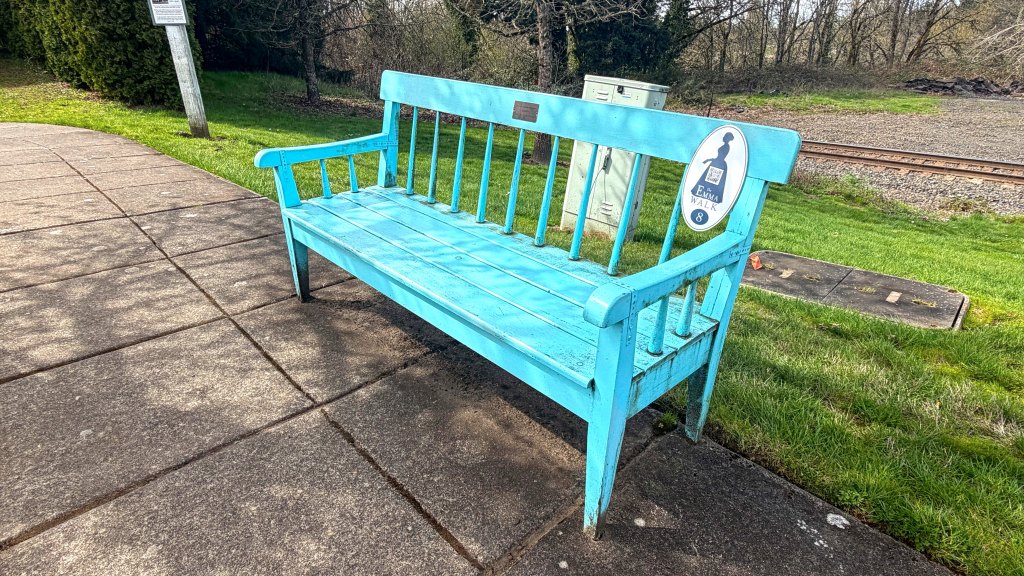
The bench itself—painted in a soft, unmistakable blue—becomes part of that realization. As the brochure explains, these are reproductions of colony-style benches. Colonists painted them in a variety of colors, but blue was a favorite—often referred to as “Prussian” or Aurora Blue.
It is a small detail.
But it reveals something essential: the walk is not only about structures that remain, but about choices—colors, objects, preferences—carried forward into the present.
The bench is not original.
But the decision behind it is.
Aurora State Bank —
Memory with a Sense of Humor
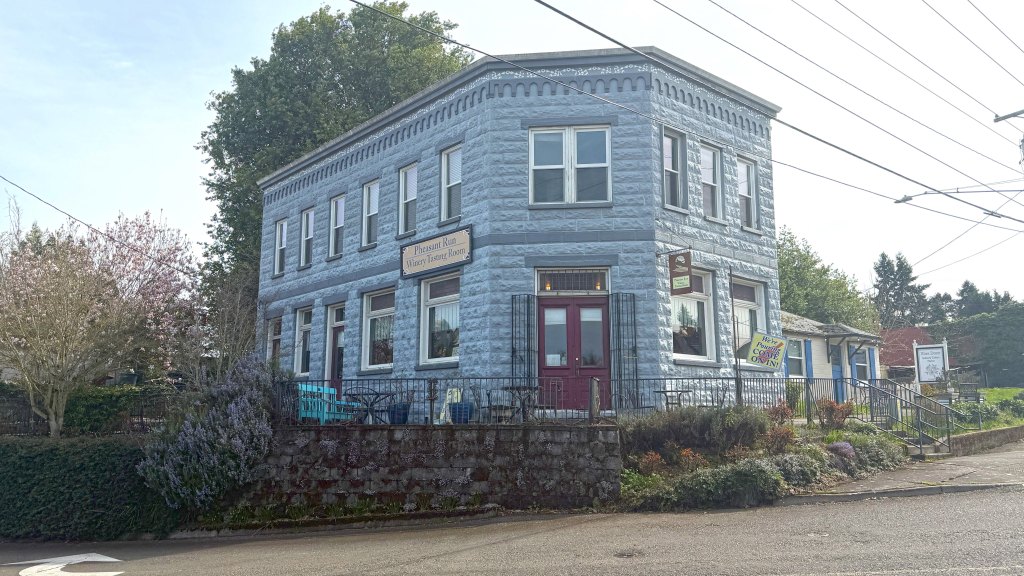
The building does not try to remain what it once was.
Emma identifies it plainly in the brochure—the Aurora State Bank, relocated from the 1905 Lewis and Clark Exposition, disassembled, numbered, and brought here piece by piece. It functioned as a bank until the Great Depression, a symbol of a different kind of order than the communal life that preceded it.
Before banks, there was trust.
Before currency, there was shared labor.
Emma notes, almost casually, that if gold or silver existed within the colony, it was kept under Dr. Keil’s pillow. A detail that feels both practical and quietly surreal—wealth reduced to proximity, to belief, to a single point of stewardship.
Now, the building holds something else entirely:
Wine.
The Pheasant Run Wine Tasting Room occupies the space, continuing a different thread of history. Emma’s own family, she reminds us, were wine lovers—advised to drink daily, to favor wine over whiskey. A continuity that feels less institutional and more personal, less economic and more lived.
And then, just outside—
A sign.
“Sweet Emma or Naughty Emma?”
It interrupts nothing.
It feels entirely at home.
The tone shifts, not away from history, but into it—into the idea that the past is not fixed, not solemn, not preserved behind glass. It can be playful. Reinterpreted. Even gently teased.
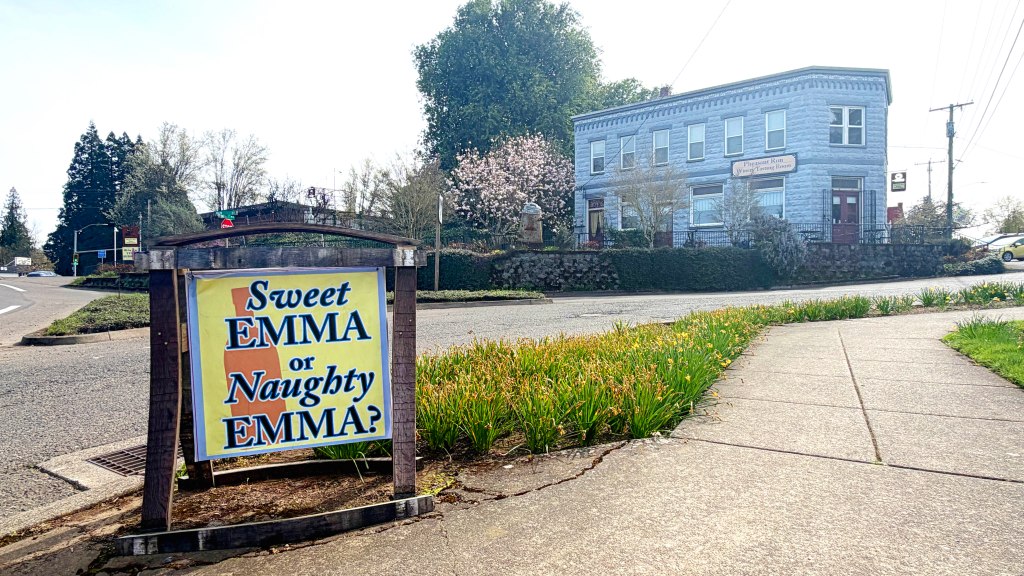
The question is not answered.
It isn’t meant to be.
Because by this point in the walk, Emma is no longer only a historical figure.
She is a presence—flexible, reframed, and still being decided.
— ❦ —
The Brochure —
A Constructed Memory
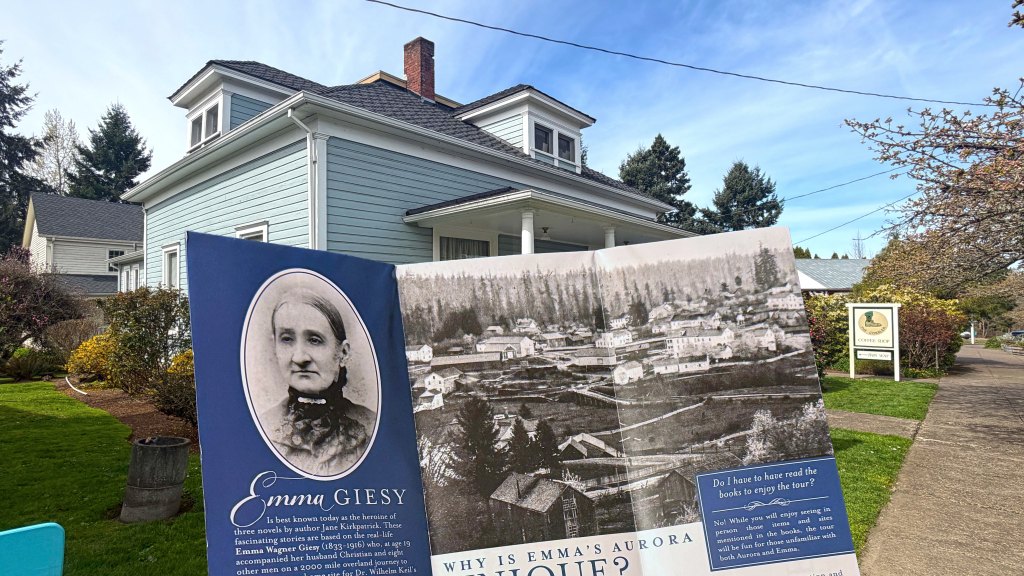
The brochure folds open like a careful introduction.
Emma appears first as an image—oval portrait, composed, distant—and then as text: a life condensed into dates, movement, purpose. A young woman traveling west in 1862, her story later retold, researched, archived, and reassembled through letters and interpretation.
She is at once:
- a historical figure
- a literary subject
- a narrative guide
The walk depends on this layering.
Emma is not simply remembered—she is presented. Her voice, reconstructed. Her perspective, curated. The experience becomes not just a path through Aurora, but a story already arranged—waiting to be stepped into.
And yet, walking through the town, that arrangement feels deliberately light.
There is space left between the lines.
— ❦ —
Interlude —
The Space Between Stops
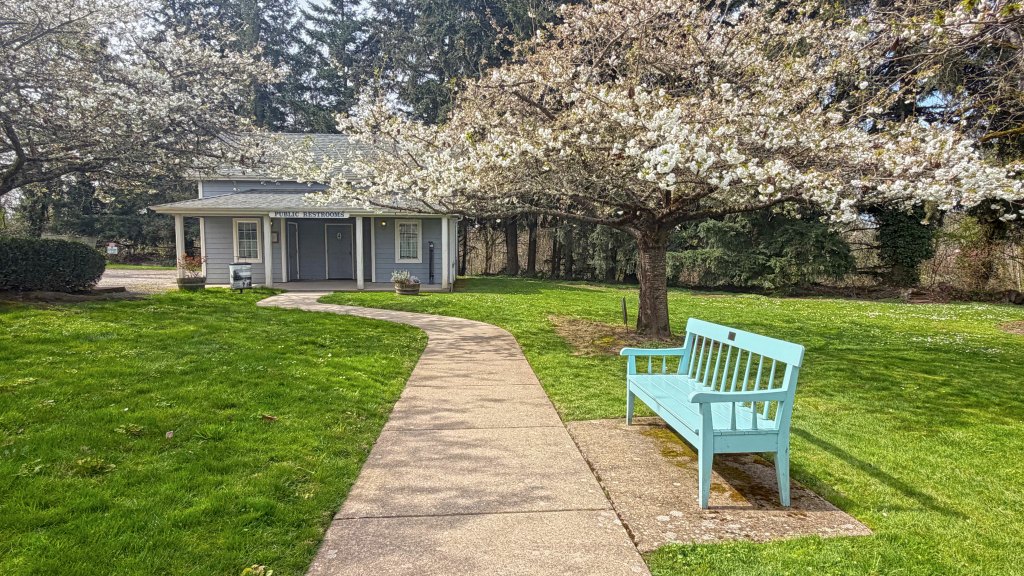
Not everything on the walk is labeled.
A bench beneath a flowering tree. A curve in the path. A moment that exists without explanation or instruction.
The tour does not direct attention here.
It allows for it.
The experience pauses—not because it is designed to, but because it can. The structure gives way to something more personal, less narrated. A reminder that not every meaningful part of a place is marked or interpreted.
Some of it simply exists.
Leonard Will House —
A Different Kind of Continuity
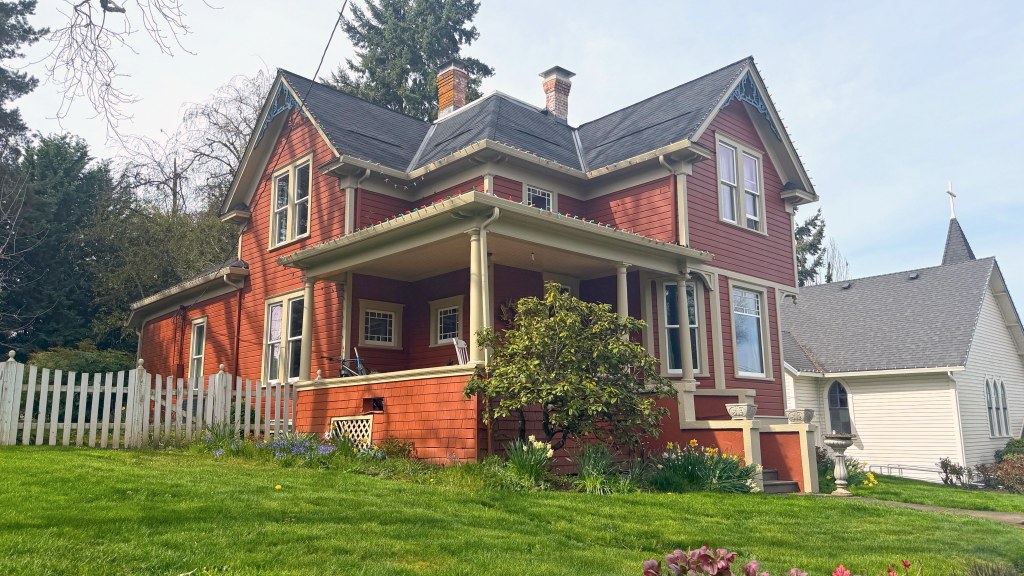
The Will House stands with a different presence.
More ornate. More deliberate. Built in 1908, it reflects a shift—from communal experiment toward established life, toward permanence shaped by individuals rather than collective identity.
Its story carries another layer.
Later known as the Will Sisters House, it was inhabited by two sisters and their cousin, all of whom remained unmarried. A detail easily passed over, but one that lingers—suggesting a household defined not by expectation, but by its own internal continuity.
The street itself reflects that evolution.
Still quiet. Still intact. But no longer experimental—settled, defined, enduring.
Blending Old and New —
Without Friction
The walk promises a blending of past and present, and it delivers—but not through contrast.
There is no sharp division.
A post office becomes an antique shop. A QR code sits beside a nineteenth-century silhouette. A reconstructed bench carries forward a historical preference in color and form.
The present does not overwrite the past.
The past does not resist the present.
They coexist—quietly, without friction.
Aurora does not feel preserved in isolation. It feels inhabited, continuous, and aware of itself without needing to declare it.
Conclusion —
Who Leads the Walk
The tour suggests that Emma leads.
Her voice frames the experience. Her story provides structure. Her perspective offers a way in.
But walking through Aurora, that guidance reveals itself as something lighter.
The town does not depend on her voice.
It supports it.
In the end, the walk becomes something else.
Not a guided experience—but an observed one. Not a narrative imposed—but a space entered.
Emma begins the walk.
But she does not finish it.
That part belongs to the one who continues the walk.
 Scott Bryant
You must be logged in to post a comment.