
Portland Japanese Garden
Washington Park – Portland, Oregon
March 25, 2026
10am
The Ascent — Washington Park
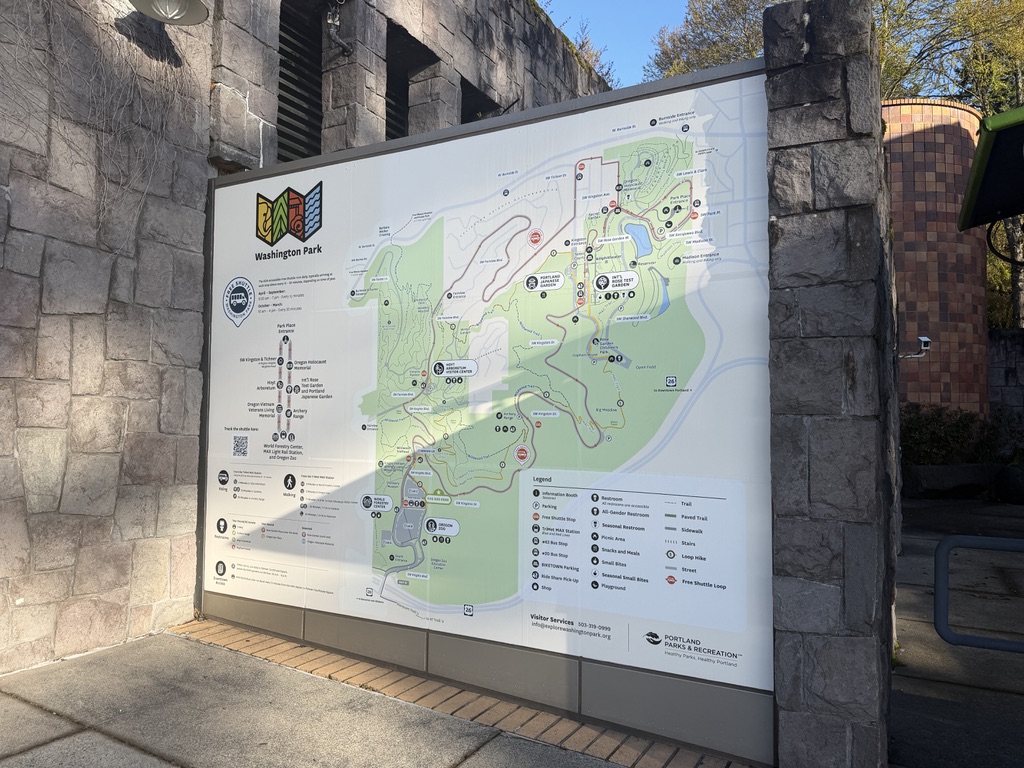
The visit begins below the garden, near the Oregon Zoo and the World Forestry Center.
Here, Washington Park presents itself not as a single destination, but as a network—maps set into stone, routes traced across terrain that extends beyond what can be seen at once. The garden is somewhere above, not yet visible.
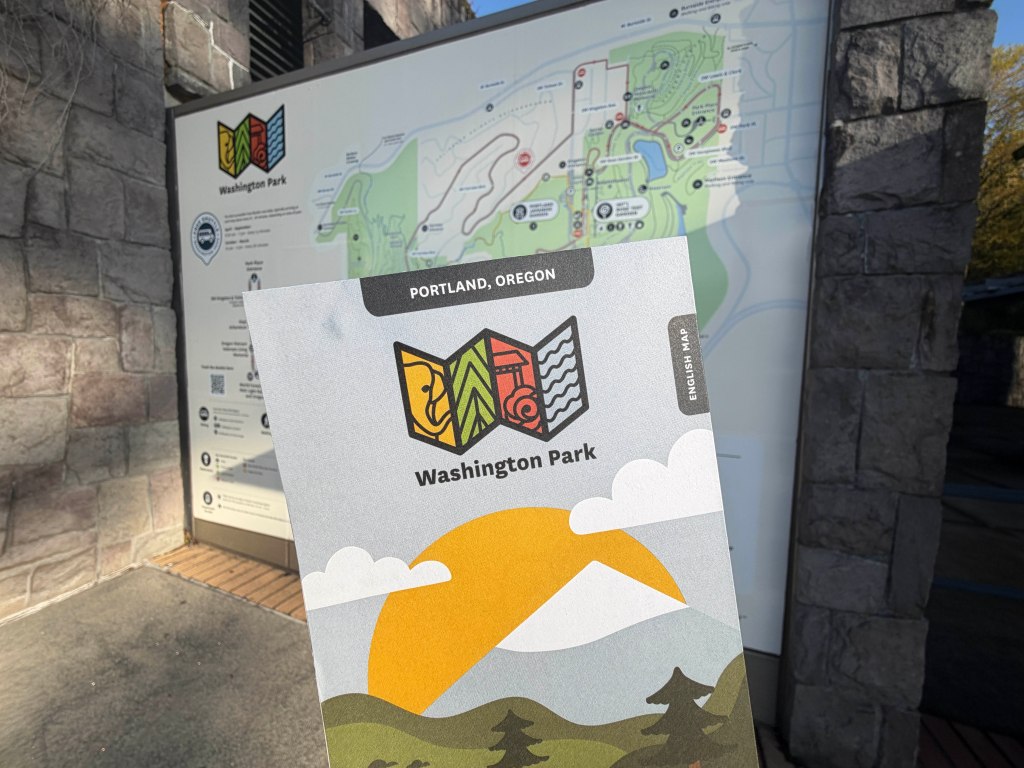
I take a brochure as orientation—a way of holding the park before entering it.
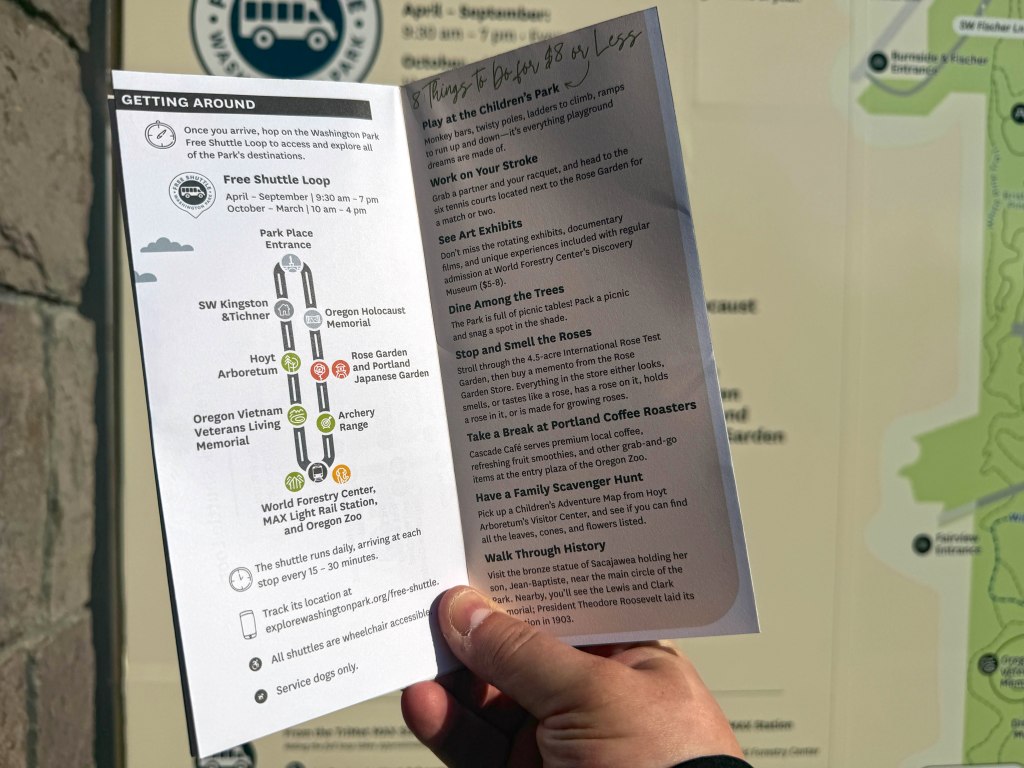
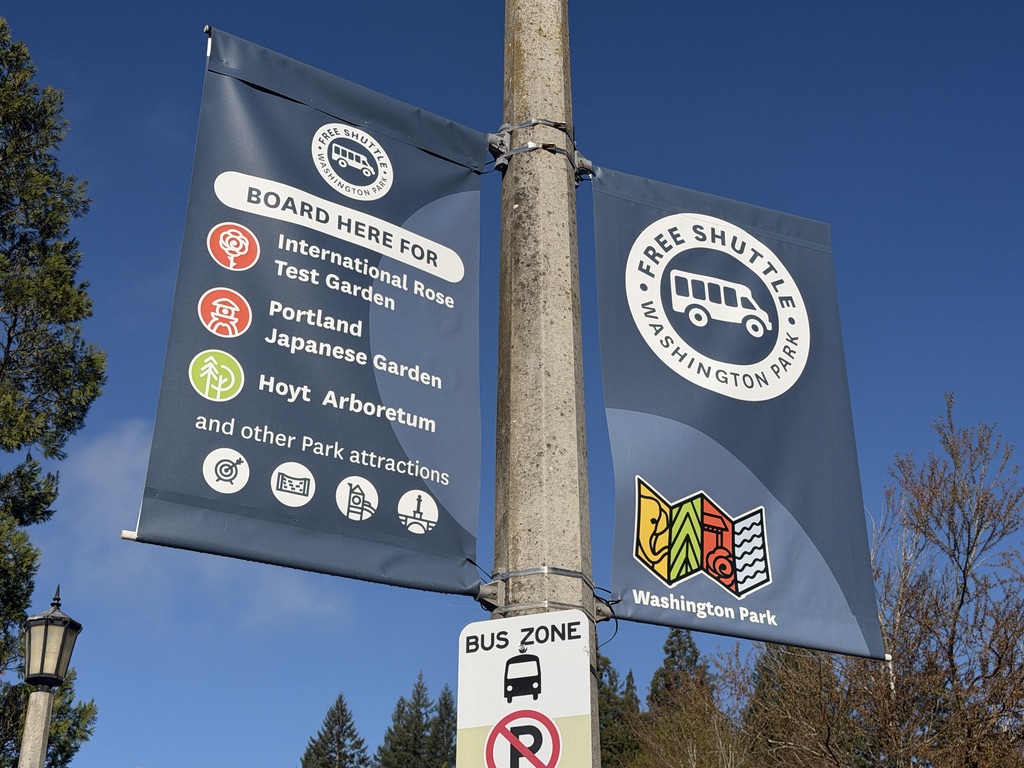
Nearby, the free Washington Park shuttle waits.
The full shuttle loop runs about thirty minutes, with roughly fifteen minutes from the lower park to the Rose Garden and Portland Japanese Garden.
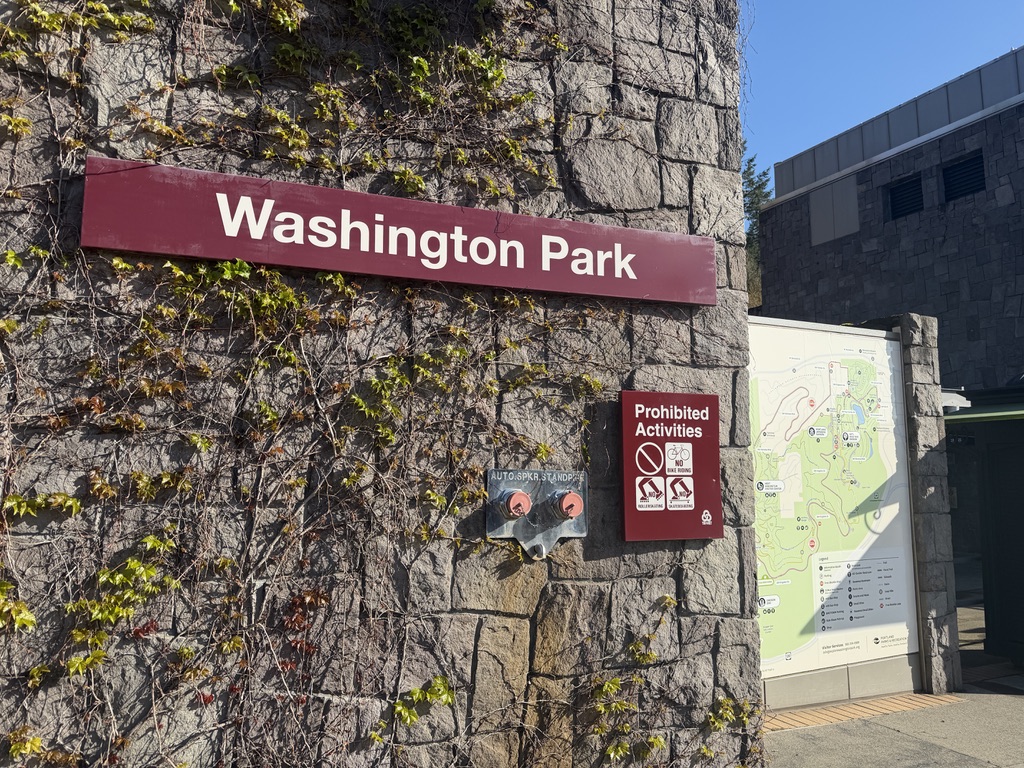

Boarding it feels less like transit and more like transition. By the time it begins to move, the shift has already started.
Marked clearly, without ceremony, it does not announce the garden. It only points toward it.
The Gate — Entering the Garden
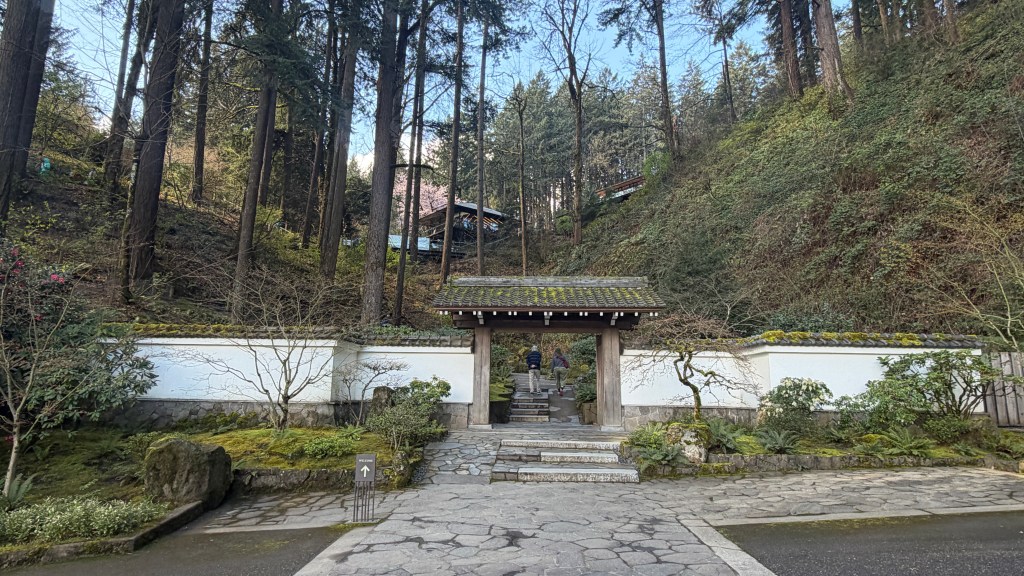
The garden begins with a gate.
At the base of the hill, the Antique Gate stands as a point of passage—not grand or imposing, but deliberate. Beyond it, the path rises, drawing you upward step by step.
The movement changes here. What was mapped below becomes physical. The ascent is not long, but it separates what came before from what follows.
Even before the garden is visible, there are signs of it—structures set into the hillside, a glimpse of blossom through the trees.
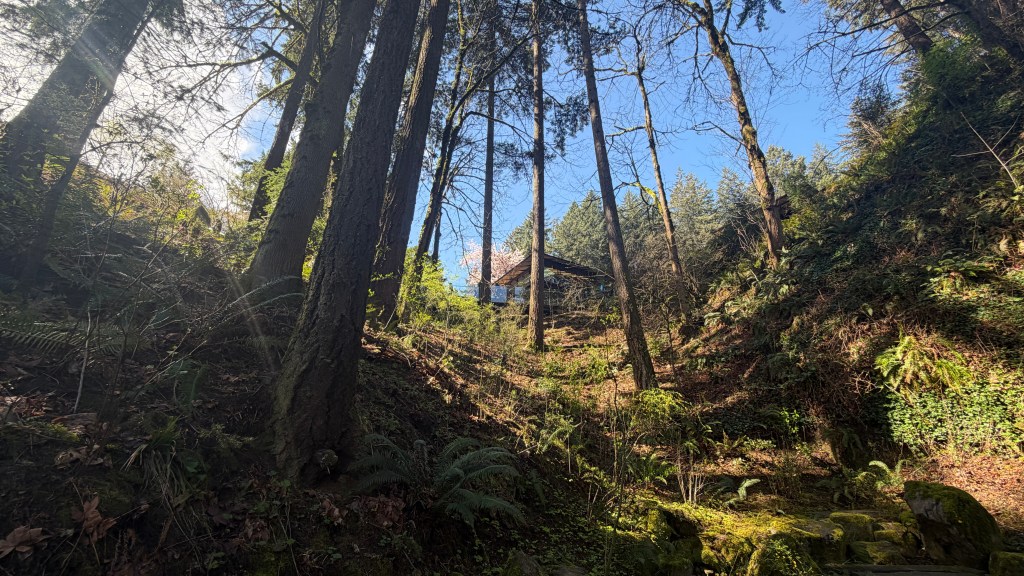
Beyond the gate, the path narrows into the hillside.
The ascent becomes quieter—less defined. Trees rise in long vertical lines, and the ground shifts from stone to earth, moss, and root. The garden is still not fully visible, but it begins to suggest itself in fragments: a roofline through branches, a pale burst of blossom higher up the slope.
You move toward it without needing to see it all at once.
The Garden Begins to Reveal Itself
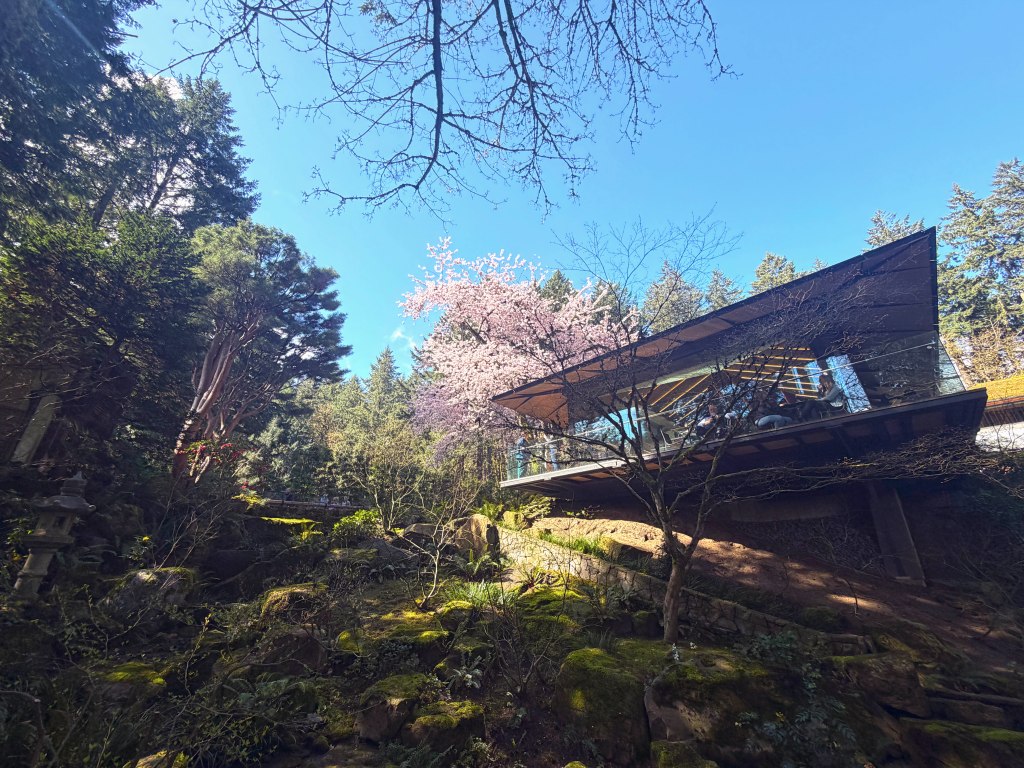
As the path continues upward, the garden begins to take shape in fragments.
Above, the lines of the Cultural Village emerge through the trees, set into the hillside. The structure does not dominate the landscape, but sits within it. Beneath it, the ground remains uneven—moss, stone, and shadow holding their place.
Between them, a cherry tree blooms—bridging what is natural and what has been built.
The garden does not present itself directly. It allows you to approach it first.
The First Reveal — The Tree
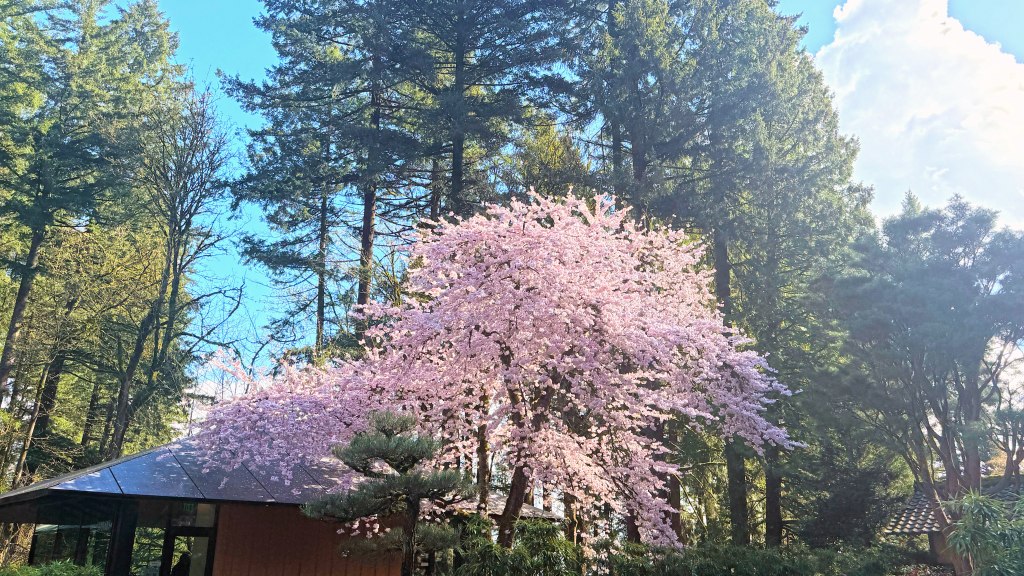
In the Cultural Village, off to the side, the cherry tree stands in full bloom—its branches extending outward in layered clusters, catching the light as it filters through the surrounding trees. It is not centered, but placed within the space, held between structure and landscape.
You don’t arrive at it directly. You come upon it.
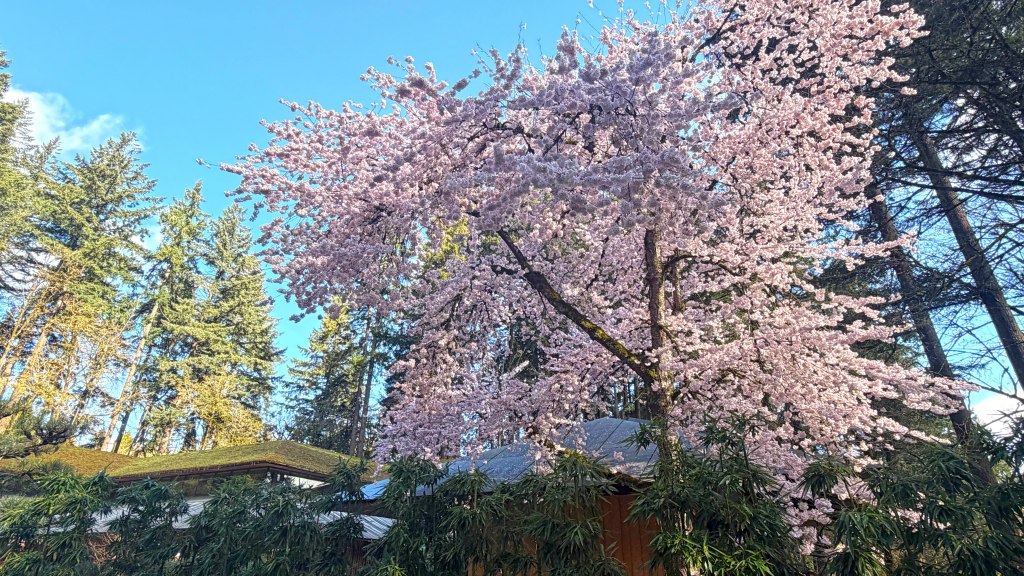
Up close, the tree shifts again.
What first appears as a single form separates into layers—branches extending outward, clusters of blossoms catching light at different depths. The structure remains present, but recedes. What fills the frame is canopy and color.
The Castle Wall
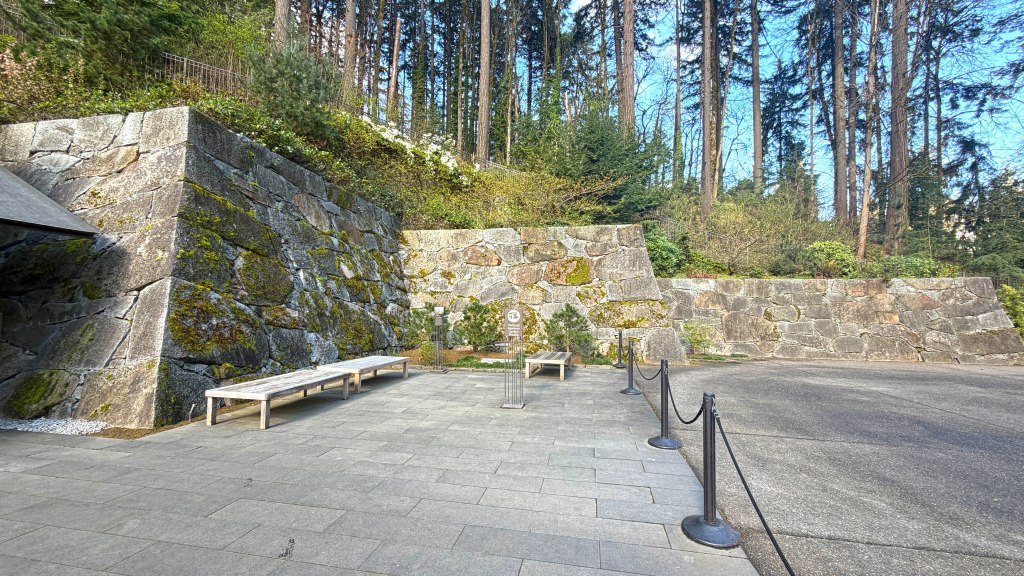
Beyond the blossoms, the garden shifts again.
The Castle Wall rises in contrast—stone set deliberately, its surface marked by time and weather. Where the tree expands outward, the wall holds its shape.
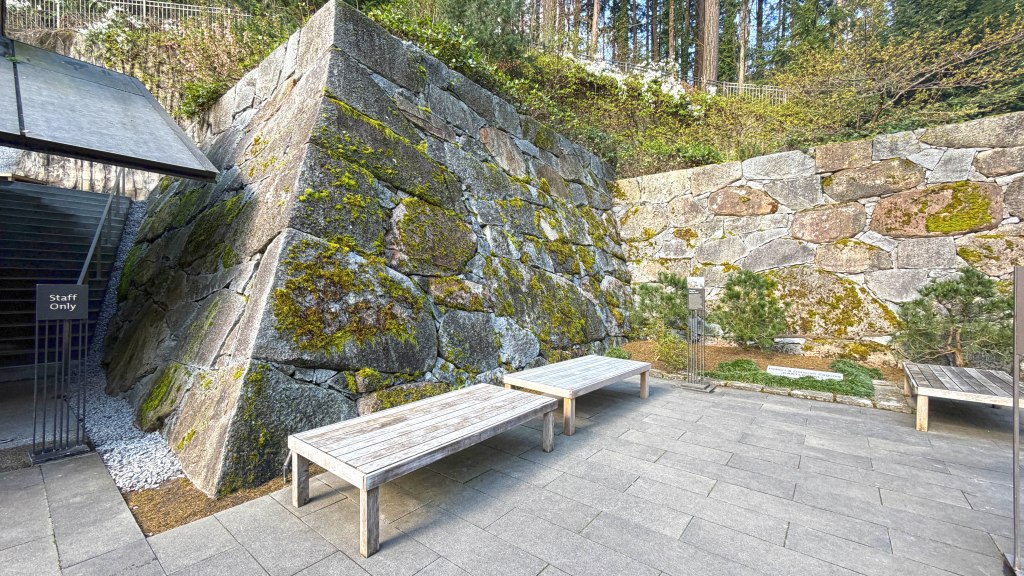
It is not ornamental. Built in the style of a traditional Japanese castle wall, it also serves a practical purpose—holding the hillside in place. The stones are dry-stacked, fitted together without mortar, a technique shaped over centuries and carried here by a master stonemason whose lineage stretches back generations.
Moss gathers in its crevices, softening its edges without changing its structure. The space around it is open and restrained—benches placed with intention.
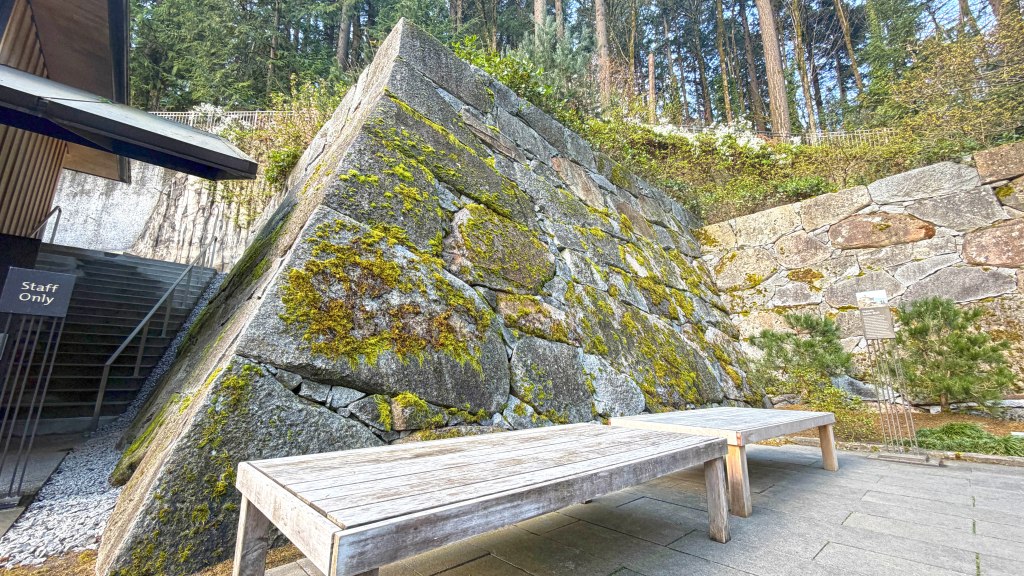
The stone itself—Baker Blue granite—has been shaped and placed individually, each piece carrying both weight and function.
It is the first of its kind built outside Japan, though it does not draw attention to that fact.
It is a place to pause.
The garden does not stay in one mode. It shifts between them.
The Gate — Returning to the Garden
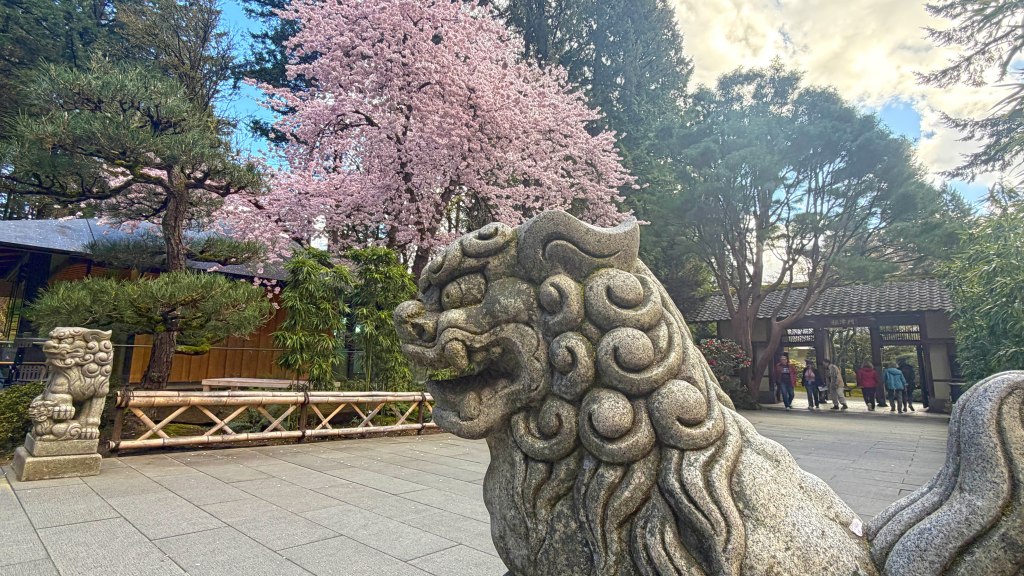
From the Cultural Village, the path leads back toward the garden.
The Nezu Gate marks that transition. The space narrows again, and the materials shift—wood and stone replacing the open layout of the plaza. Movement becomes directed rather than optional.
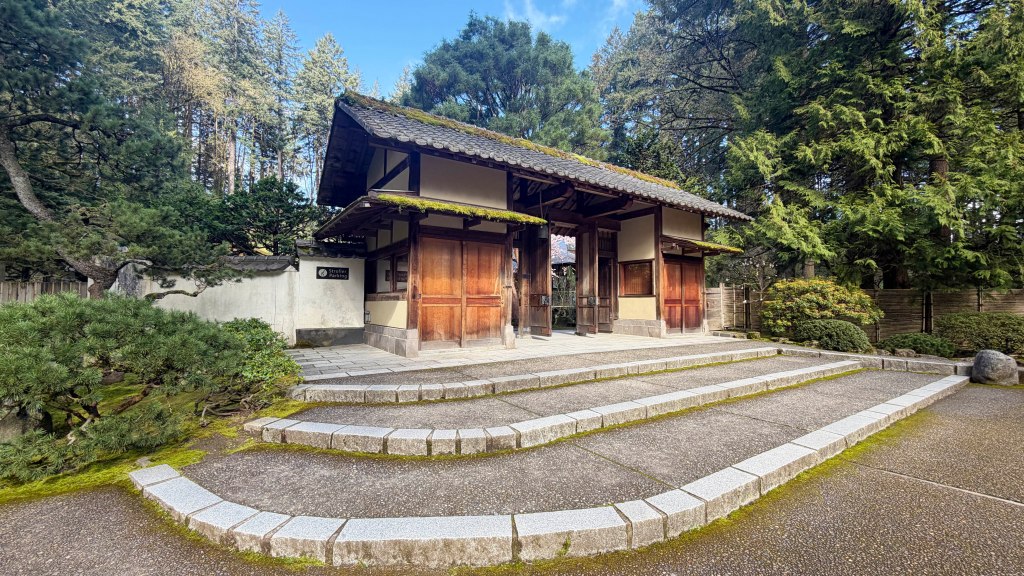
Passing through the gate is straightforward. There is no pause built into it, no moment of presentation. It functions as a passage, returning you to the garden beyond.
The Flat Garden
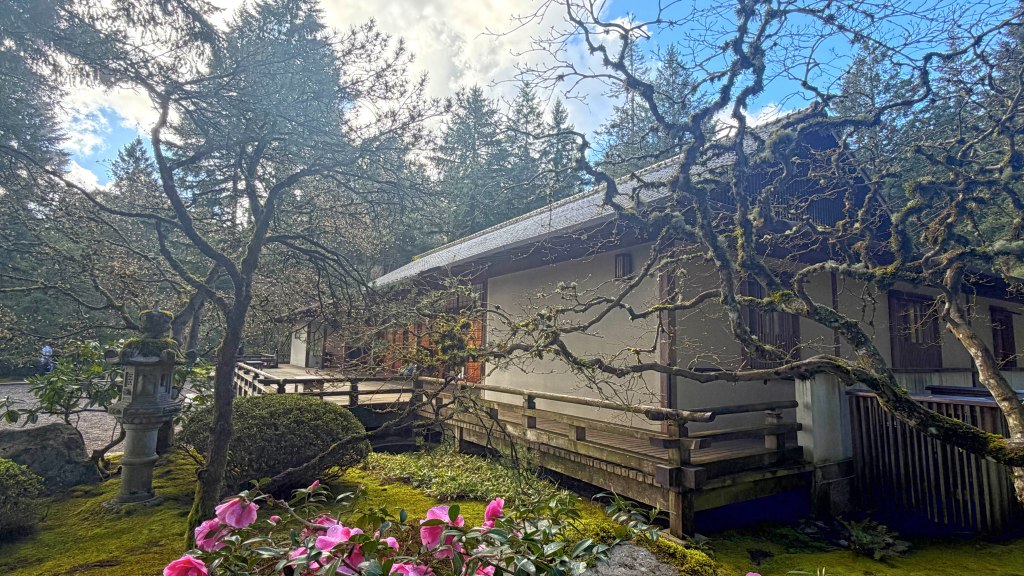
Beyond the gate, the path opens into the Flat Garden.
The Pavilion Gallery runs along one edge, its structure low and continuous, set just above the ground. The transition is gradual—wood, moss, and stone continuing without interruption.
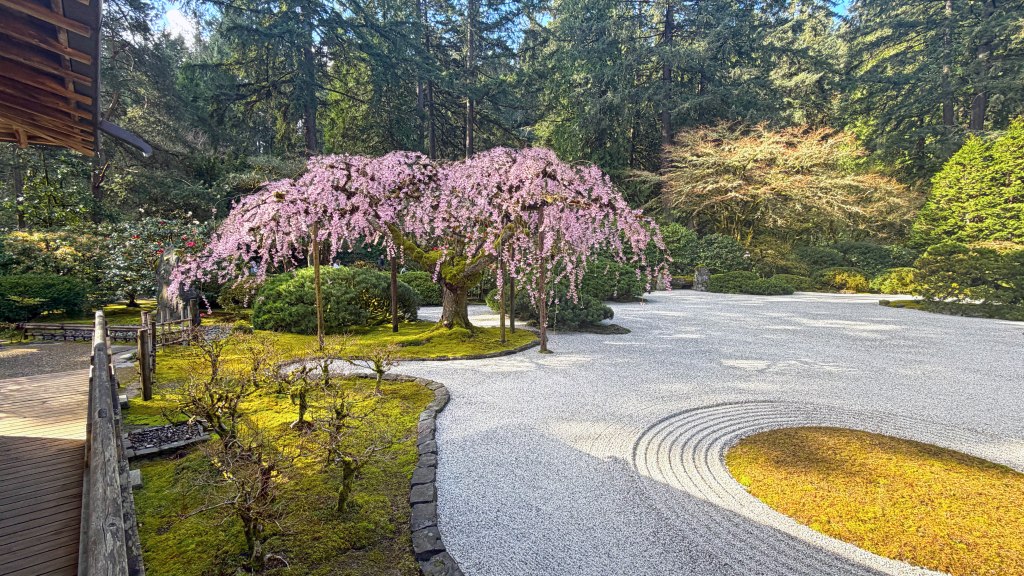
The space is defined less by height and more by surface. Raked gravel extends outward, broken by islands of moss and stone. The composition is controlled, but not rigid—elements placed with spacing rather than symmetry.
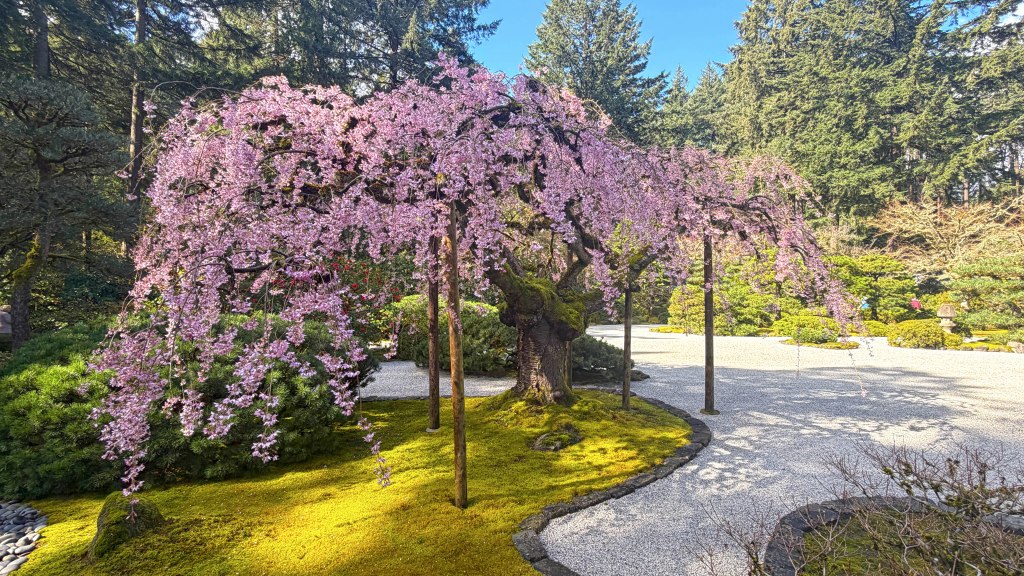
The tree anchors the space, its branches supported and directed rather than left to extend freely. What appears natural is also maintained.
The garden here is not about movement. It is about arrangement.
The Strolling Pond Garden
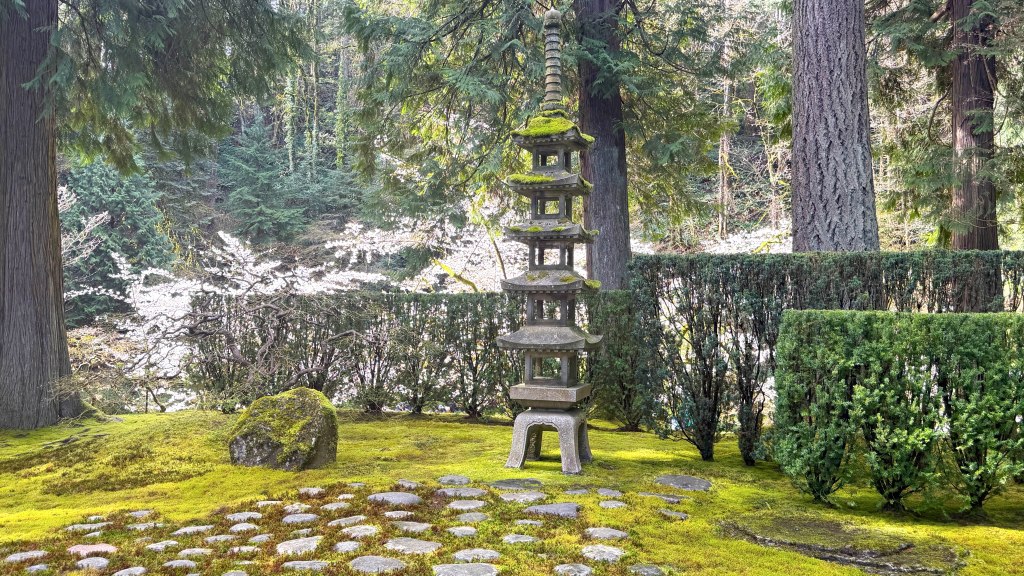
Beyond the Flat Garden, the path continues into the Strolling Pond Garden.
Here, the layout shifts again. The space becomes less open and more directional—paths guiding movement through trees, water, and placed elements rather than presenting them all at once.
Just past the wisteria arbor, the Sapporo Pagoda stands set into the moss.
It is a five-tiered stone lantern, rising vertically against the surrounding foliage. Unlike the broader compositions seen earlier, this element is singular and defined—placed to be encountered rather than viewed from a distance.
The pagoda was a gift from Sapporo, Japan, part of the sister city relationship established with Portland in 1959. It was installed here a few years later, positioned along the path rather than at a central point.
It does not dominate the space. It marks it.
The garden continues to shift—not by scale, but by how each element is introduced.
Water and Crossing
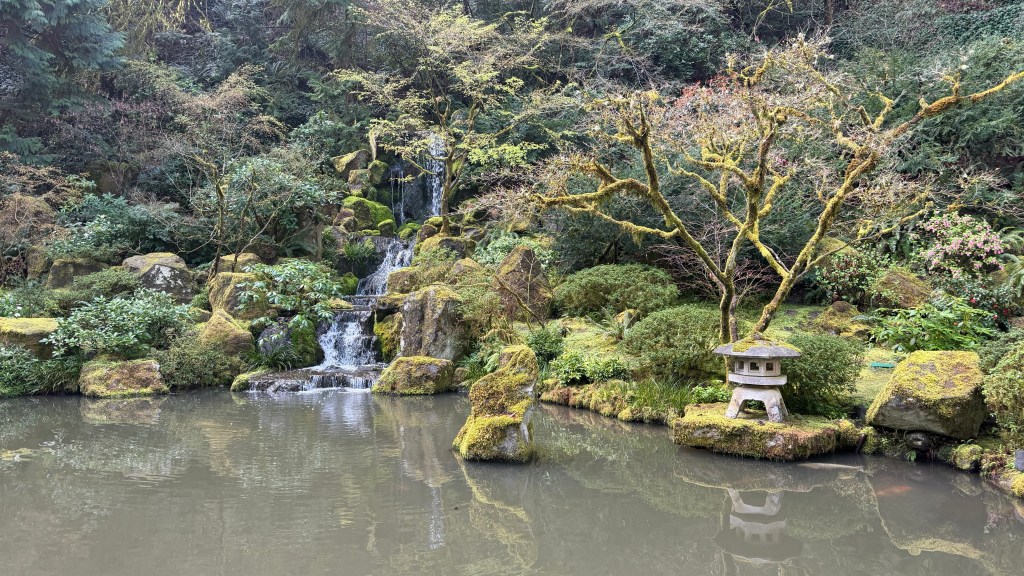
Further along, the garden introduces movement through water.
Heavenly Falls descends through a series of stones, not as a single drop but as a sequence—water stepping downward, breaking and reforming as it moves. The surrounding rock is irregular and moss-covered, softening the structure without obscuring it.
The sound is present but contained. It does not carry far, but it anchors the space.
The garden shifts again nearby.
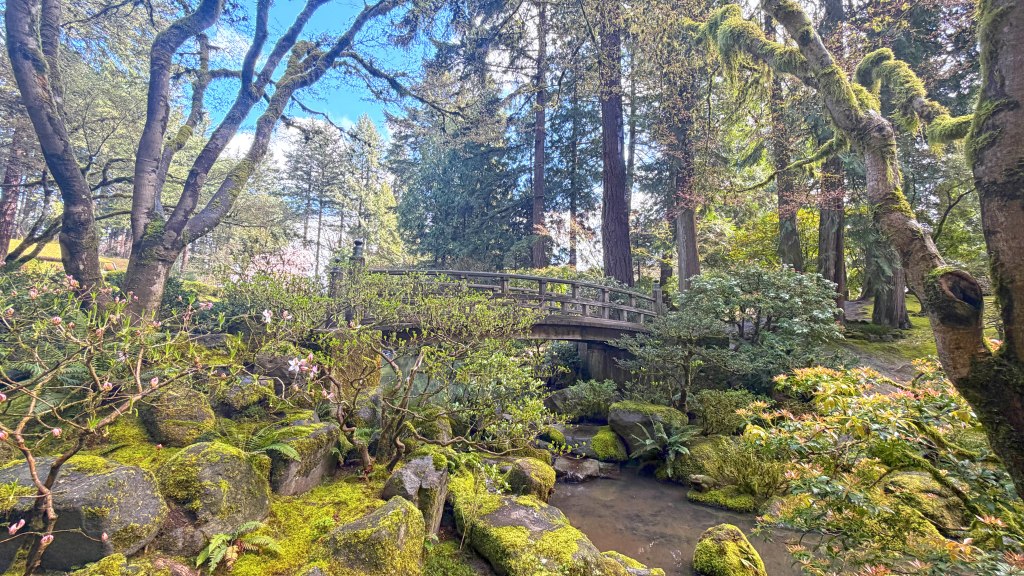
A wooden bridge crosses the water, its arc subtle but deliberate. The Moon Bridge does not dominate the landscape, but it redirects movement—offering a crossing point rather than a destination.
From a distance, it reads as part of the environment. Up close, its structure becomes clearer—wood, railings, and curve working together to guide the path forward.
The water continues beneath it, unchanged.
Here, the garden moves between elements—falling, flowing, crossing—without pause.
The Tea House
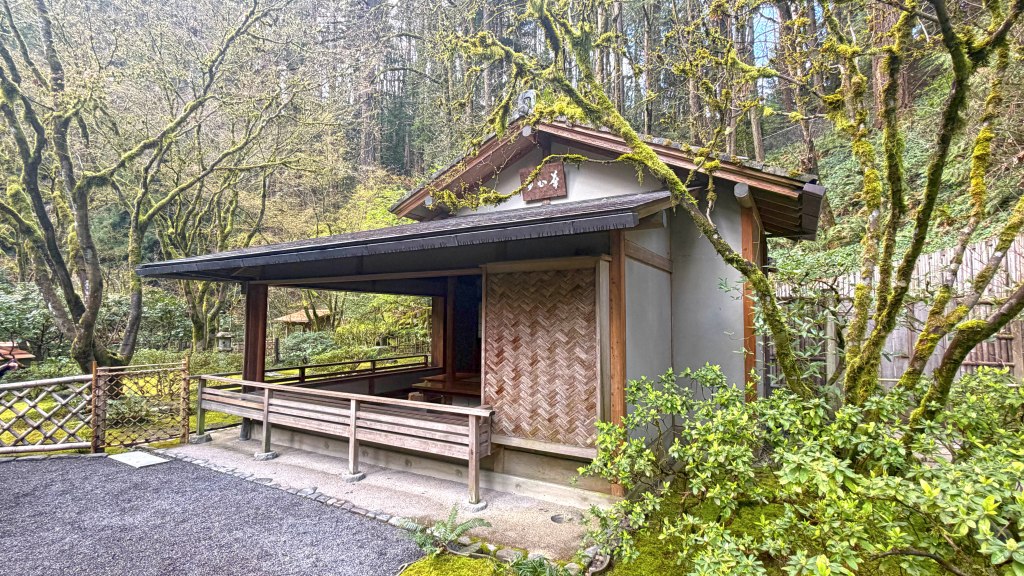
The path continues into a more contained space.
The Kashintei Tea House sits slightly apart from the main flow, set within the Tea Garden rather than along the primary route. Its structure is low and deliberate, framed by wood, moss, and filtered light.
It does not draw attention to itself from a distance. It is encountered.
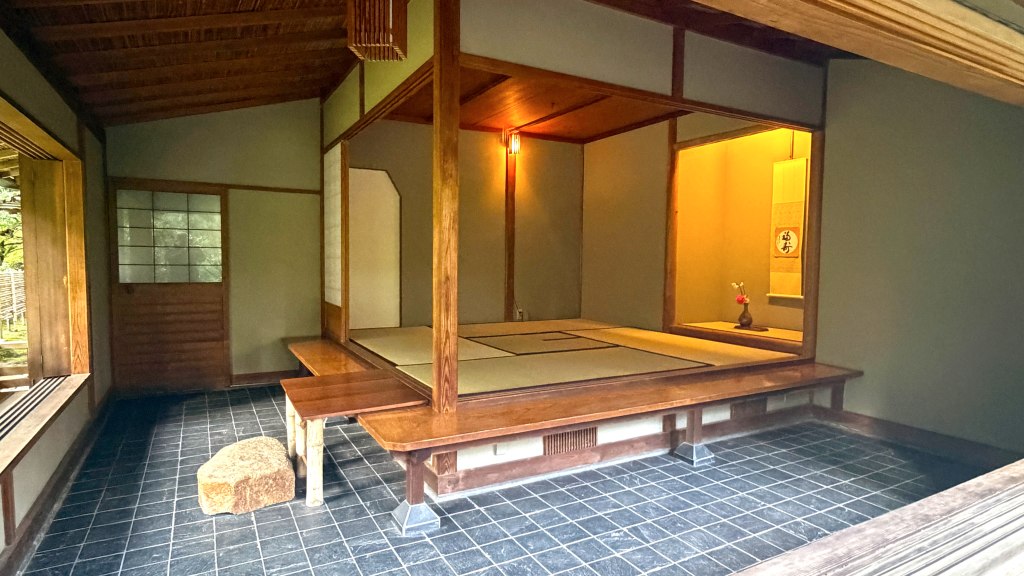
Inside, the space becomes more defined.
The room is arranged according to traditional tea house structure—tatami mats forming the floor, a raised sitting area, and an alcove set into the wall. The materials are simple: wood, paper, and stone, each used without excess.
The tea house was constructed in Japan, then shipped and reassembled here. While it remains authentic in form, certain elements have been adapted—sliding panels and surrounding flooring allowing it to function for demonstrations as well as ceremony.
The space is not large. It is precise.
Like the rest of the garden, it does not present itself all at once. It requires you to step closer.
The Terrace — Looking Back
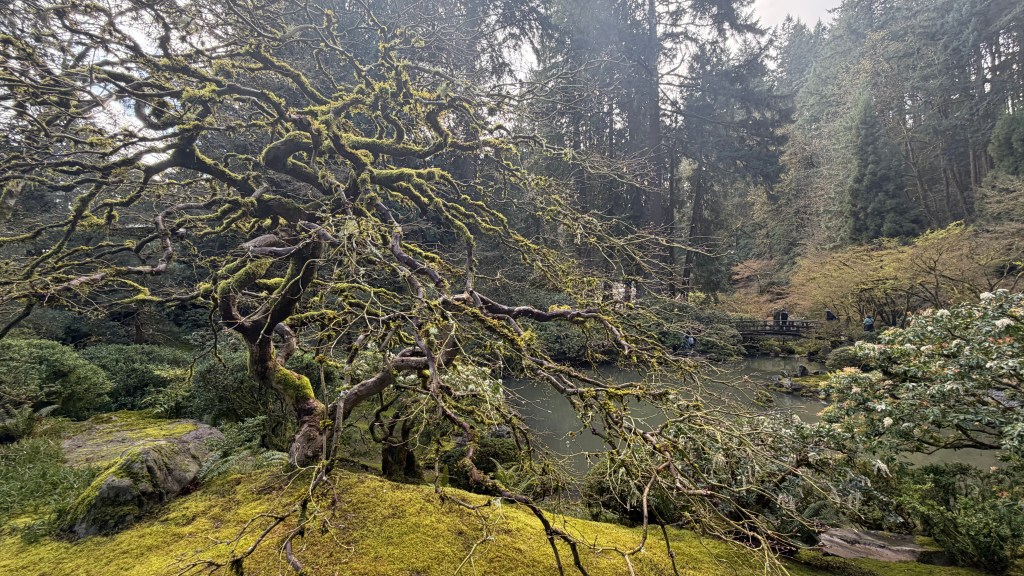
The path turns upward again.
After passing back through the Nezu Gate, the movement shifts—less enclosed, more open. The ground rises gradually, and the garden begins to spread out below rather than around you.
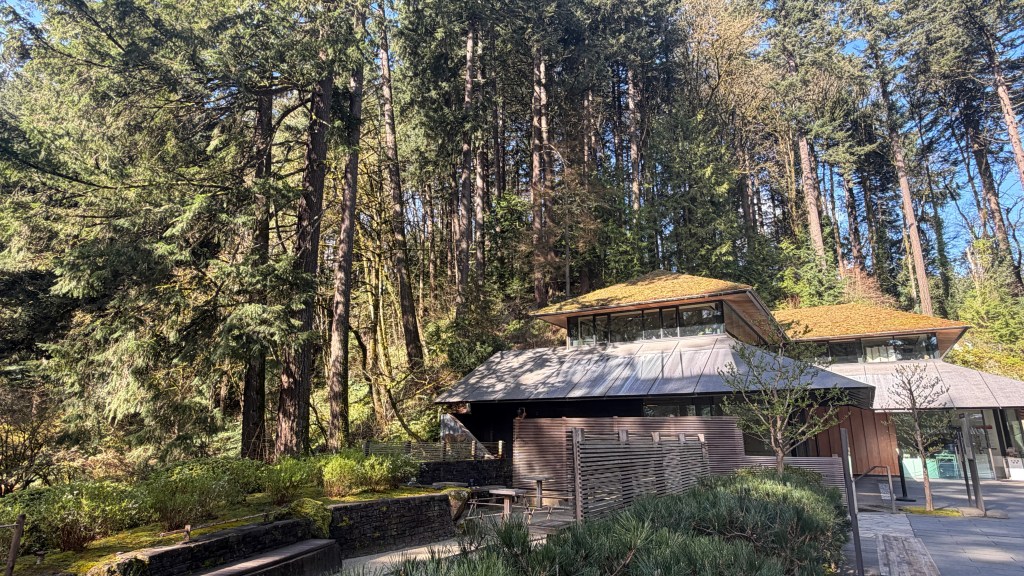
The Bonsai Terrace sits along this transition. Its structure is modern but restrained, set into the hillside without breaking from the surrounding landscape. It does not interrupt the garden so much as frame a different way of seeing it.
From here, the perspective changes.
What was experienced step by step—bridge, water, stone, and tree—begins to compress into a broader view. The garden becomes less about individual elements and more about how they relate to one another.
The path, the water, the structures—all remain, but at a distance that allows them to be understood together.
The movement slows here.
Not because the space demands it, but because it offers a different kind of attention.
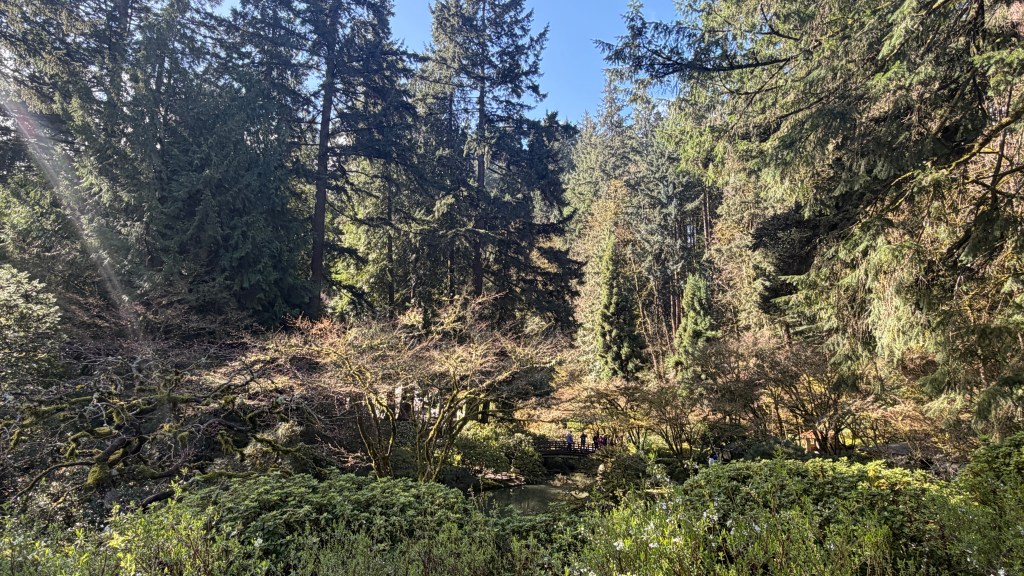
The path does not end so much as it returns you.
From the terrace, the garden can be seen in parts and as a whole—each space connected, but distinct in how it is experienced. Moving through it is not about reaching a single point, but about passing through a sequence of environments, each shifting pace and attention.
By the time you leave, the structure of the visit is clear, even if it wasn’t fully visible at the start.
 Scott Bryant
You must be logged in to post a comment.