
Cultural Notes — Theatre / Dance
Northwest Dance Theatre
Portland Community College Syvlania, Portland, Oregon
Saturday, April 11, 2026
2pm
On a clear spring afternoon, the approach to the PCC Sylvania Performing Arts Center unfolds through quiet campus pathways—steps cutting through greenery, concrete softened by color, and a sense of arrival that feels unhurried. It is a space that allows the experience to begin before the performance itself.

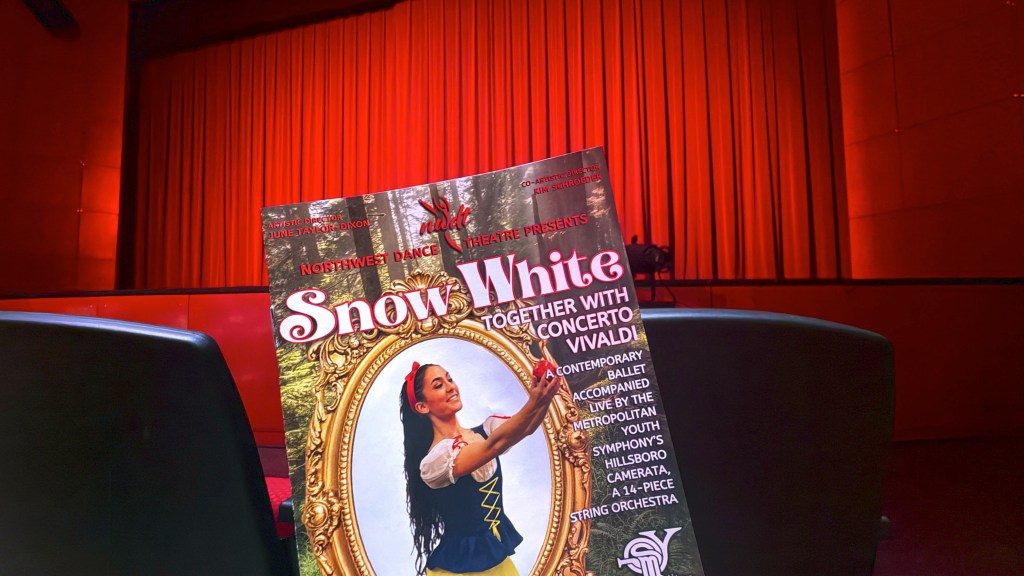
Inside, Northwest Dance Theatre presents Snow White, structured in two parts. An opening suite set to Antonio Vivaldi establishes a formal, abstract language of movement before transitioning into narrative. The second half shifts decisively into story, unfolding to music by Bogdan Pawlowski, performed by the Kiev Ukrainian Orchestra. The effect is immediate: structure gives way to character.
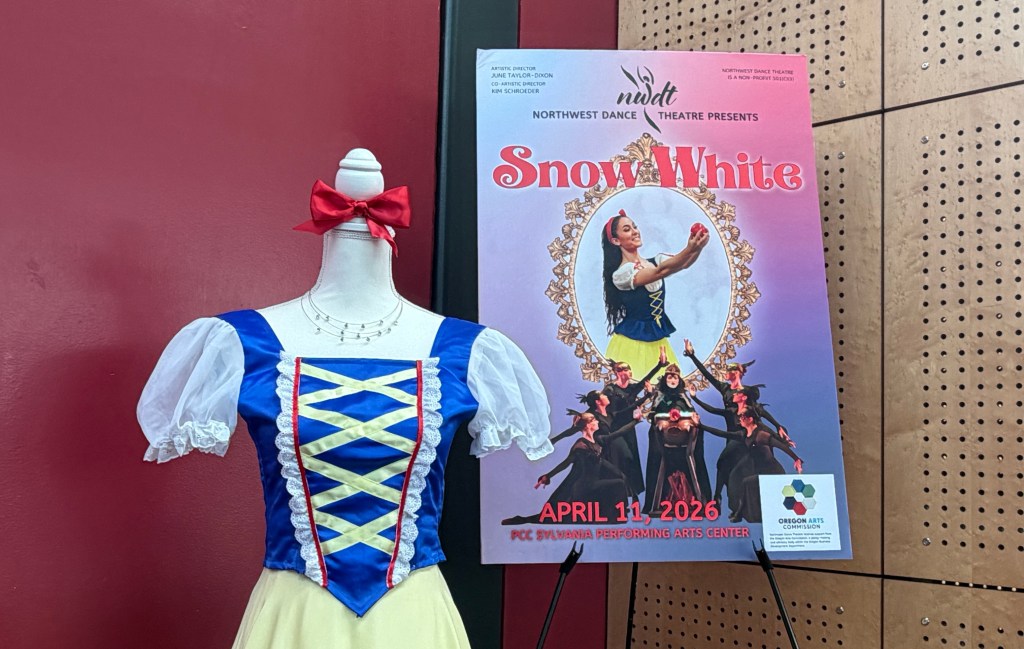
The ballet, staged and choreographed by June Taylor-Dixon and Kim Schroeder, opens not with Snow White, but with the Queen—already enthroned, already in control. Dressed in black and dark burgundy, she is surrounded by attendants who reinforce her authority, tending to her with ritual precision. The mirror confirms her identity as the fairest, and the world appears stable.
That stability fractures almost immediately. While the Queen is occupied, Snow White and the Prince begin to dance—unseen. When the Queen turns and witnesses it, the shift is instantaneous. The mirror, once affirming, now names Snow White as the fairest. Snow White is banished. The Prince refuses the Queen’s command to kill her. And in that refusal, the Queen’s authority begins to collapse.
What follows is transformation. Cloaked and bent over a cane, the Queen reshapes herself into the old peddler woman. The shift is entirely physical—upright control replaced by performed fragility. Power, no longer enforced through command, becomes something closer to manipulation.
The staging leans into classical pantomime throughout, with gesture and expression carrying the narrative as clearly as the choreography itself. The Queen’s gestures—signaling beauty, command, and violence—echo a shared vocabulary also seen in figures like Carabosse in The Sleeping Beauty. Even the dwarves rely on this language. A repeated rolling gesture above the head signals an invitation to dance—clear, direct, and instantly understood.
The dwarves, each defined through color and exaggerated physical vocabulary, introduce a contrasting movement language—gymnastic, comedic, and deliberately theatrical. Sleepy drifts through rolling, half-conscious motion, while Sneezy’s attempts at dance collapse into repeated interruptions, his body unable to complete a phrase without disruption. These moments shift the tone of the ballet, offering levity while maintaining clarity of character.
The world around Snow White is constructed through bodies rather than scenery. Dancers become trees—wrapped in vines, crowned with branch-like forms—transforming the forest into a living presence that surrounds and observes. Even the ensemble itself is largely female, from the Queen’s attendants to the dwarves, reinforcing a stage dynamic where women define both the central conflict and the environment in which it unfolds.
The turning point arrives outside the cottage. Once Snow White eats the apple and collapses, the Queen sheds her disguise. Cloak removed, she circles the fallen figure, her gestures unmistakable—pointing, claiming, reasserting herself as the fairest. Her attendants return, restoring the structure of power that had briefly fractured. For a moment, control appears fully regained.
The final confrontation shifts into a physical duel. The Queen, armed with the cane that once defined her transformation, commands the space through her attendants, their presence enclosing the Prince. In response, the forest itself intervenes—birds, rabbits, and foxes breaking that control. When the Prince seizes the staff and snaps it in two, the gesture reads as more than victory; it is the collapse of the Queen’s authority. She is carried off, no longer commanding, but removed.
Even within this classical framework, traces of cultural memory persist. An instrumental echo of “Heigh-Ho” surfaces briefly, and in the audience, a small red-and-blue bow appears—reminders that Snow White and the Seven Dwarfs continues to shape how the story is recognized. The ballet exists in that space between tradition and familiarity, where the fairy tale is never entirely separate from its most enduring adaptation.
Seen 50 days after Oregon Ballet Theatre’s The Sleeping Beauty, this performance offers a different scale of experience. Where the former presents ballet at its most canonical and expansive, Snow White reveals it as something more immediate—constructed through gesture, contrast, and the physical language of its performers. It is not spectacle that defines the afternoon, but clarity: a story built in motion, and understood through it.
 Scott Bryant
You must be logged in to post a comment.