
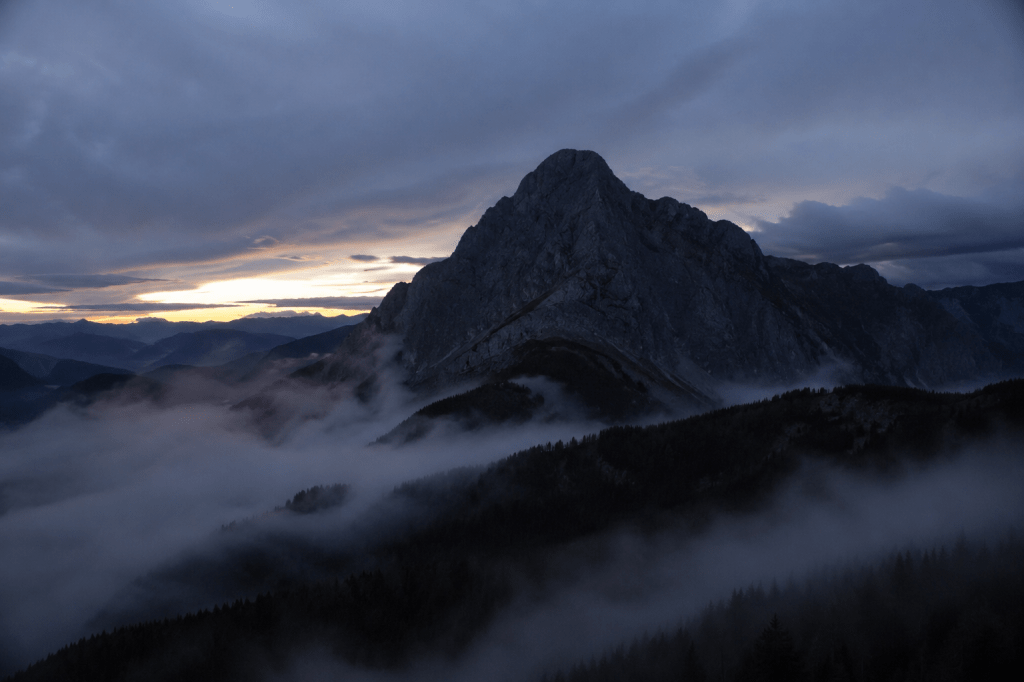
In Disney’s Fantasia (1940), Night on Bald Mountain stands apart not because it depicts darkness, but because it refuses to comfort the viewer with a simple victory. What begins as a familiar struggle between darkness and light ultimately becomes something stranger. Rather than resolving itself through conquest, the sequence observes a particular form of power—and quietly shows why it cannot last.
At the center of the sequence is Chernabog, a towering, demonic figure less defined by personality than by function. He presides. He occupies the highest point of the frame, monumental and immobile, issuing commands through gesture alone. His authority is centralized, vertical, and absolute. Everything below him exists to move, to swirl, to rise and fall at his will.
What unfolds is not chaos, but order staged as spectacle.
The ghosts, ghouls, and spirits he summons from the village graveyards below the mountain are not dragged upward—they are drawn. Their ascent feels almost seductive, as if answering a promise: motion instead of stillness, visibility instead of erasure. They rise toward the mountain willingly, pulled into orbit by the possibility of participation. But once there, nothing awaits them except performance. They are animated briefly, shaped into display, then released back into darkness. No one remains. Nothing is carried forward.
The system feeds on longing, not resistance.
Crucially, this power leaves nothing behind. It requires constant motion and constant attention to sustain itself. Authority here has to be asserted again and again. The spectacle does not build toward transformation or consequence; it exists only in the present tense, as long as it is watched.
The music reinforces this logic. Wave after wave of sound rises and falls across the sequence, building force through repetition and escalation. Like the spectacle it accompanies, it sustains itself through intensity. When the bells interrupt it, the shift feels less like defeat than exhaustion—sound giving way to space.
Then the bells ring.
When the first flash of light cuts across the frame, Chernabog is not attacked or overpowered. He is exposed. The light does not meet him as an opposing force—it changes the conditions that allowed him to exist. His scale collapses. His gestures lose coherence. The towering figure that moments ago commanded the entire image is pressed back into the mountain itself, reabsorbed into the landscape.
Nothing defeats him. The environment simply no longer supports the performance.
This distinction matters. The sequence does not frame light as triumph, nor darkness as vanquished. What follows is not victory, but transition. As the film moves into Ave Maria, the logic of power shifts entirely. Movement becomes collective rather than commanded. The frame flattens. Light reveals rather than overwhelms. No single body anchors the image.
Where Night on Bald Mountain is vertical, singular, and theatrical, Ave Maria is horizontal, durational, and shared. Authority is not replaced by another dominant figure; it dissolves into continuity. The earlier spectacle does not collapse—it simply no longer belongs.
This is why the sequence continues to resonate. Its insight is quiet but lasting: fear and dominance cannot ultimately prevail because they cannot endure. They depend on darkness, attention, and repetition to survive. Light does not need to conquer them. It only needs to arrive.
Seen this way, Night on Bald Mountain is not a morality tale, nor a struggle between opposing forces. It is an observation about systems of power that mistake display for something lasting. When the conditions change, those systems do not fall. They fade—folded back into the ground they briefly rose from.
The sequence trusts the audience to recognize that difference, without instruction. And in doing so, it remains one of Fantasia’s most uncompromising—and most contemporary—visions.

You must be logged in to post a comment.