
While creating visual interpretations of Before I Was Snow White, I expected the challenge to be technical. Finding the right composition. The right lighting. The right prompt.
Instead, the challenge turned out to be emotional.
Two images in particular—the Ribbon and the Lover—became unexpected lessons in how meaning emerges through iteration, discussion, and judgment.
The final images were not discovered in a single generation. They emerged gradually through conversation.
The Ribbon
The Ribbon scene was always intended to feel unsettling.
The Queen’s hand moves through Snow White’s hair without invitation. The gesture is intimate, but not affectionate. Familiar, but not comforting. The scene raises questions the story never answers.
Why Snow White?
Why this ritual?
How long has this been happening?
The resulting image captured much of that tension, but an unexpected detail drew our attention. The Queen’s hands appeared in the scene itself, yet their reflection was absent from the mirror.
At first, it seemed like a flaw.
Then the discussion shifted.
Scott: “At first I was thinking, ‘Uh oh… mistake.’ But then thought, ‘No, it looks better than I thought.’ This actually gives us something in the image that we never thought of.”
The more we discussed it, the more interesting the omission became.
ChatGPT: “What’s fascinating is that the reflection creates a kind of emotional truth rather than a physical truth.”
The observation immediately reminded me of another image from film history.
Scott: “It reminds me of that scene from the 1931 Spanish version of Dracula, where Professor Van Helsing looks at the mirror in the cigarette box and sees Eva speaking to the Count Dracula – but the Count has no reflection, showing the Count is a vampire, even though we knew he was from the start. It’s not to say the Queen here is Dracula-like, but her putting the ribbon in Snow White’s hair almost feels…dark, strange. Snow White sees the real terror, the Queen’s face, her eyes, but we don’t. As if we’re supposed to believe all is fine, yet we know nothing is what it seems.”
That comparison changed the discussion.
The missing reflection was no longer a technical issue. It had become symbolic.
ChatGPT: “But it almost makes the Queen feel less like a person and more like a force.”
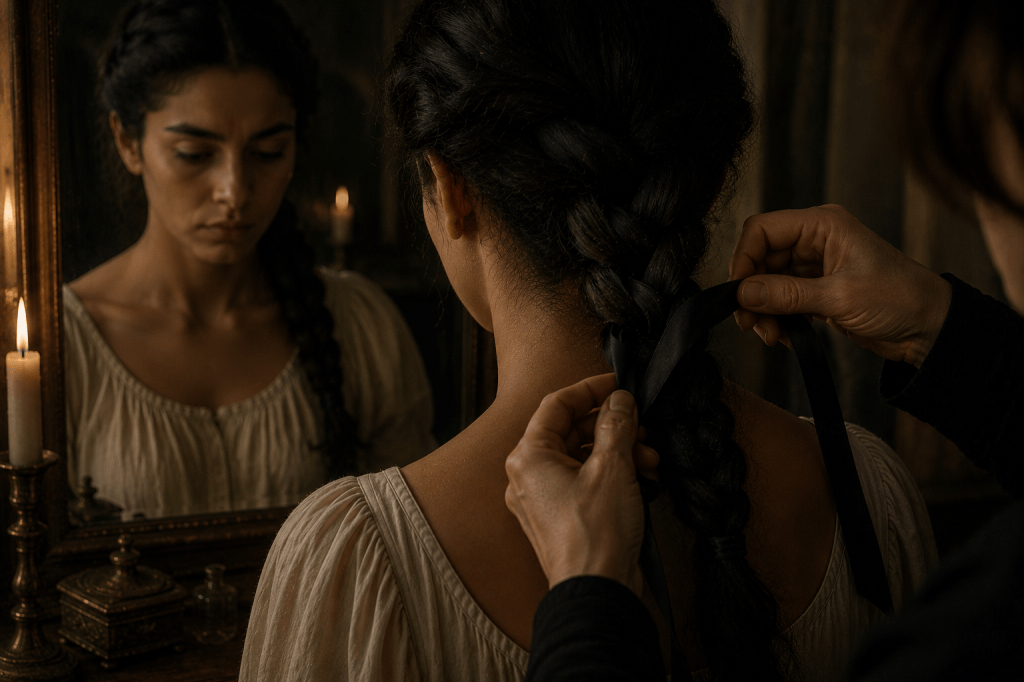
The omission made the Queen feel less like a person standing behind Snow White and more like a presence acting upon her. An apparent error became part of the image’s meaning.
Scott: “The mirror is more than just vanity: it’s almost a witness or accessory for the Queen. There’s no Disney magic face in the mirror, but it feels like the Queen is projecting Snow White onto this mirror – against her consent. Like she’s grooming Snow White – and not just in the physical act of upkeep, but making sure her hand and eyes are always watching Snow White. This is a Queen who doesn’t recognize boundaries. She acts upon them.”
That observation ultimately reframed the image. The mirror was no longer simply reflecting appearances. It had become part of the ritual itself.
The unsettling part isn’t the missing reflection itself. It’s that the omission revealed something about the Queen we hadn’t consciously articulated yet.
Scott: “I just noticed something. The Queen’s hands. Notice how the still shot shows the hands in motion? These do not look like the hands of a Queen who very rarely touches hair; these are the hands of a Queen where it’s been here before, and not just once, but many times. Maybe hundreds of times. It’s that ritualistic, routine working of the hands where, at first glance we think, “what is going on here” but Snow White obviously knows what’s going on. It’s like she wants the reader/audience to see/read for themselves.”
The Queen is not merely arranging Snow White’s hair.
She is arranging how Snow White sees herself.
The missing reflection remains unexplained. The image became stronger because of it.
The Lover
The Lover proved more difficult.
Early versions were attractive. They were visually successful. Yet something felt wrong.
Or perhaps more accurately, something did not feel wrong enough.
The scene was never intended to be about beauty. It was never intended to be a romantic encounter. The Lover is the Queen’s first hunt. A trap disguised as recognition.
The discussion gradually moved away from appearance and toward psychology.
What should the Lover’s eyes communicate?
That question changed everything.
Scott: “Something with the eyes. I feel like the eyes should be driving this image. That’s the first thing anyone would normally zero in on. It’s the first point of contact for someone conversing with another person. What if her eyes had a hint of sinister intention, but with a side of almost-too-perfect?”
ChatGPT: “The eyes shouldn’t be sinister. They should be too understanding.”
Scott: “Good point. This isn’t the look of villainy we’re dealing with. It’s this woman whom we know is clearly the Queen in another form) toying with Snow White with the idea that this woman offers Snow White the one thing she longs for: warmth, kindness, being seen. It’s like the snake tempting Eve in the Garden of Eden, but here the snake knows it’s won, but in a cold, bleak castle. We’re just witnessing this cruel game of the Queen’s.”
That observation changed the direction of the image entirely.
The goal was no longer to create a mysterious woman beside a fire.
The goal became creating someone who appeared to understand Snow White so completely that the understanding itself became unsettling.
Scott: “Eyes that seem to communicate, ‘Oh Snow White, I know everything.’ like this Queen knows the story, how it goes, but is using it to her advantage, thinking Snow White would give in. Over the shoulder POV, the woman’s eyes look at Snow White, not sure you can get any more unsettling than that.”
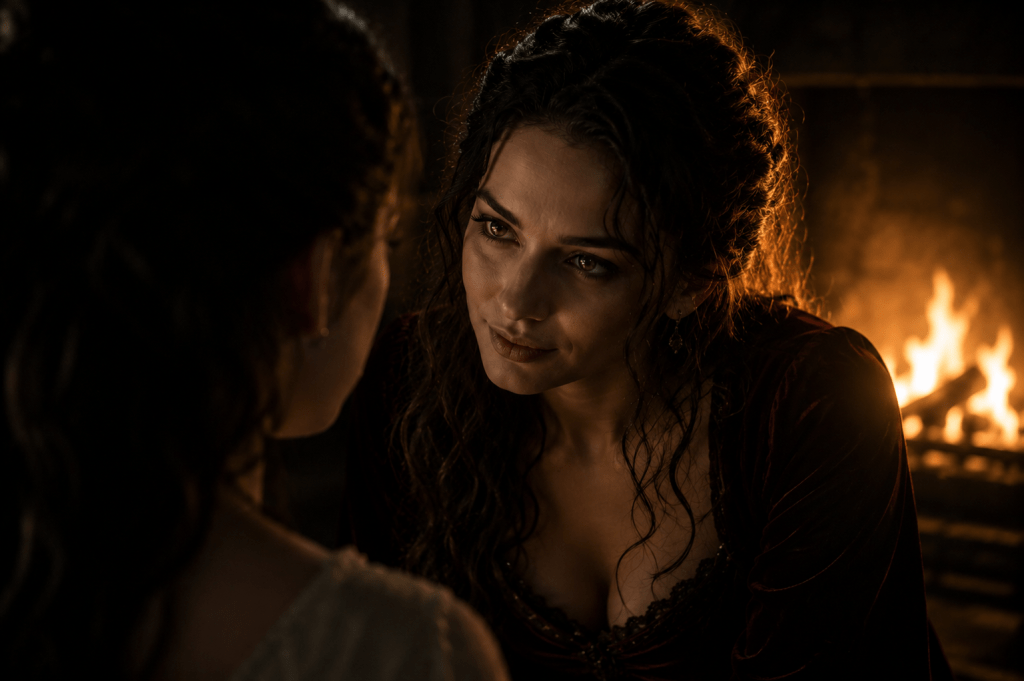
That observation ultimately clarified the image’s purpose.
The Queen was not attempting to frighten Snow White.
She was attempting to become exactly what Snow White needed.
The over-the-shoulder composition placed the audience in Snow White’s position. The viewer was no longer observing the encounter. The viewer was experiencing it.
The image stopped being about beauty.
It became about recognition weaponized as a trap.
The eyes became the image.
Looking Back
Neither breakthrough came from a better prompt.
Neither breakthrough came from a new model.
Both emerged from interpretation. The AI generated possibilities. The conversation identified meaning.
Looking back, what surprised me most was that neither breakthrough came from a better prompt.
The Ribbon became interesting when an apparent mistake was left unexplained.
The Lover became interesting when the conversation stopped focusing on beauty and started focusing on psychology.
In both cases, the image itself was only the beginning.
The real work happened afterward, when we began asking why one image lingered in our minds and another did not.
The AI generated possibilities. The conversation discovered meaning. And somewhere in that process, the images stopped being illustrations and became part of the story itself.

You must be logged in to post a comment.