
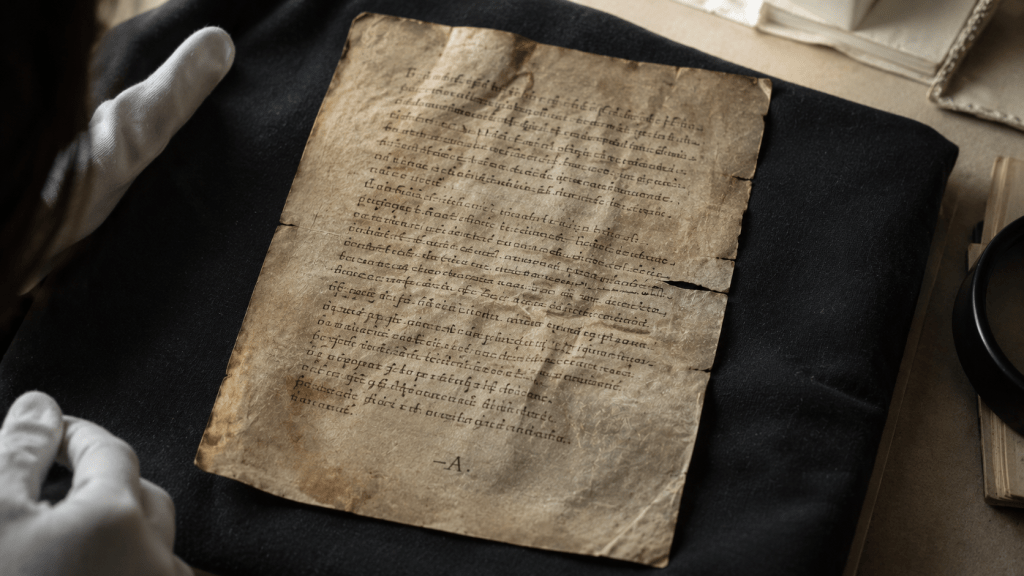
Recovered from a private book kept by a lady-in-waiting, believed to be Adelina, late 11th century.
One page survives. The remainder is lost.
Preserved and translated by women scholars.
Shared with care by Scott Bryant at their request.
❦
I write this because the night has not yet loosened its hold on me.
The hall was full—too full—of voices weighing land and promises as if they were stones to be shifted from one hand to another. I stood where I was meant to stand. I nodded when I was meant to nod. The music had already begun somewhere beyond the pillars, strings sounding patient beneath the talk.
Héloïse caught my eye just as the cups were being cleared. That was enough. It always is.
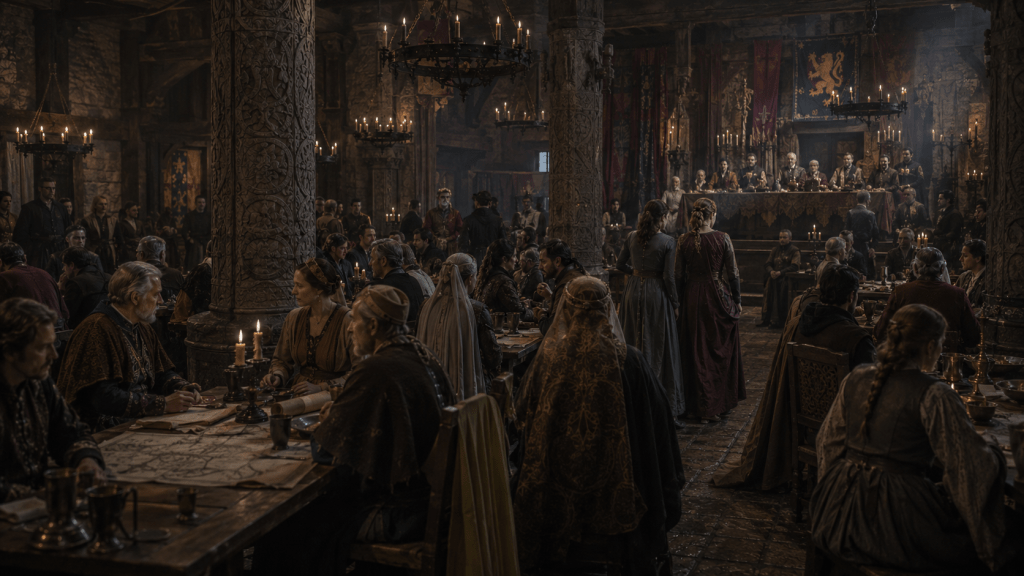
We left without remark. No one stopped us. They never do.
The corridor kept the music for a time and then did not. I remember thinking how sound obeys doors more readily than people. We went to the small chamber above the stair—one of those rooms that has learned us by now. There were cushions laid out from some earlier use, and a candle already burned low, as if it had been waiting.
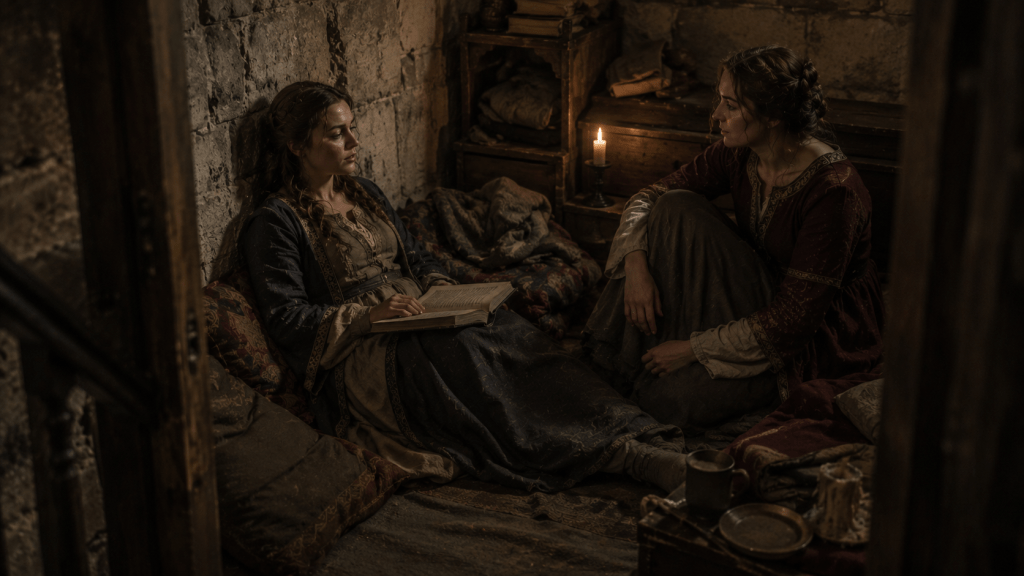
She laughed first. Quietly. We were tired from sitting through the afternoon’s display—armor, dust, and shouting, men convincing one another of what did not require saying. Héloïse said it was a mercy the horses endured it better than we did. I told her I would gladly trade a week of such shows for a single evening like this. She said there were never enough nights when the land grew interesting.
That was when she spoke of Mercia.
Not as a tale yet. As news. As something still unsettled.
They are saying the countess rode. They are saying many things, but the riding remains. I heard the name Godiva once, though not from the same mouth. We sat with that for a while. Héloïse wondered who first decided how it would be told. I said it would not be her. We did not say the countess’s name again for some time, though it stayed with us, warm and dangerous.
Later—softer—we spoke of Guinevere. Not as she appears in songs meant for men, but as she appears when the room is quiet: watched, judged, turned endlessly in other people’s hands. Héloïse said she never forgave the stories for needing her to stand still while others moved. I said perhaps that was why we kept reading them.
We had both brought our books, as we always do. Hers was heavier than mine, the spine already worn in places she pretended not to notice. I asked what she had been writing. She asked me the same. We did not exchange pages. That, too, is part of the understanding.
The music found us again through the floorboards—harp this time, and something bowed that held a note long enough for thought to rest inside it. We did not stop speaking, only let our words arrive between the sounds. There was a line of verse she half remembered, and I supplied the ending, though I am no longer certain which of us spoke it aloud.
For a while we said nothing. The candle shortened. The court continued elsewhere, untroubled by our absence.
When we finally parted, it was without ceremony. She pressed my hand once, as she does. We will not see one another again until kingdoms require it.
I write this now because it belongs somewhere. Because nights like this do not leave marks unless one gives them a surface.
If this page is found without the others, let it be enough to say that we were here, and that for a little while, we were allowed to sit.
—A.

You must be logged in to post a comment.