
Lysglimt over Svalbard
Story Written & Told by
Astrid Bjørnsen & Ingrid Solberg
Visuals & Imagery Created by
Ida Fjellheim, Ella Skogen, Marte Østgaard,
Signe Løvik, & Scott Bryant
With care and reverence, this story is shared by
Scott Bryant at the request of
Astrid Bjørnsen & Ingrid Solberg.
Author’s Opening Note
From Astrid, Ingrid & Freya
Astrid:
Some stories live quietly for a long time before they choose to be shared. Ours began that way — in the stillness between wind and ice, where you learn to listen more than you speak. The Arctic doesn’t offer grand declarations; it asks for presence. What happened between us belongs to that kind of silence.
Ingrid:
I came north with questions — scientific ones, practical ones, ones I didn’t know how to name. What I found was a landscape that answered in its own rhythm: slowly, honestly, without hurry. This story is not about discovery in the academic sense. It’s about the moments that changed us when we weren’t looking.
Freya:
I told them both that stories don’t stay warm unless you pass them on. So here we are. Take it slow. Let the cold settle before the warmth finds you — that’s how it works up here. And remember: nothing in Svalbard is rushed, not even the truth.
Together, we offer Skylight Over Svalbard with care — a small light carried through a long night, shared now with those willing to listen.
Astrid Bjørnsen
That’s me, Astrid Bjørnsen. The cold didn’t bite—it seeped into you, threading through your layers until it became part of you. I tugged the sled across the snow, the weight of the morning’s catch grounding me. Out here, even burdens had a way of steadying you. The town’s faint glow shimmered in the distance, fragile against the endless dark. Above it, the Seed Vault sat silent, like a promise—or a warning.
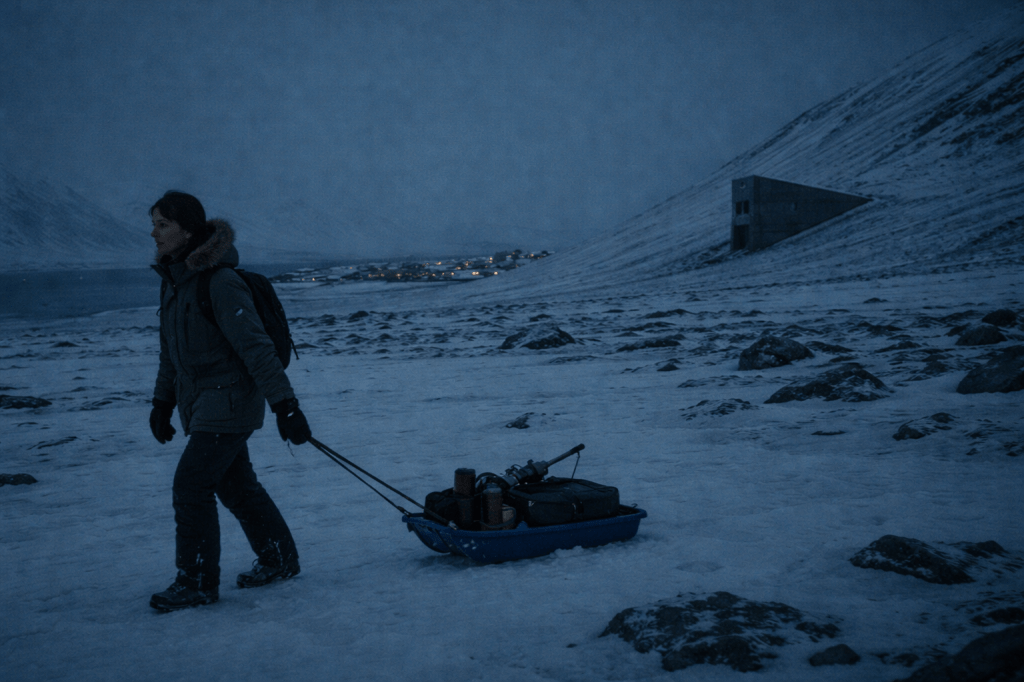
Longyearbyen’s lights glimmered faintly in the distance, fragile against the vast, endless dark. Above the town, the Global Seed Vault rested like a silent promise—or a warning. People liked to talk about it as hope, but to me, it was more like a contingency plan. You don’t build an insurance policy unless you expect things to fall apart. The town was quiet this time of day—a blessing. The polar night wrapped around everything, muting even the hum of voices or the occasional sound of machinery. My boots crunched softly on the snow as I approached the shop, the sled creaking behind me.
Freya Isvik’s shop was an institution, though she’d laugh if you called it that. The door creaked, and the shelves overflowed with salted cod and jars of pickled herring, Freya’s unmistakable scrawl marking each label. A weathered sign above the door read simply: Fisk og Proviant.
I could already picture her behind the counter, teasing someone about forgetting their gloves again or overpaying for canned goods they didn’t need.
The bell jingled as I pushed the door open, letting the heat wash over me. The air was thick with the smell of fish and salt, mingling with the faint aroma of coffee brewing in the back.
And then I saw her.
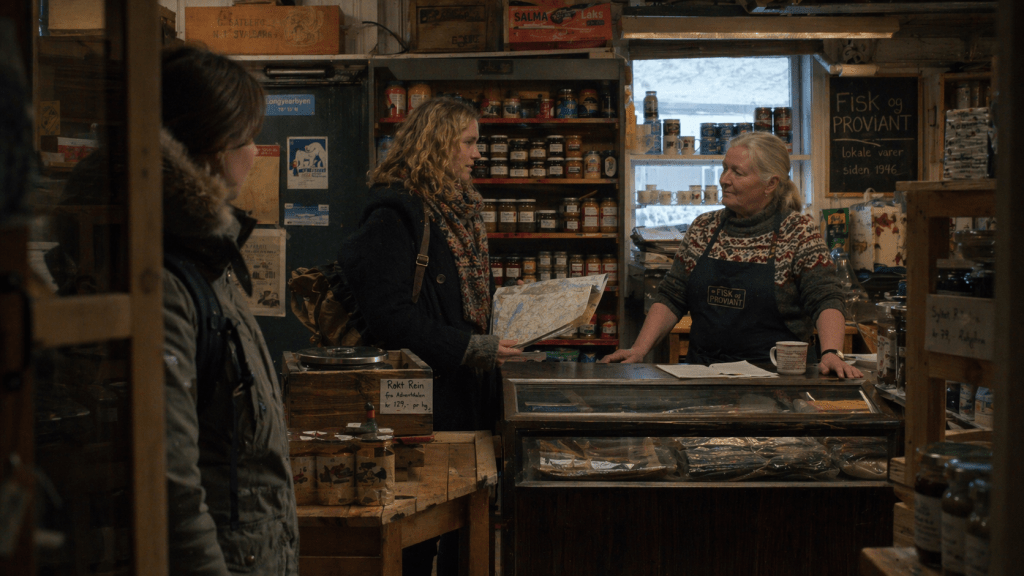
She stood at the counter, wrapped in so many layers she looked like a puffin, her scarf slipping as she gestured animatedly with a folded map.
“I just need someone who knows the area,” she said, her tone clipped but not rude. “The fjords, glaciers, all that. It’s for research.”
“Research,” Freya repeated, her tone dry as a January wind. “Well, we don’t get many of you up here this time of year.”
“It’s important work,” the woman insisted, her voice rising just slightly. “If I could just—”
Freya spotted me and grinned. “Maybe Astrid can help you.”
I froze, my hand tightening on the sled’s handle. Helping tourists wasn’t my job—not even close—but Freya had a way of throwing me into things whether I wanted to or not.
The woman turned, her cheeks flushed from the cold or frustration—or both. Her eyes landed on me, a flicker of hope lighting up her face. As I set the sled’s handle down, the puffin-wrapped woman fidgeted with her map, oblivious to the cold air I’d let in.
Her eyes lit up with something that might have been hope—or desperation. I couldn’t decide which one made me more uncomfortable.
Ingrid Solberg
I, Ingrid Solberg, tightened my scarf, my fingers stiff from the cold. The map crinkled in my pocket—a reminder of the deadlines and the emails waiting back in Oslo.
Results are critical, Ms. Solberg.
The funding committee’s words buzzed in my mind, sharp and unrelenting. Every step here mattered. Every delay was a risk I couldn’t afford. But standing in Freya’s shop, with Astrid glaring like I’d already lost, I wondered if I’d miscalculated this entirely. Her sharp, unflinching gaze made my palms sweat. I shifted my weight, adjusting the map and juggling my gloves.
But I couldn’t afford to lose this. Not here, not now.
“This isn’t tourist stuff,” I said, watching the woman behind the counter raise an unimpressed eyebrow. “It’s research—marine ecosystems under extreme conditions. I’ve spent years studying how changes here affect global systems,” I said, though the words felt thinner than they used to, as if they no longer carried all the weight I’d once placed on them. “This might be my last chance to collect the data I need before the funding runs out.” My voice wavered slightly at the end, but I steadied it, refusing to let doubt creep in. “I need someone familiar with the fjords.”
I’d spent years studying how changes here affect global systems, inspired by a professor who first showed me the beauty of these icy landscapes. She once told me, ‘The Arctic isn’t just a place—it’s a story we can’t afford to lose.’
Freya Isvik, as she’d introduced herself, leaned casually against the counter.
“Fjords aren’t exactly welcoming this time of year,” she said, her tone dry. “And you’re about four ullundertøy short of ready.” She grinned, clearly enjoying herself, before adding, “Wool base layers, in case you’re wondering. You’ll thank me later.”
“I’m not a tourist,” I repeated, though I could tell it wasn’t convincing anyone.
The door creaked open behind me, bringing with it a gust of icy wind. I turned and immediately lost whatever argument I’d been about to make.
The woman who entered looked like she’d been carved out of the Arctic itself, all sharp edges and quiet strength. Her coat was dusted with frost, her boots heavy with snow, and her eyes—pale and piercing—swept the room with practiced ease.
“Maybe Astrid can help you,” Freya said, her grin widening.
The woman—Astrid Bjørnsen, apparently—stopped in her tracks, her expression shifting from neutral to wary in an instant.
“Hi,” I said, smiling despite the sudden dryness in my throat. “You’re Astrid?”
Her gaze locked onto mine, assessing.
“Who’s asking?”
The silence stretched for a moment too long, and I cleared my throat.
Astrid didn’t like outsiders—most came with a sense of entitlement, expecting the Arctic to bow to their plans. She still remembered the time a tourist had ignored her warning about thin ice, their recklessness costing more than just their expedition. Her wariness wasn’t rudeness; it was survival, sharpened over years of solitude.
“Ingrid Solberg,” I added quickly, hoping to sound professional. “I’m with the University of Oslo.” I held out my hand, but she didn’t take it.
Astrid: I didn’t take Ingrid’s handshake. Not out of rudeness—just habit. Too many people came here thinking they could tame this place with a handshake and a grin. Most didn’t last the winter.
“She needs a guide, Astrid,” Freya said, grinning.
Astrid shot her a glare, her jaw tightening, but it softened just slightly—an almost imperceptible shift, like she was too tired to hold the walls up completely.
“And Freya’s too nosy to mind her own business.”
Freya chuckled softly but didn’t elaborate further.
“She knows these fjords better than anyone,” she said instead, stepping aside. “You’ll be in good hands.”
Astrid’s lips twitched—just enough to suggest a smile that never quite came. It lingered like a crack in the frost, subtle but unforgettable.
Freya caught me by the counter as I folded my map for the tenth time. “She’s stubborn, you know,” she said, setting a jar of pickled herring on the shelf. “Astrid?”
I nodded, and she laughed. “Always has been. But she wasn’t always so…” She paused, her smile faltering. “So careful. The Arctic will do that to you.”
I tilted my head, curious.
Freya glanced out the frosted window, her voice softer now.
“We lost someone once—another researcher. Years ago. Storm came in faster than it should have.”
She didn’t say more.
The silence that followed said more than her words.
“What happened?” I asked gently.
Freya didn’t answer right away. “Ask her yourself. Just don’t expect her to hand you the whole story on a silver platter. But… she’s still out there. That tells you something, doesn’t it?”
Later, as Astrid adjusted the sled’s straps, I thought about what Freya had said.
She wasn’t always like this, you know. She used to laugh more.
I glanced at Astrid’s sharp profile, her focus entirely on the task at hand. Maybe Freya was right. Maybe there was something thawing under all that frost—it just took the right kind of warmth.
Freya would probably roll her eyes later and claim credit for the whole thing:
“I told her Astrid needed thawing. She’s just lucky I didn’t charge her matchmaking fees!”
It made me stifle a laugh—but also glance at Astrid, wondering if there was truth in Freya’s playful words.
“No, I know,” I said quickly. “But you know the fjords, right? Better than anyone else?”
“Depends,” she said again, her voice flat. “On what?”
“On whether or not you listen.”
First Outing
Astrid
The dock was empty, except for the faint groan of the ice shifting below—a sound that never stopped reminding you to respect this place or leave it altogether. The wind carried a biting chill that slipped past even the thickest layers, gnawing at the edges of your resolve. I leaned against the sled, adjusting the harness straps for the third time, though I knew they didn’t need it.
Ingrid was late.
I checked my watch, even though I didn’t need to. People didn’t last long out here if they weren’t punctual. In the Arctic, being late wasn’t just inconvenient—it was dangerous.
Just as I was about to give up, hurried footsteps crunched over the snow, sharp and uneven.
“Sorry!” she called, her voice breaking through the stillness like a gust of warm air. “I didn’t realize how far the dock was—or how slippery.”
I turned to see her half-jogging, half-sliding toward me, a bag clutched in one hand and her scarf trailing behind her like a forgotten thought. Her boots were pristine, the kind you bought after Googling “best Arctic gear” and picking the top result.
“Your boots,” I said flatly, nodding toward them. “You’ll need spikes. The ice isn’t forgiving.”
She came to an abrupt stop, her breath clouding in the air. Her cheeks were flushed pink, whether from the cold or embarrassment, I couldn’t tell.
“I’ll be fine,” she said, though the slight tremor in her voice betrayed her.
I raised an eyebrow, letting the silence stretch just long enough to make her shift uncomfortably.
“We’ll see,” I said, turning back to the sled without waiting for a response.
The wind picked up, sharper now, carrying the kind of chill that burrowed deep into your bones. I focused on the sled, running through the equipment checklist in my head even though I’d already done it twice.
“Do you always do this alone?” Ingrid asked, her voice curious but hesitant, like she wasn’t sure if the question was allowed.
“Yes.” My answer was clipped, my focus still on the sled.
“Oh.”
Her voice was soft, but not disappointed. I glanced up briefly to see her staring out at the jagged peaks, her gaze intent, as though she were searching for answers hidden in the snow-draped horizon.
“Most people don’t,” I added, the words slipping out before I could stop them.
Her eyebrows lifted slightly, and a small, teasing smile played on her lips.
“But you’re not ‘most people,’ are you?”
I looked at her sharply, caught off guard by the unexpected lightness in her tone. Her face was open, thoughtful. Maybe she’d last longer than I thought.
Ingrid
The cold hit harder than I’d expected, even with all my carefully chosen layers. My breath fogged up my scarf as I jogged toward the dock, clutching my bag like it might shield me from the bite of the Arctic air.
When I reached the dock, I saw her immediately—standing tall and still beside a sled piled with gear. Astrid looked like she belonged here in a way I never could, her presence filling the space around her as if it were carved out just for her.
“Sorry!” I called, waving with my free hand.
Her expression didn’t change as she turned to look at me, her pale eyes sharp and assessing.
“Your boots,” she said, her voice low and steady. “You’ll need spikes. The ice isn’t forgiving.”
“I’ll be fine,” I said quickly, though my heart was pounding and my legs felt unsteady beneath me.
Her eyebrow arched, just slightly, as though she was weighing the truth of my words.
“We’ll see,” she said, turning back to the sled without another word.
The silence that followed wasn’t hostile, but it wasn’t exactly welcoming either. She moved with practiced efficiency, checking and re-checking the sled’s straps, her focus unwavering. I shifted awkwardly, unsure of where to stand or what to say.
“Do you always do this alone?” I asked, the question spilling out before I could think better of it.
“Yes,” she replied, her tone neutral, her eyes never leaving the sled.
“Oh.”
The dock stretched out before us, the ice groaning faintly below like it was alive, testing our presence. For a fleeting moment, I wondered if I’d made a mistake—if I should turn around, head back to the shop, and leave her to the solitude she clearly preferred.
But then she glanced at me, just briefly, her expression softening for a heartbeat before turning back to the sled. It wasn’t much, but it was enough to root me in place, enough to remind me why I was here.
A Crack in the Ice
Astrid
The silence shattered with a sharp crack, the sound ricocheting through the frozen air. My hand shot out, gripping the edge of the sled as my breath hitched.
“Stå stille,” Stay still, I said, my voice low but firm as I raised a hand to stop her.
Ingrid froze immediately, her wide eyes locking onto mine, her breath visible in shaky clouds against the cold air.
“What was that?” she whispered, her voice barely audible above the eerie stillness.
“Isen,” Ice, I replied, my tone steady despite the tension coiling in my chest.
Moments like these reminded me why I’d chosen this life. This place didn’t reward bravado; it demanded respect. Its stillness wasn’t empty; it was a warning, a reminder that you were only ever a visitor here. The ice beneath us, the endless expanse of snow, even the biting wind—they all demanded acknowledgment, reverence.
I’d built my life around understanding that truth.
But now, as I glanced at Ingrid, her pale face illuminated by the faint glow of the horizon, I felt something unexpected—a quiet pull, a desire to share this world with someone who might come to love it as much as I did.
“Is it safe?” she asked, her voice trembling slightly as her gaze flicked downward.
“For now,” I said, keeping my tone calm as I tilted my head toward the sled. “Step carefully. Keep your weight balanced.”
To her credit, she didn’t panic. She didn’t ask questions. She simply nodded and moved exactly as I’d instructed—deliberate, measured, careful. Most people would have faltered, but she didn’t.
The ice groaned beneath her boots, each step an uneasy reminder of how fragile this moment was. My breath held steady, but my chest felt tight, waiting for her to reach me.
When she finally did, I nodded once.
“Bra gjort,” Well done, I said, my tone neutral but sincere.
Ingrid
The sound of the ice cracking had sent a jolt through me, freezing me in place.
“Stå stille,” Stay still, Astrid said, her voice low and firm, cutting through the rising panic in my chest.
I obeyed immediately, my breath catching as I followed her gaze.
For a moment, I forgot how to breathe. It wasn’t just fear I felt—it was awe. The Arctic wasn’t just something to study; it was alive, and I wanted to be part of it.
I thought about Astrid’s words earlier: The Arctic wasn’t something you mastered — you learned to move with it.
My chest tightened as I thought of Oslo—the deadlines, the noise, the constant need to prove myself in a world that always demanded more. Could I let go of that need for control and learn to adapt, as Astrid had, to a world that asked only for stillness and respect?
When I reached the sled, Astrid’s calm expression hadn’t shifted, but the faintest flicker of approval softened her eyes.
“Bra gjort,” Well done, she said again, her tone neutral but genuine.
I exhaled slowly, the tension in my shoulders easing just enough to feel my legs beneath me again.
“Thanks,” I muttered, trying to sound nonchalant even as my heart still raced. “Guess I owe you one already.”
Her lips twitched, almost imperceptibly—not quite a smile, but close enough to surprise me.
“Just listen next time,” she said, turning her attention back to the sled. “It’ll save us both the trouble.”
Her words were sharp, but there was something quieter beneath them—an acknowledgment, maybe even trust.
And for the first time, I thought that perhaps I could belong here—not just to this place, but to the rhythm of her world.
The Polar Bear
Astrid
The polar bear crested the ridge, black eyes sharp and searching, its fur patchy in places where the winter hadn’t been kind. I’d seen them before, but this one was different—gaunt, desperate, every step a calculation.
“Ingrid,” I said quietly, gripping the rifle. “Move behind me. Now.”
She didn’t move at first, her wide eyes locked on the bear. Outsiders always froze like that, caught between awe and fear. But awe wouldn’t save her.
“Now,” I said again, sharper this time. Finally, she obeyed, stepping back carefully. Good. The ice might tolerate her mistakes, but the bear wouldn’t.
The bear sniffed the air again, its massive frame silhouetted against the jagged ridge. I adjusted my grip on the rifle, finger resting just near the trigger but not on it. Shooting wasn’t my first choice. It never was.
“It’s thin,” I murmured, almost to myself. “It’s too far south. No seals here.”
“What does that mean?” Ingrid’s voice was barely a whisper, her breath visible in shaky clouds.
“It means it’s hungry,” I said.
That was enough.
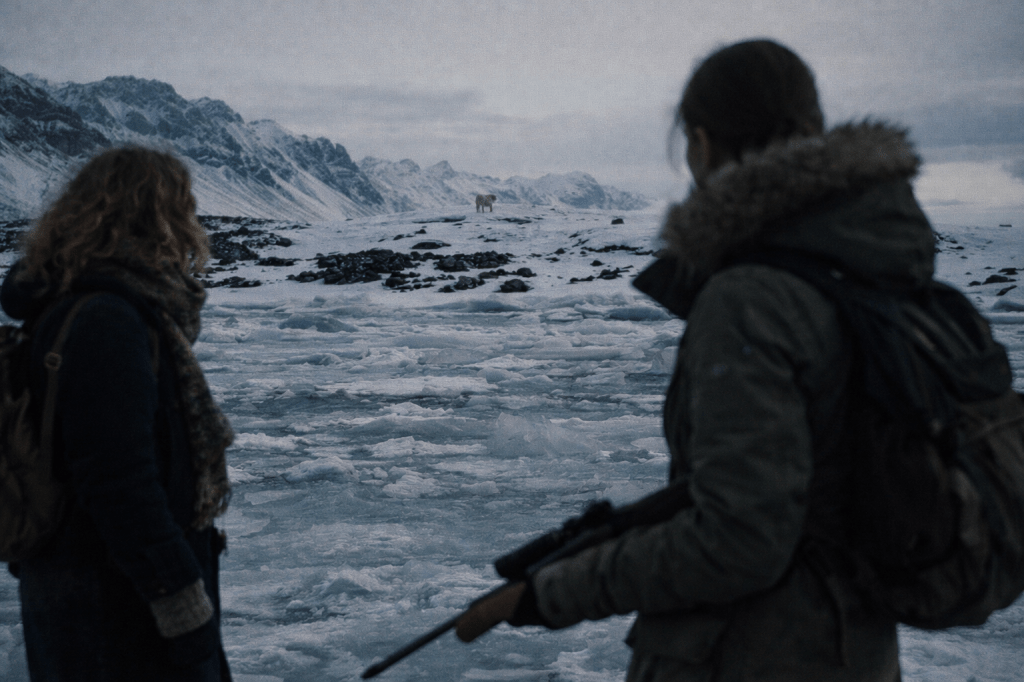
The bear tilted its head, staring at me for a long moment. Then, slowly, it turned, lumbering back the way it had come. I lowered the rifle but didn’t relax. “Let’s move,” I said, my tone leaving no room for argument. “It won’t be the last.”
Ingrid
Astrid lowered the rifle with slow, deliberate movements, her gaze fixed on the ridge where the bear had disappeared. She moved like she’d done this a hundred times before. Maybe she had.
But something flickered in her expression—a fleeting tightness around her mouth, a shadow in her eyes. It passed quickly, replaced by her usual calm. Yet the moment lingered, making her strength feel all the more real, and all the more intimidating.
“Are you okay?” she asked, her voice steady, her gaze sharp and assessing.
I nodded, though my legs still felt like jelly beneath me. “I think so,” I managed, my breath fogging in the icy air. Watching Astrid’s calmness, I realized survival here wasn’t just about instinct. It was about respect for the land’s rhythms, something I still had to learn.
She studied me for another second before nodding, slinging the rifle over her shoulder with practiced ease. It wasn’t a comforting nod—it was clinical, like she was weighing whether I was worth the effort.
“We should move,” she said simply. “It might come back.”
“Might come back?” I repeated, my voice rising in spite of myself. “That’s comforting.”
She didn’t respond. She didn’t need to. She was already turning back to the sled, her focus shifting seamlessly to the next task. No hesitation, no wasted motion.
I hesitated, glancing back at the ridge. My heart was still racing, the bear’s deliberate, almost indifferent movements replaying in my mind. It hadn’t been in a hurry. Neither had Astrid. I wasn’t sure which unnerved me more.
“Hey,” Astrid called over her shoulder, her tone sharp enough to snap me out of it. “Keep up.”
Her words grounded me, and I hurried after her, the crunch of my boots on the snow louder than I wanted.
When I caught up, she didn’t look at me. Her focus was fixed on the trail ahead, her steps steady and unrelenting, like she’d already forgotten the bear entirely.
“Does that happen often?” I asked, my voice still unsteady, more from the memory of the bear than from the cold.
“Sometimes,” she said, her tone as indifferent as the Arctic itself.
I waited for her to elaborate, but she didn’t. Instead, she adjusted the sled’s harness, her hands working with precision, her attention unwavering. There was no room for lingering fear in her world.
“You weren’t scared?” I asked after a moment, the question slipping out before I could stop it.
She turned her head slightly, just enough for me to catch her profile. Her pale eyes flicked to mine for a moment, unreadable.
“Fear doesn’t help,” she said, her voice low but certain.
It wasn’t bravado. It was fact. She had lived with fear long enough to see it for what it was: a distraction, a liability. Her calm steadied me in a way I didn’t expect, even as the memory of the bear lingered in my chest like a slow, unrelenting drumbeat.
I swallowed the sarcastic response on the tip of my tongue. It wasn’t the time. Instead, I fell into step beside her, my thoughts swirling—about the Arctic, about the bear, about her.
The bear’s massive form was still vivid in my memory, but so was Astrid’s unwavering calm, her absolute focus in the face of something that could have killed us.
“Thanks,” I said quietly, the word feeling small compared to what she’d just done for me.
She didn’t respond immediately, her gaze still fixed on the horizon. But then, just barely, the corner of her mouth twitched. Not quite a smile, but close enough to catch me off guard.
“Stay close next time,” she said, her voice softer but still firm. “It’ll save me the trouble.”
The Northern Lights
Ingrid
The sky shimmered with greens and purples, the Northern Lights stretching and twisting as though they belonged to another world entirely.
The air bit at the edges of my scarf, sharp and unforgiving, the cold seeping through even the thickest layers. But I barely noticed. Each breath fogged the air in front of me, fading quickly into the stillness. The crunch of snow underfoot was the only sound as we stood side by side, the lights above painting the expanse in hues so vivid they felt alive.
I glanced at Astrid, her face lit in fleeting bursts of green and violet, her gaze locked on the sky. The cold seemed to have no effect on her. She stood still, her sharp features softened by the ethereal glow.
“Do you ever get used to this?” I asked, my voice barely above a whisper, afraid to break the spell of the moment.
“No,” she admitted, the honesty carrying a weight I didn’t expect.
I turned to her, surprised. The answer was simple, but something about the way she said it felt more profound—like this place had managed to keep its hold on her, no matter how much time she’d spent here.
Astrid
Ingrid’s question lingered in the stillness, a quiet echo against the vast sky. “No,” I said before I could think to guard the truth.
The word felt heavier than it should have, like it carried more than an answer. Even after years of watching the lights dance, the awe never faded, not entirely. But I didn’t tell her that. Some things weren’t meant to be explained; they were meant to be felt.
I glanced at her briefly, catching the way her eyes reflected the sky—wide with wonder, unguarded in a way I couldn’t quite match. She didn’t belong here, not yet, but there was something about the way she stood, unmoving and silent, that made me think she wanted to.
“Good,” she whispered, breaking my train of thought. “I’d hate to think I’m the only one who’s completely in awe.”
Ingrid
I turned back to the sky, Astrid’s answer lingering in my thoughts. It wasn’t just the lights that held her attention—it was something more. The stillness of this place, its honesty, maybe even its indifference. It mirrored her somehow, and for the first time, I wondered if she saw herself in it.
She didn’t respond, but I thought I saw the faintest shift in her posture—a relaxation, maybe. I couldn’t be sure.
The lights above twisted and swirled, alive with an energy that felt impossible. I’d seen photos before, but they hadn’t prepared me for this—colors in motion, pulsing like the Earth’s breath.
I felt small standing there, but not in a bad way. Maybe it was enough to be here, to belong here.
Astrid
The lights moved across the sky, a rhythm I’d long stopped trying to understand. Their beauty was undeniable, but it wasn’t just the sky that drew me in tonight—it was her. The way she stood beside me, her awe so transparent it made me feel something I couldn’t name.
Ingrid didn’t ask questions, didn’t try to fill the quiet. Instead, she just watched. That was rare—most people came here to search, to demand answers from a place that didn’t owe them anything. But Ingrid… she seemed willing to listen.
I glanced at her again, and for a moment, I let the thought settle: Maybe sharing this didn’t have to mean losing it.
The First Kiss
Astrid
The cabin was quiet, the kind of silence that came after a long day in the cold. The fire crackled softly, its warmth chasing away the chill that had seeped into my bones. A pot of reindeer stew simmered on the stove, filling the air with the rich aroma of juniper and thyme—a fleeting reminder of the season’s abundance.
I leaned back in my chair, watching Ingrid out of the corner of my eye. She fiddled with her scarf, her fingers moving in small, nervous gestures. Outside, the polar night stretched on endlessly, but in here, the glow of the fire and the scent of the stew made the dark feel less consuming.
She’d held up well today. Better than I expected.
“You did good,” I said finally, my voice breaking the quiet.
She looked up, startled. “What?”
“Out there,” I clarified, nodding toward the door. “You listened. That’s more than most.”
She smiled faintly, tucking a stray strand of hair behind her ear. “High praise coming from you.”
I didn’t respond, but her words lingered in the air between us, soft and almost teasing.
Ingrid
Astrid’s words were simple, almost matter-of-fact, but they warmed me in a way I didn’t expect. I hadn’t realized how much I’d needed to hear them—needed to know I wasn’t just fumbling my way through this.
I stood and walked to the window, my footsteps light on the wooden floor. The frost on the glass caught the firelight, casting delicate shadows across the cabin. I stared outside, at the faint outline of the mountains and the stillness of the snow-covered world.
“It’s so still here,” I said after a moment, my voice barely above a whisper. “It’s like the whole world just stops.”
She didn’t respond right away, but I felt her watching me. Her gaze was steady, grounding. It made me feel seen in a way I wasn’t used to.
“It’s different,” I added, almost to myself. “I’ve lived in cities my whole life. Oslo, London. Even the quiet there isn’t really quiet. It hums with traffic, phones, people moving too fast. But here…” I trailed off, pressing my fingertips lightly to the frosted windowpane. “Here, it’s not just quiet—it’s like the land is holding its breath, waiting for you to notice it.” My voice softened as I added, “It’s alive, in a way I didn’t expect.”
Astrid
Ingrid’s words caught me off guard. Most people couldn’t see it—not the way this place lived and breathed, not the way it demanded more from you than you thought you had. But Ingrid… she did. Or at least, she wanted to.
“You don’t disappear,” I said finally, the words slipping out before I could think. “You just learn to be part of it.”
She turned to me then, her expression open and searching.
“You’re not like most people who come here,” I said before I could stop myself.
“What do you mean?” she asked, tilting her head slightly.
“They don’t stay. Most people come looking for something, but when they find it, they leave.”
“And you?” Her voice was quiet but insistent.
“I’m not looking for anything,” I replied simply.
Her lips curved into a faint smile, but there was something vulnerable in her eyes. “Maybe that’s why you’ve found it.”
Ingrid
Astrid’s words settled into the space between us, heavy and grounding. She didn’t look away, her pale eyes steady on mine, and for a moment, I wondered if she could see the way her presence made me feel less lost.
I reached out hesitantly, my fingers brushing hers lightly where they rested on the windowsill. She didn’t pull away.
Her lips brushed mine, tentative and soft, like a question waiting to be answered. The moment stretched, fragile and intimate. Outside, the wind shifted, and the cabin creaked softly, as though the Arctic itself exhaled in relief. The frost on the window caught the faintest glimmer of light from the aurora above—a quiet acknowledgment of something new. My breath mingled with hers, carrying the faint scent of firewood and stew.
I hesitated—just for a second—then didn’t pull away.
The thought flickered briefly, but it was drowned out almost immediately by something deeper: Why does this feel right?
Her hand brushed mine again, steadying and grounding me in the moment. When she leaned back slightly, her eyes searched mine—not for reassurance, but for understanding, for something unspoken. Slowly, I let the hesitation melt away and leaned in again.
Astrid
The kiss deepened, deliberate and slow, like we were the only two people left in the world. Ingrid’s lips were warm, soft, and full of questions I didn’t know how to answer. But I didn’t pull away. I let the walls I’d built around myself crack, just slightly, letting her in.
Her hand was warm beneath mine, solid and steady, and I realized I didn’t want to move away. For so long, I’d told myself I didn’t need this—didn’t need anyone—but Ingrid made me question that. She made me wonder if staying guarded was worth what I’d been missing.
“You belong here,” she said softly, her voice barely above a whisper.
Her words hung in the air, wrapping around me like the warmth of the fire. I met her gaze, seeing the quiet certainty in her eyes, and for the first time, I let myself believe her.
I leaned closer, brushing my forehead lightly against hers. The kiss felt like a crack in the ice—a tiny fissure, letting warmth into spaces I’d kept frozen for too long.
Ingrid
When the kiss broke, neither of us moved far. Astrid’s forehead rested against mine, her breath warm on my skin.
“Was that okay?” I asked softly, the words barely audible.
She nodded, her hand brushing mine again. “It was,” she said, her voice quiet but sure.
The faintest hint of a smile touched her lips, and I realized I’d never seen her look so unguarded. It made me want to stay, to see what else was behind those walls she’d let me glimpse.
The fire crackled softly in the background, but I barely noticed. The silence between us wasn’t heavy—it was shared, grounding, and full of possibilities I hadn’t dared to imagine.
Ingrid’s Decision
Ingrid
The email sat in my inbox, its subject line glaring like a challenge:
FINAL RESPONSE NEEDED: Research Team Lead Position.
Forty-eight hours. That’s how long Oslo had given me to decide. My inbox blinked with its usual urgency: Your research could change everything, Ms. Solberg. Once, I’d believed it. Now, the words felt hollow. I stared at the cabin walls, the faint hum of the fire steadying me more than any promise from the university. I thought of Astrid—how she moved through this place like it was a part of her, how she didn’t need to prove anything to anyone. The cursor blinked back at me, unrelenting.
Change everything.
But maybe I already had.
It offered no accolades, no certainty — only honesty. But leaving meant giving up more than Oslo—it meant giving up the very life I’d been chasing. What would people think? My colleagues, my friends, my family? The expectations were still there—quiet, waiting. I stared at the screen a moment longer, then looked away.
Yet staying wasn’t simple either. The Arctic wasn’t forgiving, and neither was isolation. I would miss birthdays, late-night city walks, even the hum of life back home. My mother’s voice rang in my ears: “Why can’t you settle somewhere safe, somewhere close?” But here, with Astrid, I felt safer than anywhere else. Even when the ice cracked, even when the bear loomed, her steadiness reminded me there was a different kind of safety—the kind found in trust.
I stared at the screen, the words blurring slightly as a memory surfaced.
The hum of lecture hall lights, the faint scent of markers on whiteboards, the clink of coffee mugs set down too loudly by latecomers. My hands trembled as I clicked through slides on Arctic ecology, the projector whirring behind me. In the front row, Professor Lunde sat smiling, steady and encouraging, her presence grounding me in a way that felt like an anchor in the storm.
“You’ve got something, Ingrid,” she had told me afterward, pressing a coffee into my hands. “Don’t let anyone tell you otherwise.”
That moment had felt like the beginning of everything. But now, as I stared at the glowing screen, I couldn’t shake the feeling that it had all been leading me somewhere else.
Oslo loomed in my mind—the hum of trains, the glare of fluorescent lecture halls, the constant race to prove myself. But here, the silence didn’t feel empty. It felt infinite.
It wasn’t waiting to be solved. It simply existed, and you adapted. It didn’t care if I stayed or left. But it had shown me something I hadn’t expected—a way of being that didn’t revolve around deadlines or accolades.
What would staying mean? A life measured not in accolades but in moments: the crackle of a fire, the first glow of sunrise, Astrid’s steady gaze. Could I trade ambition for peace, recognition for something quieter—but no less profound? The email still sat in my inbox, unanswered. Maybe I’d respond, or maybe I wouldn’t. But for the first time, I wasn’t in a rush to decide. The Arctic had taught me to wait, to listen—and that was enough for now.
My chest tightened as the cursor blinked in the email. Oslo felt like an old chapter, one I wasn’t sure I wanted to reread.
Astrid
The fire crackled softly, filling the cabin with a steady warmth. Outside, the wind howled, a low, mournful sound that made the silence inside feel even heavier. Ingrid sat by the fire, her laptop open, the blue glow of the screen reflecting on her face. She looked tense, her brow furrowed, her fingers hovering over the keyboard.
I leaned against the doorframe, snow still clinging to my coat.
“You’re thinking too hard,” I said, breaking the quiet.
Her head snapped up, startled. She quickly closed the laptop, like a child caught sneaking sweets.
“Sorry,” she said, her voice tight. “I didn’t hear you come in.”
I shrugged, stepping into the room. “You didn’t wake me,” I said, glancing at the closed laptop. “Big decision?”
“Yeah,” she admitted, softer now. “But it’s more complicated than I thought.”
I didn’t push. If she wanted to tell me, she would. Instead, I crouched by the fire and added another log, watching as the flames licked at the fresh wood. The light flickered across the room, softening the sharp edges of her face.
Ingrid
I watched Astrid for a moment, her movements deliberate and unhurried, as if tending the fire was the only thing that mattered. She had a way of grounding everything—like she didn’t need to say much for her presence to fill the room.
“It’s a job,” I said finally, the words tumbling out. “In Oslo. Everything I’ve worked for.”
She didn’t look up, but I saw the faintest twitch of her brow. “Sounds like a good thing,” she said evenly.
“It is,” I replied, though the words felt hollow. “But…”
She turned her head slightly, waiting. I stared at the fire, the warmth on my face doing little to ease the cold knot in my chest.
“Back in Oslo, everything made sense,” I continued. “I used to measure success in deliverables: published papers, secured grants, packed lecture halls. Momentum had always felt like meaning. But out here…” My voice trailed off, my fingers tightening around the edge of my mug.
“Here, everything’s different,” I said, quieter now. “The land doesn’t fit into a schedule. It’s not waiting for you to figure it out. It just is.”
The words surprised me as I said them, as if they’d been sitting inside me all along, waiting to be spoken. I looked up at her then, needing to see if she understood.
Astrid
Ingrid met my gaze, her eyes searching mine for something I wasn’t sure I could give. “I didn’t know how much I needed that,” she said softly.
Her honesty caught me off guard. Most people came here with plans, with expectations, with the belief that they could mold this place to fit them. Ingrid wasn’t like that. She was learning to listen, to let this place shape her instead.
I sat back, letting her words settle into the room. “Sounds like you’re the one deciding what matters most,” I said after a moment.
Her lips twitched, but it wasn’t quite a smile. “If I stay,” she said quietly, “what does that even look like?”
I didn’t have an answer for her. That wasn’t my decision to make.
“It looks like waking up to this,” I said, gesturing toward the window where the faint glow of the polar night still lingered. “It looks like finding your place here. And maybe it looks like not being alone in it.”
Ingrid
Astrid’s words landed heavier than she probably intended. Not being alone in it. I looked at her, at the way the firelight softened her usually guarded features. She wasn’t offering promises or guarantees, just possibilities.
“Maybe,” I said finally, my voice barely above a whisper. “Maybe it does.”
Later, after she’d gone to bed, I stared at the email again. The plan I’d built for years felt smaller now, like it didn’t fit who I’d become. Oslo wasn’t the dream I thought it was—it was a life I wasn’t sure I wanted anymore.
What would staying mean? I didn’t have all the answers, but for the first time, that uncertainty didn’t feel like failure. It felt like freedom.
The First Sunrise
Astrid
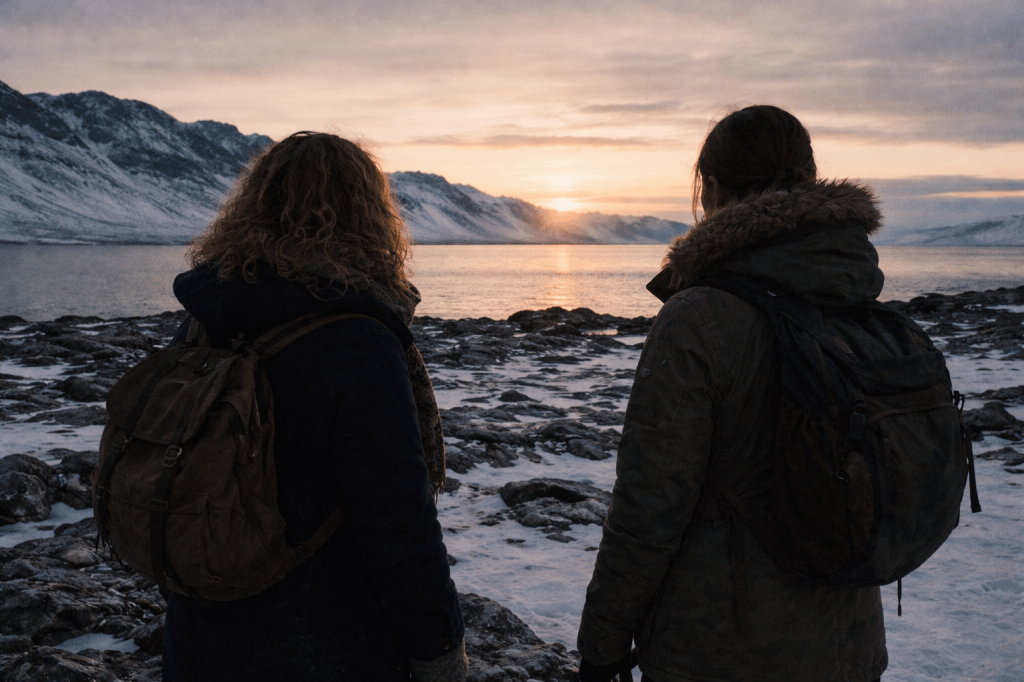
The horizon glowed faintly, hesitant, like the sun was remembering how to rise after months of exile. It didn’t rush. Here, even the light took its time, stretching across the fjord in deliberate, golden waves.
I stood at the edge of the ice, my breath mingling with the wind. Beside me, Ingrid was silent, her gaze fixed on the horizon. She didn’t fill the quiet with questions or commentary. Instead, she just watched, letting the Arctic speak for itself.
Ingrid was beside me, close enough that her shoulder brushed mine when the wind shifted. She hadn’t said much since we left the cabin, but her silence wasn’t empty—it felt deliberate, like she was letting the Arctic speak for her.
“Are you cold?” I asked, glancing at her.
She smiled faintly, her breath visible in the crisp air. “No.”
Her hands were tucked into the pockets of her coat, but her gaze was fixed on the horizon, where the first edge of the sun peeked over the mountains.
“You always forget how quiet it is,” I said softly, breaking the silence.
“What do you mean?” she asked, her tone curious but hushed.
“When the sun comes back,” I said, gesturing toward the light. “It’s never loud, but it always feels bigger than it is.”
She nodded slowly, her expression thoughtful. “I think I understand,” she said.
The light crept higher, spilling soft hues of blue and gold across the snow. It wasn’t just the return of the sun—it was a declaration, a reminder that even after the longest night, change was possible. The rays caught on the ice, scattering shimmering colors that reflected in her wide, unguarded eyes.
Ingrid
I glanced at her, watching how the glow painted her pale eyes, making them seem lighter, almost vulnerable. For the first time, she didn’t look like she was bracing against the world. She looked like she was part of it.
“You always forget how quiet it is,” she said, her voice low and steady.
I nodded. “It’s not just quiet,” I said softly. “It’s alive.”
“When the sun comes back,” she said, her words deliberate, “it’s never loud, but it always feels bigger than it is.”
I turned back to the horizon.
“I think I understand.”
The light crept in slowly, softening the sharp edges of the world. The ice beneath us reflected the gold of the rising sun, its surface shifting with the faint groans of pressure and release. It wasn’t just a sunrise.
Ingrid stood beside me, silent but resolute, and I wondered if she felt it too—that sometimes, the cracks that let light in were also the ones that held everything together. I leaned into her slightly, letting the weight of her shoulder ground me. She didn’t move, but I felt her shift just enough to press back.
“I think I could stay,” I said softly, the words surprising even me.
Her lips curved—not quite a smile, but close enough. The Arctic didn’t promise permanence, but it promised cycles: light and dark, stillness and storms. Maybe that was enough for now. Together, we’d find out what came next.
She looked at me then, her gaze steady and searching.
“For how long?” she asked, her tone careful but not dismissive.
I smiled faintly, glancing back at the horizon. “For as long as it takes.”
Astrid
Her words hung in the cold air between us, quiet but solid. I wasn’t sure what they meant exactly, but I knew they weren’t empty.
I looked back at the horizon, the sun climbing higher now, its light stretching across the fjord. It wasn’t loud, but it filled the space around us, warm and persistent. Ingrid’s presence felt the same.
“So,” she said after a while, her tone light but teasing, “is this where I finally get the famous Astrid laugh?”
I turned to her, one eyebrow arched. “You’d have better luck finding another polar bear.”
She grinned, her cheeks still pink from the cold. “Noted. But don’t think I won’t keep trying.”
I didn’t answer, but the faintest twitch of a smile played on my lips, enough to make her laugh softly.
Her laughter wasn’t loud, but it carried warmth—like the sun, creeping back after months of darkness. For the first time, I felt it too. Maybe letting her in wasn’t a risk. Maybe it was a beginning.
Ingrid
The sun rose higher, its light spreading across the fjord, softening the sharpness of the Arctic. For the first time, it didn’t feel like the return of the sun—it felt like a promise.
I glanced at Astrid, her profile silhouetted against the growing light. The cabin, the emails, the deadlines—they felt far away now, like a dream I was waking up from. Here, with her, the Arctic didn’t just challenge me—it invited me to stay, to let it teach me, to build something new.
Her hand brushed mine, hesitant but steady, and I realized I didn’t want her to move away. Slowly, her fingers curled around mine, grounding us both.
“You’re really staying?” Astrid asked, her voice softer than the wind.
I squeezed her fingers gently, my breath misting in the cold.
“I am.”
Astrid wasn’t someone who shared easily—not stories, not warmth, not herself. Yet here she was, letting me in, piece by piece. I didn’t know what had made the difference—maybe it was when I stood so still on the ice, trusting her completely. Or maybe it was the way she saw strength where I only felt fear. In this place where survival left no room for softness, Astrid was letting me see hers.
I wasn’t just staying. Somehow, I was helping her stay, too.
The End

You must be logged in to post a comment.