
لم أستطع تتبعها (Lam astaṭiʿ tatabbuʿahā)
Story Written & Told by
Samira Hassan
Visuals & Imagery Created by
Laila Farouk, Yasmin El-Sharif,
Nour Abdelrahman, Dina Khaled,
Rasha Mostafa, & Scott Bryant
With care and quiet observation, her account is shared by
Scott Bryant at the request of Samira Hassan
I did not think of her as someone new.
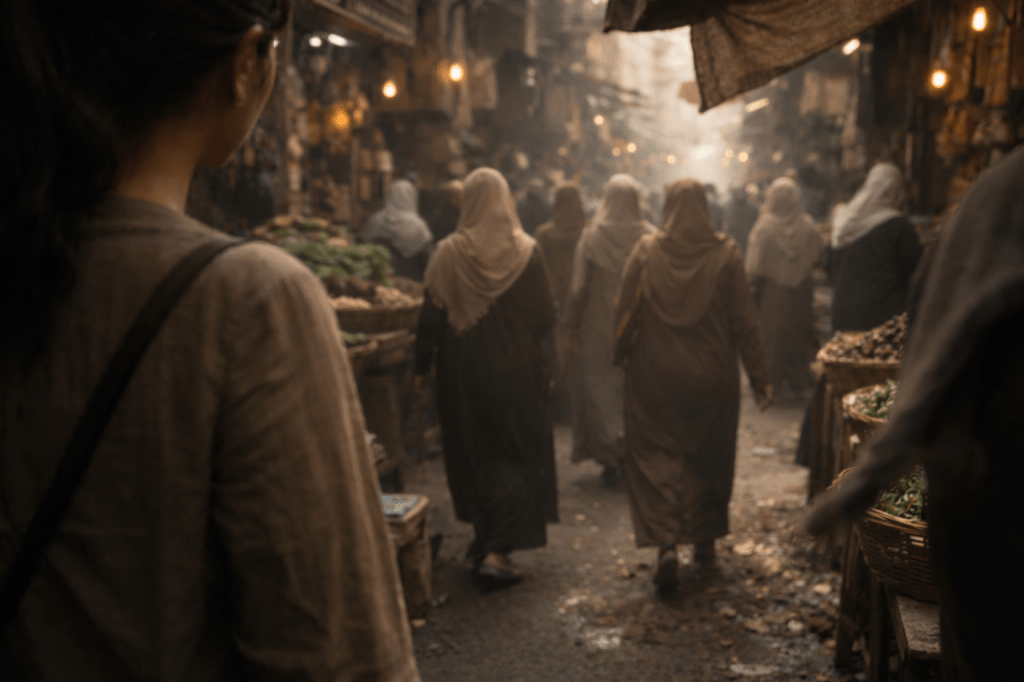
If anything, it was the opposite—the sense, arriving too late to be useful, that I had seen her before, somewhere in the passage in Cairo, where movement carries itself without asking to be seen.
The passage does not allow for careful attention. It carries people through in small, unremarked adjustments—shoulders turning, steps shortening, hands lifting just enough to avoid what someone else has not seen coming. You move with it or you interrupt it, and no one wants to be the one who interrupts it. After a while, you stop noticing how it works.
I passed through it as I always do. I was not looking for anyone.
That is why it took time.
It was not her face. I would not be able to describe it now with any certainty, and if I tried, I would only be adding things that were not there at the time.
What I recognized was the absence of correction.
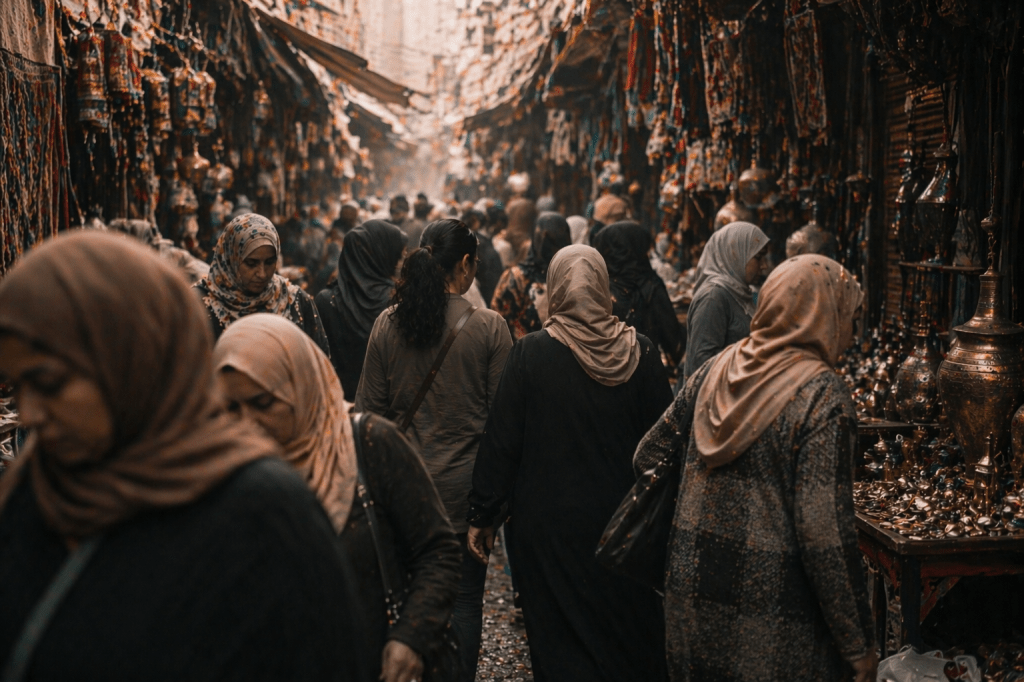
People do not move cleanly through that passage. They hesitate without meaning to, adjust without noticing, reach and withdraw as if testing whether something belongs to them before committing to it. Even those who know the space well still carry the small signs of deciding.
She did not.
She entered a stall without slowing—not quickly, there was no urgency in it, but without the slight break in movement that usually marks the edge of a space. She did not shift her weight or glance for where to stand. She paused just inside and let her attention move across the objects in front of her as though she were confirming something already known, and then, without any visible change in intention, she moved on.
At the time, it did not separate itself from anything else.
It was only later, when I found myself aware of her again, that I understood I had been seeing her for some time.
Not often enough to place. Not clearly enough to remember when it began.
Only enough that recognition came without an origin.
That was what unsettled me.
Not that she was unfamiliar—people pass through without becoming known all the time—but that I had no moment to attach her to. It felt as though she had already been there, and I had simply failed to register it.
I saw her again, and this time I remained aware of her.
That was the only difference.
Her hands were empty when she entered the passage. I am certain of that now, though I would not have said so then. There was nothing carried, nothing held in the way people hold things when they intend to keep them.
She moved as she had before—without hesitation, without adjustment, without the small signs of choosing that most people cannot avoid.
I watched her pass behind one of the stands, the narrow kind where cloth hangs low enough to break the line of sight for a moment, but not long enough to lose someone entirely.
It was not enough time.
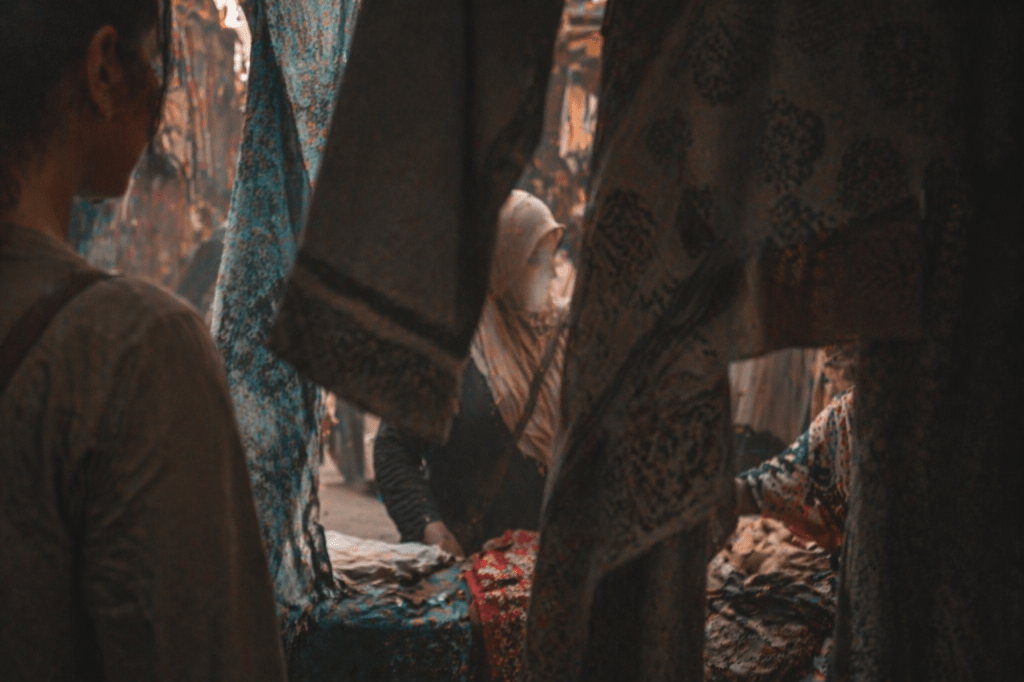
When I saw her again, she was no longer moving.
She stood at a table to the left, one I had not seen her approach, turning something small between her fingers as though she had been there for some time.
I did not see her stop, and I did not see her change direction.
I remember thinking that I must have looked away longer than I believed.
That is the explanation that presents itself first.
It held for a time.
That explanation—that I had simply failed to see what was there to be seen—was enough to return the passage to itself. There was no reason to think otherwise. The space allows for that kind of loss, brief and unremarked, and most of what passes through it does so without being fully accounted for.
I did not look for her.
Not deliberately.
And yet, when I passed through again, I found that I was aware of the possibility of her in a way I had not been before, as though some part of my attention had been left behind and was now waiting to be resumed.
I saw her before I recognized her.
It was the same—if it was the same—the way she entered a space without adjusting to it, the way her attention settled without the visible process of choosing. There was nothing in it that asked to be followed, and still I found that I was following it.
I told myself that I was only confirming what I had thought I saw.
That is how it begins, I think—not with certainty, but with the need to remove it.
She did not carry anything when she entered.
I am careful with that now, because it is easy to add clarity to a moment that did not have it at the time. But I remember the absence again—the same looseness in her hands, the same lack of anything held or accounted for.
I watched more closely.
Not enough to draw attention to myself, not enough to interrupt the way I would normally pass through, but enough that I believed I would not lose her in the same way again.
She moved ahead of me, and I kept her within the line of sight that felt most certain, the one that allowed for the least interruption. I did not follow her directly. That would have required a different kind of attention, one that belongs to something else.
I let the space carry us both.
She passed another stall. Someone stepped between us, briefly, and then was gone.
She was still there.
That, more than anything, reassured me.
I adjusted slightly—not enough to break the rhythm of the passage, only enough to keep her within view as she moved.
It seemed, for a time, that this was enough.
It did not remain that way for long, because there is a point, later in the day, when the passage changes without anyone naming it, not suddenly and not in a way that draws attention to itself, but gradually, as the spaces between people begin to narrow, and the time allowed for small adjustments shortens until movement overlaps instead of spacing itself out. You feel it first not in what you see, but in what is required of you in order to move through it.
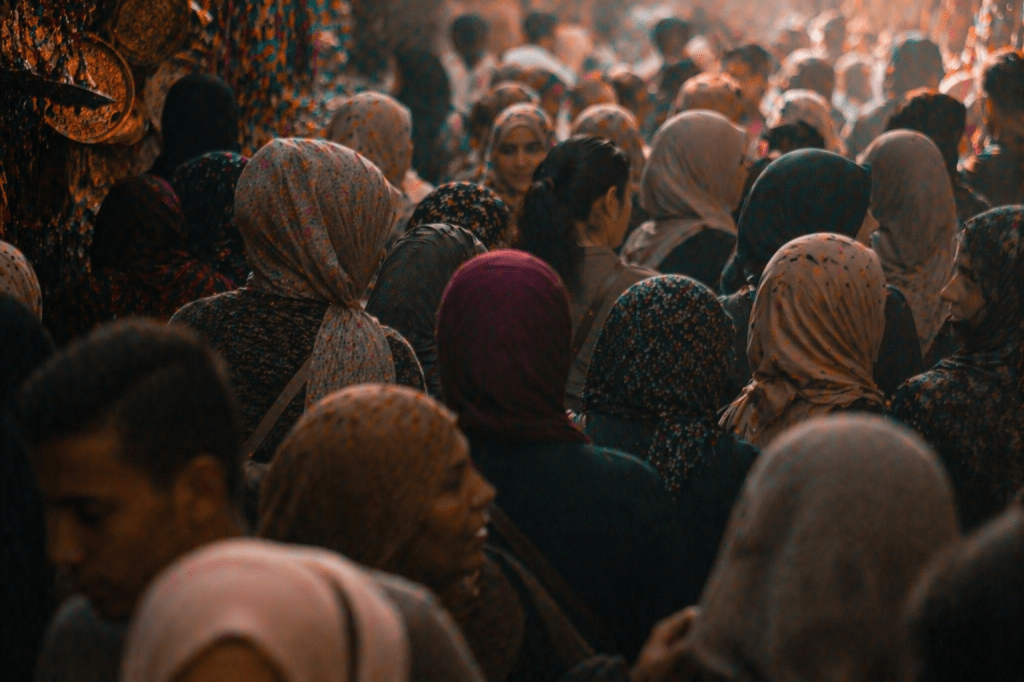
I had not intended to stay long enough to notice the shift, but I must have, because I became aware of it while I was still within it, in the quicker passing of shoulders, the way hesitation became something you could no longer afford, and the slight compression of bodies that made each step carry more consequence than it had before.
It was within that change that I saw her again, not because I had been looking for her, but because the same absence announced itself before anything else did. The same lack of visible adjustment that had first drawn my attention without my intending it.
She moved ahead of me, entering the flow without altering it, her steps neither quickening nor slowing as the pace around her shifted, and while others adjusted more sharply now, turning sooner and stepping closer with less room to do so, she did not seem to take any of that into account in any way that could be seen, though it would be more accurate to say that she accounted for it without needing to show that she had done so.
I kept her within view more carefully this time, not directly and never in a way that would require me to follow her in the manner of pursuit, but by choosing where to look before she moved and holding to the line of sight that seemed least likely to be interrupted, which required more attention than it had before, as the space no longer allowed for passive noticing to be enough.
For a time, this seemed sufficient, and I believed that what I had lost earlier had been only a failure of attention that could be corrected by the application of more of it.
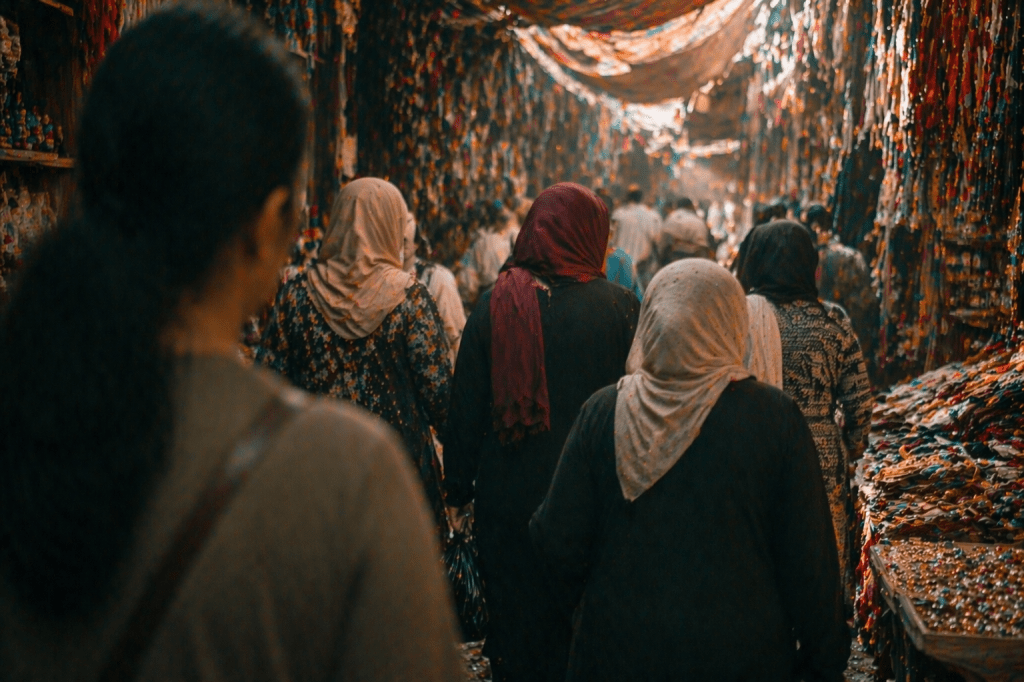
She passed a stall, pausing only slightly, her attention moving across what was laid out before her without touching any of it, and when someone stepped between us, the interruption was narrow enough that I adjusted without concern, maintaining the place where I expected her to reappear.
When the space opened again, she was there, though not where I had anticipated her to be, and not in a way that could be easily accounted for by the movement I had followed.
The difference was not large, which is what made it difficult to resolve, as she stood closer to the side of the stall than I had seen her move, her body angled in a way that suggested she had already come to a stop, without any visible indication of the step or change in direction that would have placed her there.
I allowed for the possibility that I had misjudged the distance, that in the compression of the passage movement had appeared shorter than it was, and that I had allowed for less space than had actually been present, and for a brief time that explanation held well enough to be used without strain.
She moved on again, and I adjusted my attention to keep her within it, though it required more of me now, and when someone stepped between us a second time, the interruption lasted only slightly longer, not enough to lose her, but enough to delay the moment in which I would see her again.
When I did, she was no longer moving, but already positioned at another stall I had not seen her approach, her hand resting lightly on something small, as though she had been there long enough to consider it, and it was at that point that I understood that I had not looked away long enough for that to have occurred in the way I was accustomed to understanding movement.
The explanation did not fail entirely, but it no longer held without effort, and I became aware of that effort in a way that made it difficult to continue relying on it without noticing the strain it introduced.
By the time the light began to shift again, the passage had changed further, though not in a way that could be attributed to any single cause, as the edges of things softened under the introduction of artificial light, and the distinction between one movement and another became less clear, not because the movement itself had altered, but because the conditions under which it was seen no longer allowed for the same certainty.
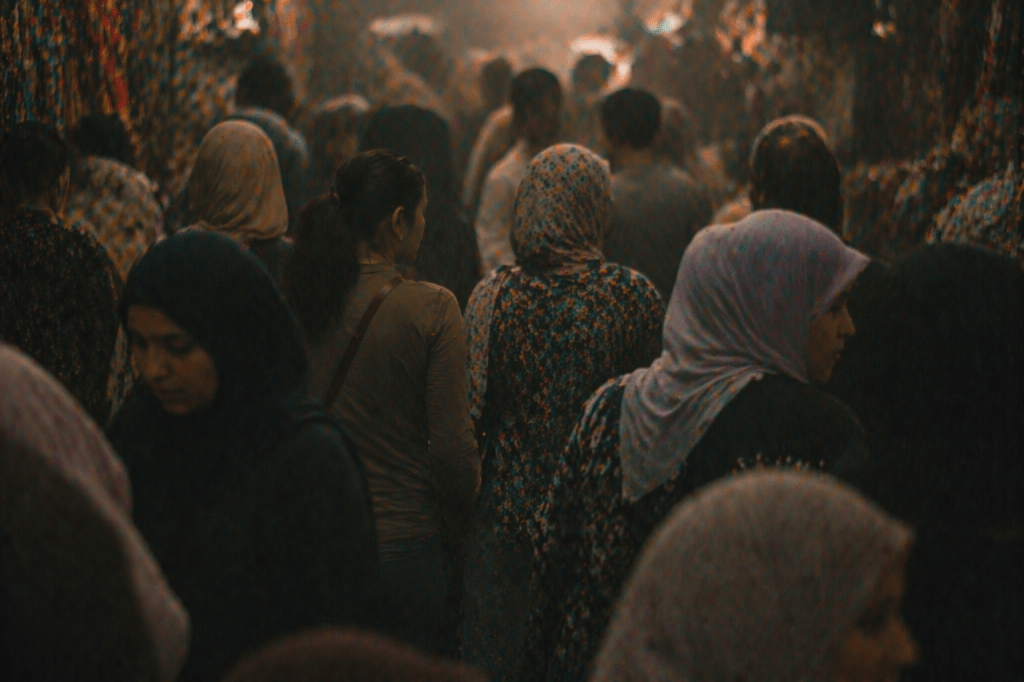
I remained.
I could have left, and there would have been no reason not to, but I found that I did not, and that my attention, once directed toward her, no longer released in the way it should have once the moment had passed.
She was within the passage again, or what I believed to be her, though by then the certainty that had accompanied that recognition earlier had begun to thin, as others moved in ways that resembled her more closely than before, not because they had changed, but because I could no longer separate what I was seeing with the same clarity I had relied on earlier.
I kept her within view as best I could, though that now required choosing not a single line of sight but several, shifting between them in a way that prevented any one of them from being held long enough to confirm what I believed I was following.
At some point, I became aware that I could no longer say with confidence that the woman I was watching was the same one I had first noticed, not because she had changed, but because the conditions that had allowed me to distinguish her had eroded.
It was then that I understood that what I had taken to be a matter of attention might not be resolved by the application of more of it, and that the failure I had been attempting to correct may not have been mine in the way I had assumed.
I did not lose her in any single moment.
There was no point at which I could say she had gone from my sight.
Only that, over time, the certainty that I had been following her at all had diminished to the point where it no longer held.
It would be possible to say that I lost her, but that would suggest a moment in which she was still fully within my sight and then was not, and I cannot identify such a moment with any certainty, as there was no clear point of departure, no interruption large enough to account for her absence, only the gradual thinning of what I believed I was able to follow until it no longer held together as a single line of movement, and I found myself no longer able to say where she had gone, or whether I had been watching the same woman at all.
I have passed through that passage many times since, and nothing in it has changed in any way that would explain what I thought I saw, as people continue to move as they always have, adjusting, hesitating, deciding in the small ways that make the space function, and yet I am aware now, in a way that I was not before, that there are moments within it that do not present themselves fully, not because they are hidden, but because they occur in the space between where attention is placed and where it is needed, and I have not been able to determine, even now, whether what I failed to follow was something that moved beyond my sight, or something that was never entirely within it to begin with.

You must be logged in to post a comment.