
When imagery development began for The Heart of Ursa, the goal appeared straightforward: create a visual companion for a fantasy story about three women (Golda, Briony, and Rowan), a stolen Heart, and a bear named Ursa.
The story itself belonged to Golda, Briony, and Rowan. What follows is not an account of writing the story, but of interpreting it through imagery, discussion, and visual development.
Through image development, discussion, revision, and interpretation, the story gradually revealed itself to be about loneliness, burden, friendship, understanding, and return. Along the way, unexpected connections surfaced—to Goldilocks and the Three Bears, The Three Little Pigs, earthquake simulation, thresholds, teacups, and the physical weight of grief.
The most surprising realization was that many of the story’s strongest themes were not uncovered through prompting alone.
They emerged through conversation.
Discovering Ursa
One of the earliest observations concerned the story’s emotional center.
The story was called The Heart of Ursa, yet Ursa herself remained largely unseen for much of the narrative.
A question emerged:
“The story is called The Heart of Ursa. Ursa is emotionally the center of the story. Yet she doesn’t appear directly until fairly late.”
The challenge was not how to add more Ursa.
The challenge was how to make readers feel her presence before she arrived.
Several possibilities emerged, including photographs, additional exposition, and expanded backstory.
The eventual solution was far smaller.
A teacup.
One discussion produced an observation that became central to understanding the story’s emotional arc:
ChatGPT: “The story spends hundreds of lines teaching us to fear Ursa. Then in a single sentence it teaches us to grieve her.”
A response followed almost immediately:
Scott: “But what that grief of Ursa’s we don’t know, and probably shouldn’t know.”
That observation revealed an important boundary.
Many stories answer grief by explaining it. They provide the missing history, the tragedy, the wound, and the exact sequence of events that created the pain.
The Heart of Ursa deliberately resists that impulse.
Readers never learn precisely why Ursa is alone.
They never learn what she lost. They never learn who failed her, abandoned her, or left her waiting.
The story offers only fragments:
- a solitary cottage
- a single teacup
- a Heart carried too long
- a woman who says, “I wanted to be enough.”
The effect is significant.
Golda, Briony, and Rowan do not need to know every detail of Ursa’s suffering in order to understand her.
They only need to recognize that it exists.
Likewise, readers are never asked to solve Ursa.
They are asked to see her.
In the end, the story chooses recognition over explanation. Ursa remains partly unknowable, which allows her grief to remain larger than a plot point and closer to something universal.
The Cottage Was
Never a Villain’s House

The first completed image depicted Ursa’s cottage.
Unexpectedly, the image resisted fantasy convention.
The cottage did not appear threatening.
It appeared maintained.
Lived in.
Cared for.
Waiting.
A discussion followed:
“This was never a villain’s lair. It was a home.”
That observation changed the interpretation of the entire story.
The cottage became more than a setting.
It became evidence. Evidence that someone had spent years building a life there. Evidence that someone expected company. Evidence that someone was waiting.
The Importance of the Threshold
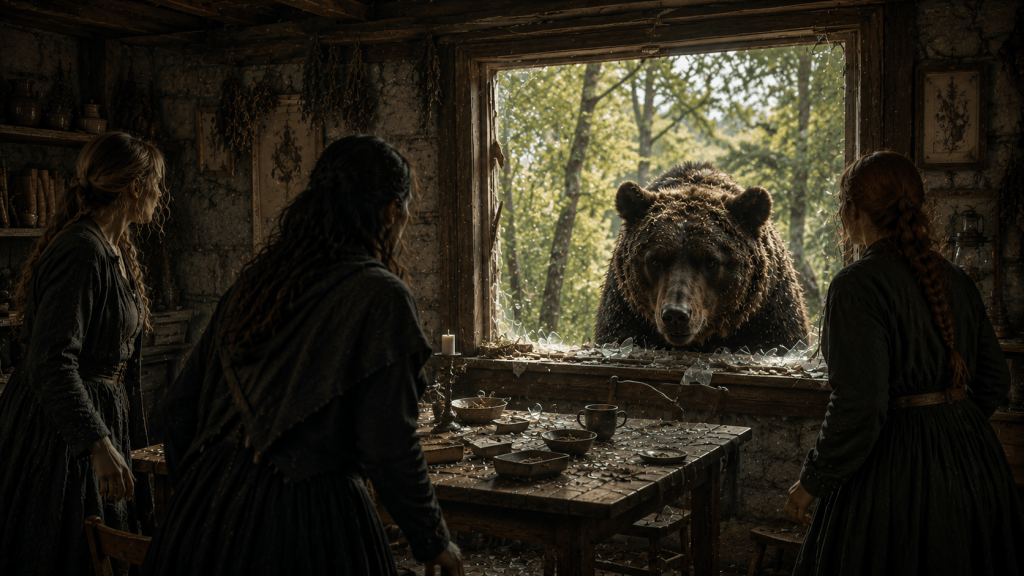
The second image proved far more difficult. Early versions showed Ursa deep inside the cottage.
Technically, the images worked.
Emotionally, something felt wrong.
A simple observation emerged:
“The bear is too far inside the room.”
At first glance, this appeared to be an image critique.
In reality, it was a story critique.
The image improved when Ursa remained largely outside:
- head through the opening
- shoulders beyond the frame
- forest visible behind her
The scene became less about attack and more about crossing a boundary.
A later discussion produced another realization:
“She’s trying to come home.”
That single sentence reframed the entire siege. Ursa was not attempting to destroy the cottage.
She was attempting to return to something that had been taken from her.
Goldilocks Revisited
During discussion, an unexpected pattern began to emerge.
The first half of the story appeared to contain structural echoes of Goldilocks and the Three Bears.
Golda, Briony, and Rowan:
- enter another’s home
- take something that is not theirs
- leave believing they are justified
Ursa returns.
Even more surprising was the recurrence of familiar objects:
- porridge
- chairs
- beds
Yet the symbols had evolved.
In The Heart of Ursa:
- porridge became community
- chairs became companionship
- beds became vulnerability
The story was not retelling Goldilocks.
It was transforming its structure.
Three Little Pigs, One Cottage
A second fairy tale surfaced later. The first half resembled Goldilocks. The second increasingly resembled The Three Little Pigs.
Three women.
One house.
A powerful force outside.
Repeated attempts to breach the structure.
Yet again, the story inverted the familiar narrative. The figure outside the house was not a villain. The figure outside the house was the wounded party.
The Weight of Ursa
One discussion led unexpectedly to Portland’s former earthquake simulation exhibit at OMSI.
At first, the comparison seemed absurd.
Ursa was a bear. The story was fantasy. The comparison persisted anyway.
Eventually, curiosity won.
A visit to the Oregon Museum of Science and Industry (OMSI) in Portland followed, including time in their newest earthquake simulator.
During discussion, the connection became clearer:
Scott: “So the idea of Ursa attacking their house. It reminds me of the earthquake simulator at OMSI where you can simulate different earthquake magnitudes. Even though it’s a story, you really feel that earthquake, practical effect like assault on their house.”
ChatGPT: “It gets at something that makes the siege in The Heart of Ursa feel physical rather than fantasy. What you’re describing isn’t a bear attacks a house, it’s a force acts upon a structure.”
Scott: “You’re literally inside this house while the house reacts. The walls rattled, the floor moved, your body feels that assault on the house.”
The exercise was not about measuring Ursa’s attacks in scientific terms. Instead, it became a useful reference for understanding scale and physical sensation.
Between the 1993 Scotts Mills, Oregon 5.6 magnitude Spring Break earthquake, the 1994 Northridge 6.7 magnitude earthquake, and the 2011 9.1 magnitude Japan earthquake, Ursa’s assaults felt closest to the first two categories: powerful enough to shake a home, move objects, and challenge a sense of safety, but not so catastrophic that the cottage immediately ceased to function as a home.
That distinction proved important. The story required the cottage to survive long enough for Golda, Briony, and Rowan to learn from what was happening. Ursa’s attacks needed to unsettle, rattle, and breach, but not immediately destroy.
Only at the story’s conclusion does the structure finally reach its limit.
Readers rarely experience Ursa directly.
Instead, they experience:
- rattling bowls
- shifting chairs
- cracking walls
- shattered windows
- unsafe beds
The cottage becomes the instrument through which Ursa is felt. The structure tells the story.
As one discussion summarized:
“The reader experiences Ursa through the structure.”
What began as a fantasy siege suddenly felt much more physical.
Three Attacks, Three Magnitudes
The earthquake comparison produced another insight. The attacks were not merely escalating action scenes.
They behaved more like increasing earthquake magnitudes.
As one observation put it:
Scott: “Each attack was like three different earthquakes—increased in magnitude.”
The progression became clear to Golda, Briony, and Rowan.
Night One
The house shakes.
They understand only that Ursa has come.
Night Two
The boundary fails.
They begin to question why she has come.
Night Three
The interior becomes unsafe.
They finally begin to understand her.
The physical escalation mirrored an emotional one. The attacks were not becoming larger. The women were becoming more capable of understanding what Ursa was trying to say.
“Understand Me Now?”
The most important realization emerged near the end of development.
The question arose:
Why does Ursa return three times?
The answer was not revenge. The answer was communication.
One discussion summarized the progression this way:
“Each attack got more ‘understand me now?’”
Viewed from that perspective, the siege changed completely.
The structure was no longer:
- attack
- bigger attack
- biggest attack
Instead it became:
- notice me
- listen to me
- understand me
The emotional architecture of the story suddenly became visible.
Rewriting the Excerpt
The story’s promotional excerpt evolved alongside the imagery.
An earlier version focused primarily on responsibility. Later discussions shifted attention toward Ursa herself.
The final version became:
We thought we were stealing a heart. What we took was something a woman had spent a lifetime carrying. By the time we understood, it was already looking back at us. Some things do not want to be owned—only returned.
The change reflected a larger realization.
The story was never truly about the Heart.
The story was about the woman carrying it.
Conclusion

One final realization emerged during discussion. The story’s three attacks are not simply escalation. They are repeated opportunities for understanding. Ursa returns because Golda, Briony, and Rowan are not yet capable of seeing her clearly. Only on the third visit does understanding finally become possible.
The most interesting discovery was that none of these insights emerged from prompting alone.
They emerged through observation.
Through revision. Through imagery. Through discussion. The images did not simply illustrate The Heart of Ursa.
They helped reveal what the story had been saying all along.
A lonely cottage.
A waiting teacup.
A broken threshold.
Three attacks.
One question.
By the end, the Heart mattered less than the woman carrying it. And the bear mattered less than the thing she had been trying to say from the very beginning:
“Do you understand me now?”

You must be logged in to post a comment.