
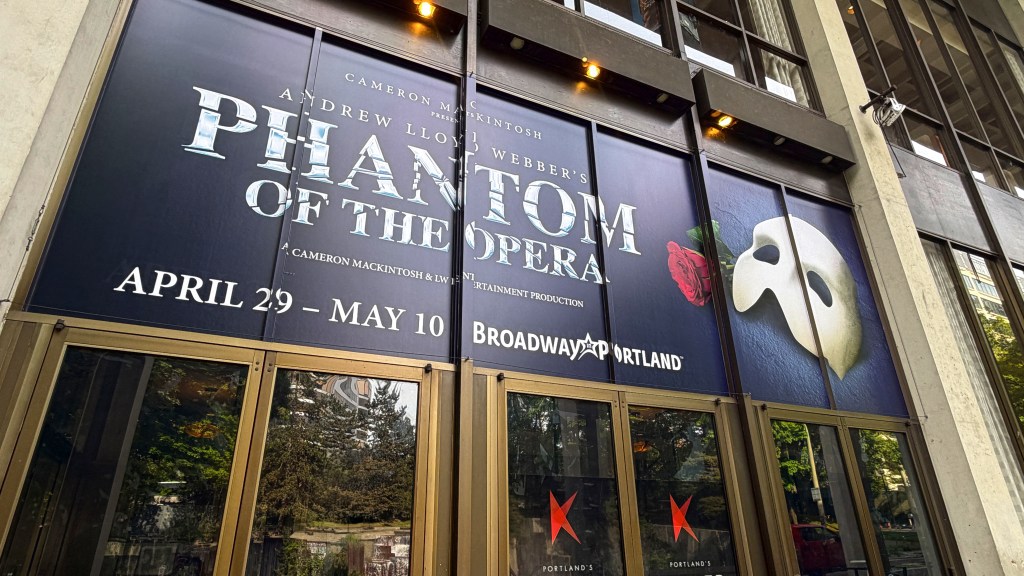
The Phantom of the Opera
Keller Auditorium, Portland, Oregon
Saturday, May 9, 2026 | 2pm Matinee
At 9:40 in the morning, Keller Auditorium still belonged to the city.
Traffic moved normally along SW Clay Street. Reflections of trees, the Ira Keller Fountain, and nearby buildings drifted across the theater’s tall glass windows.
The massive Phantom of the Opera banner hung against the concrete facade with an almost temporary quality, as though the production had arrived overnight and quietly claimed the building for only a brief moment before eventually disappearing again.
Hours later, the same entrance would be surrounded by crowds, ticket holders, ushers, and the low anticipatory noise that gathers before a major performance. But that morning, the theater still existed in a strange in-between state — not yet fully awake, but no longer entirely ordinary either.
By early afternoon, the transition had begun.
✦
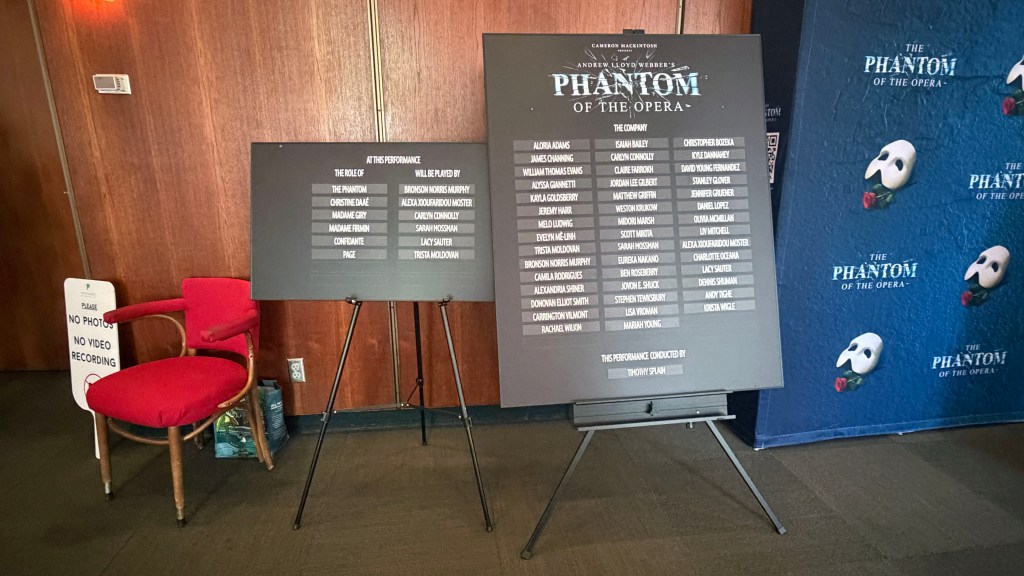
Inside the lobby, cast boards leaned against dark wood-paneled walls beside signs warning patrons about haze, pyrotechnics, and sudden loud noises.
For a brief period after the theater doors opened at 1:30pm, the auditorium existed in a suspended state between architecture and illusion.
The stage remained fully visible, the covered chandelier still hanging overhead while the audience — not yet silent — slowly settled into place beneath it.
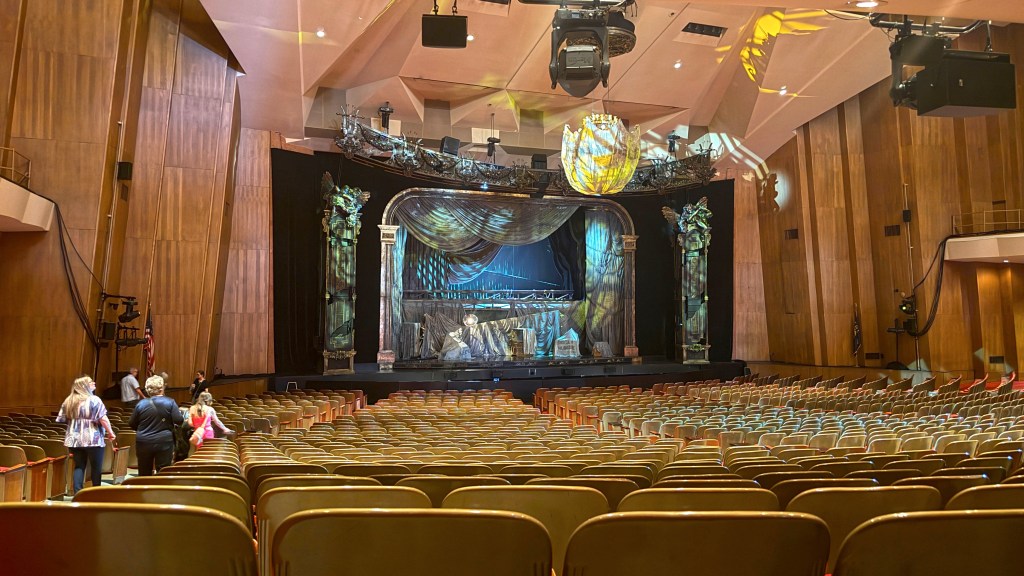
Ushers guided audience members toward rows of deep red seating while visitors paused to photograph the stage before the performance began. Some stood quietly beneath the chandelier. Others studied the curtain itself, already illuminated in gold and shadow long before the overture started.
What became immediately noticeable upon entering the auditorium was the sheer scale of the production design.
The stage curtain alone felt monumental — heavy folds of dark fabric illuminated with gold detailing that resembled aging ornamentation more than scenery. Suspended beside it hung the chandelier itself, already glowing softly above the audience long before it would become central to the production. Even at rest, it dominated the room.
What struck me most, however, was how the audience behaved in those opening minutes before the overture.
Not during the performance — the production strictly prohibited photography once the show began — but beforehand, nearly everyone seemed compelled to capture the room while they still could. Some photographed the stage itself, others posed with programs in hand beneath the chandelier.
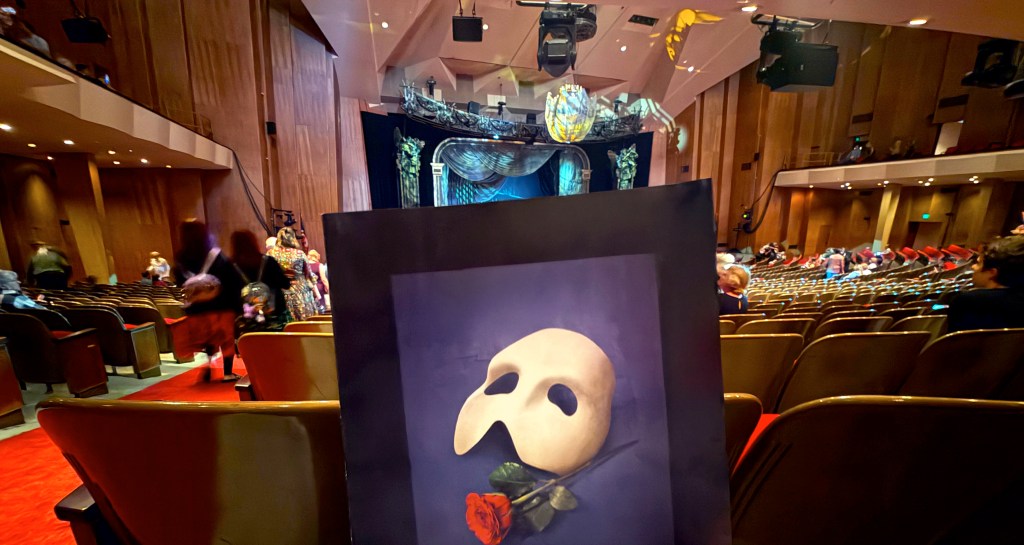
The theater doors had only recently opened, yet audience members immediately raised their phones toward the curtain and chandelier as though documenting evidence that the space truly existed in front of them.
The last time I attended The Phantom of the Opera in Portland was during its previous touring engagement in 2018–2019. Returning several years later created an unusual sense of theatrical déjà vu — not because the production felt identical, but because certain images remained immediately recognizable the moment the auditorium doors opened.
Some productions change entirely in memory over time. Phantom instead felt suspended somewhere between familiarity and rediscovery, as though the visual language of the production had remained waiting quietly inside the theater long after the previous tour had ended.
For a few minutes, the auditorium became observational rather than performative.
The illusion had not fully started yet.
The mechanics of theater remained visible:
lighting rigs suspended overhead,
ornamental framing surrounding the proscenium,
audience chatter echoing through the hall,
late arrivals stepping carefully through the rows.
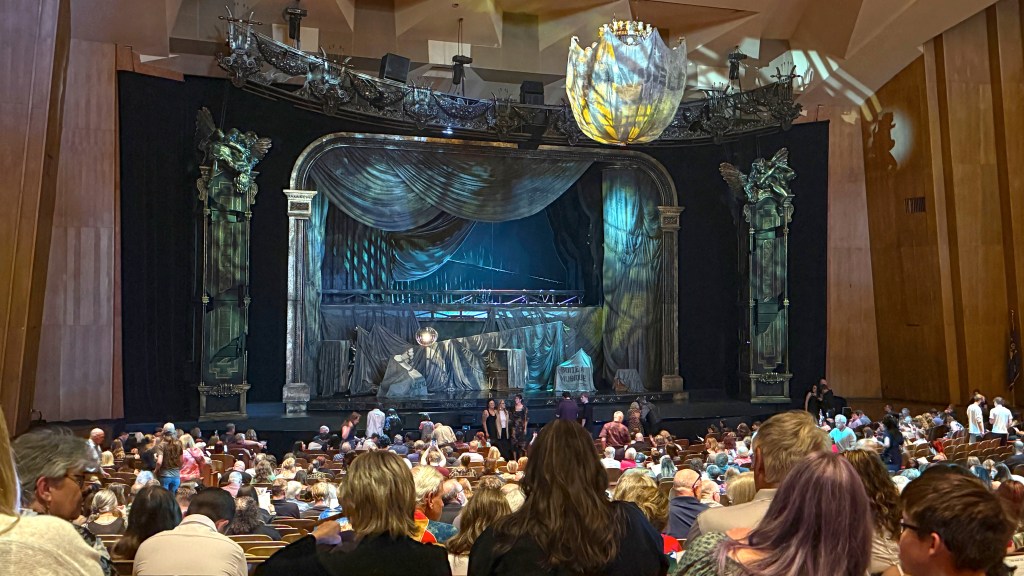
Even the chandelier carried a strange tension before the production began. Suspended above the audience in full view, it felt less like decoration and more like a promise waiting to be fulfilled.
From my seat near the exit aisle, the perspective gave the room an unusual openness. I could observe the audience filling in row by row while still remaining slightly removed from the center of the crowd itself. It also created an unexpectedly clear sightline toward the full width of the stage, allowing the scale of the production design to settle in gradually rather than all at once.
✦
Once the overture finally began, the auditorium changed almost immediately.
The opening organ motif surged through the auditorium with enough force to feel architectural rather than musical, vibrating through the seating rows beneath the chandelier overhead.
The audience that had spent the previous twenty minutes documenting the room gradually disappeared into silence as the production shifted from spectacle into theatrical illusion. What had previously felt observable — curtains, lighting rigs, audience chatter, the visible mechanics of the stage itself — suddenly became immersive the moment the house lights lowered and the production’s opening movements began unfolding beneath the chandelier overhead.
The space transformed into the Paris Opera House in 1905.
One of the most striking transitions arrived during Act One, Scene 3 (“Christine’s dressing room”), “Angel of Music.”
Until that point, the production still carried traces of theatrical distance. Christine’s dressing room initially appeared grounded and almost intimate compared to the enormous scale of the opera house surrounding it. The space felt smaller, quieter, more physically reachable. Madame Giry moved through the scene with restrained authority while the surrounding ballerinas and backstage activity retained the feeling of a functioning theater still partially rooted in reality.
Then the mirror sequence began.
What made the scene particularly effective was not simply the appearance of the Phantom himself, but the way the production transformed physical space around Christine in real time. The mirror no longer behaved like part of a dressing room. It became a threshold.
The staging emphasized this transformation carefully. Blue-grey light spread across the set while the room itself seemed to loosen from architectural stability. As Christine moved toward the mirror, the production gradually abandoned realism altogether, allowing the opera house to feel increasingly dreamlike without ever fully losing its physical weight.
The transition beneath the opera house remained one of the most visually impressive moments of the production.
As the Phantom guided Christine downward into his hidden world, the staging created the sensation of impossible depth through shifting staircases, moving set pieces, and angled perspective. At several points, the descent no longer felt horizontal or vertical in any realistic sense. Instead, the production created the illusion that both Christine and the audience were being drawn deeper beneath the theater itself.
What struck me most was how suddenly the production abandoned the ordinary physical rules established earlier in the afternoon. Only minutes before, audience members had been photographing curtains and chandeliers beneath full house lighting. Now the same room felt unstable, submerged in darkness and illusion.
The opera house no longer felt like a building in downtown Portland.
For a brief period, it became its own enclosed world entirely.
The production’s most famous visual moment arrived near the end of Act One.
By that point, the chandelier no longer felt ornamental. The audience had spent nearly an hour watching it remain suspended overhead — visible, illuminated, unavoidable — until its eventual movement carried less surprise than inevitability.
When it finally descended, the reaction inside the auditorium was immediate. Gasps echoed across the seating rows as the illusion briefly overwhelmed the physical awareness of the room itself.
✦
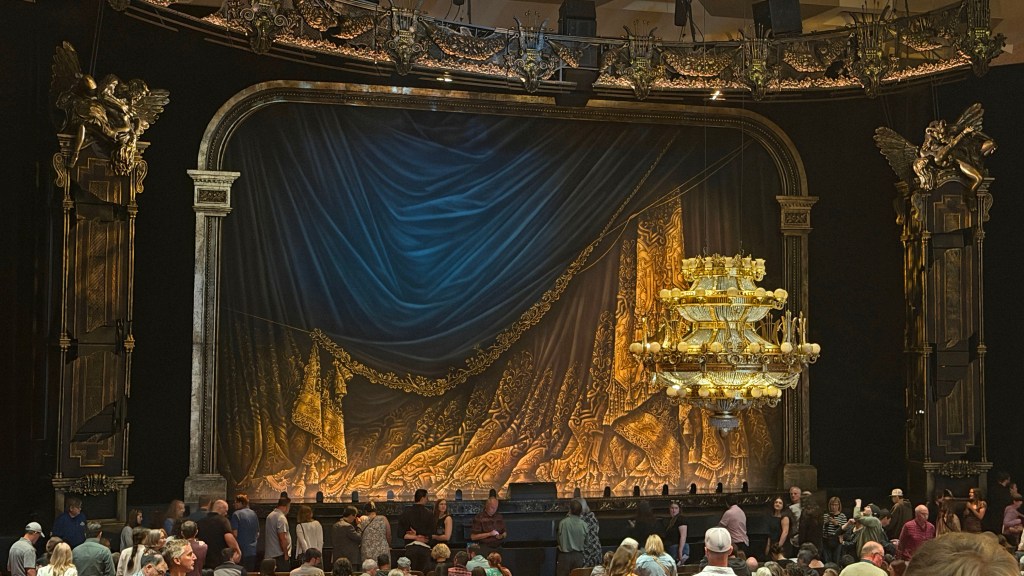
During intermission, the audience slowly returned to ordinary behavior again.
Conversations resumed in the aisles. Programs reopened. Ushers redirected patrons toward the lobby while the stage remained partially exposed beneath altered lighting.
Yet the auditorium no longer felt identical to the room audiences had entered earlier that afternoon.
By Act Two, the production no longer relied on surprise as much as accumulation.
The audience already understood the visual language of the opera house by then — chandeliers, mirrors, curtains, underground passageways — allowing the production to distort those same spaces more aggressively as the performance continued.
Eventually, the performance would end once Meg Giry discovered the Phantom’s mask in the Phantom’s lair. The audience would rise from their seats, programs folded beneath their arms as conversations returned to the aisles and lobby once again. Outside, downtown Portland continued moving normally beneath the late afternoon light.
But for several hours inside Keller Auditorium, the production achieved something increasingly rare in contemporary entertainment: the complete transformation of physical space.
✦
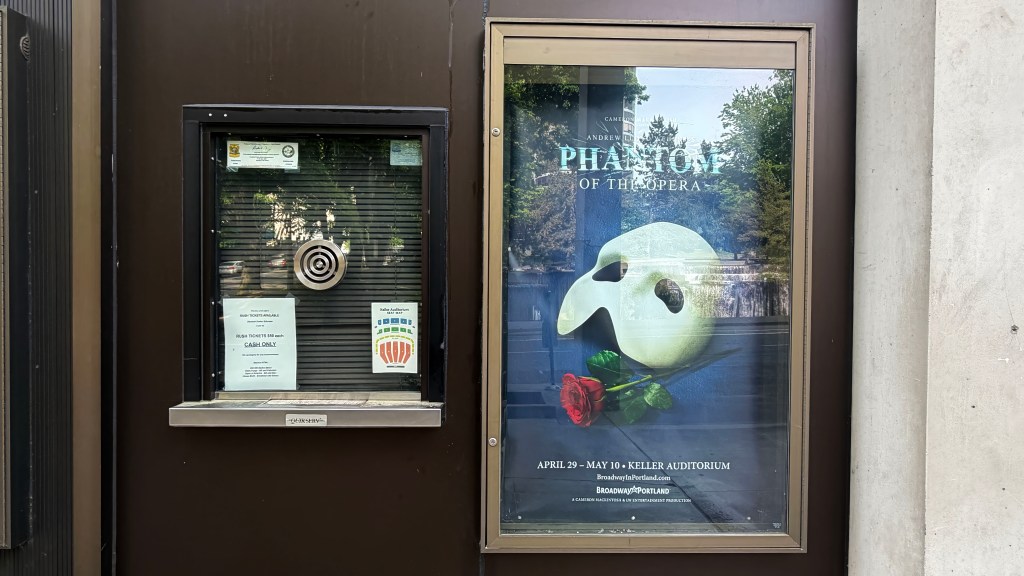
What began earlier that morning as a quiet concrete building along SW Clay Street gradually disappeared beneath curtains, shadow, music, and illusion until the opera house itself seemed to exist independently from the city surrounding it.
Long before the chandelier ever fell, the audience had already surrendered to it.

You must be logged in to post a comment.