
Willamette Shore Trolley
Lake Oswego, Oregon
Saturday, June 6, 2026 | 10am
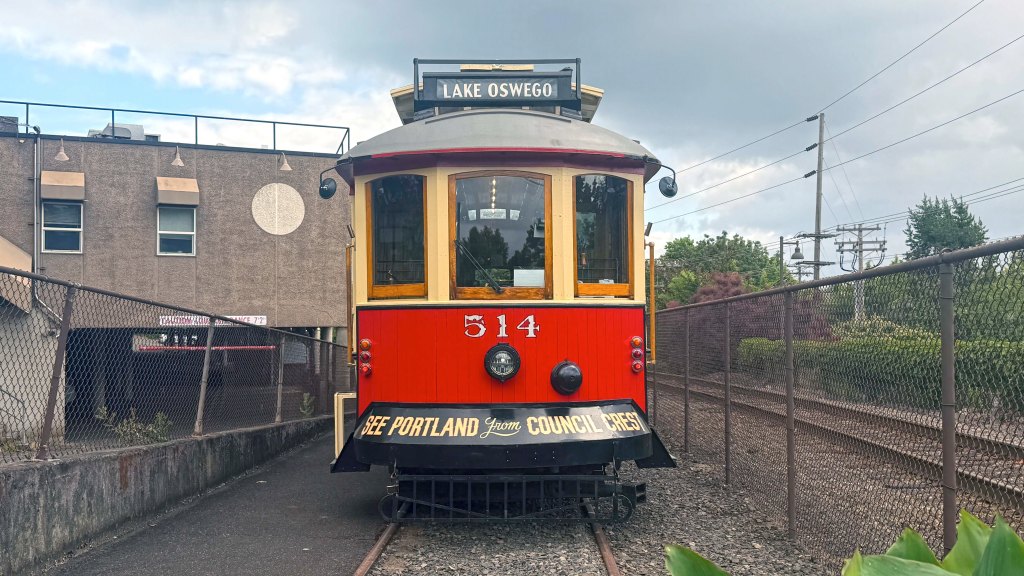
When I boarded the Willamette Shore Trolley in Lake Oswego, I expected a pleasant ride along the river and an opportunity to experience a small piece of Oregon transportation history.
What I did not expect was how often the journey would return to things that have vanished.
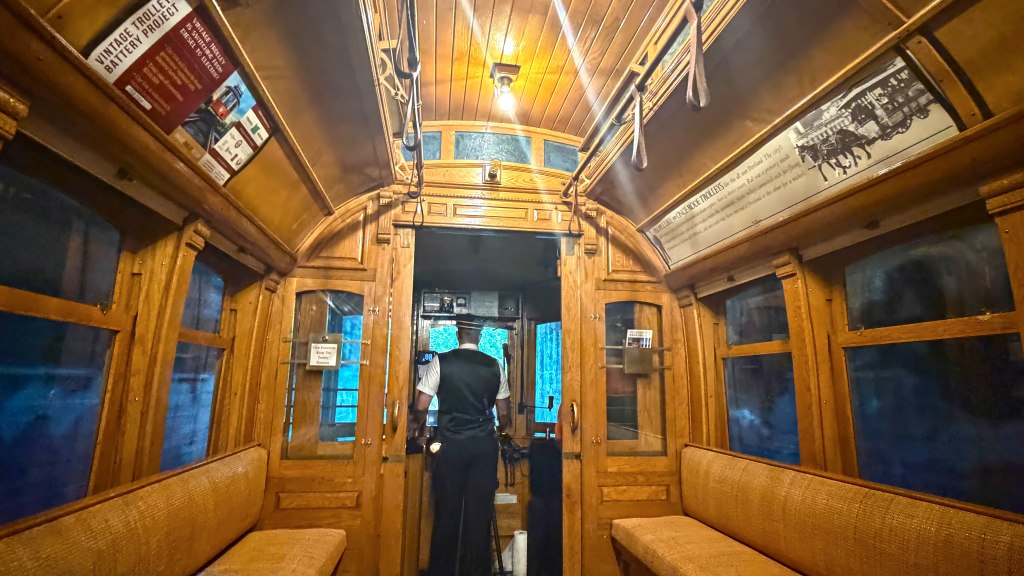
The trolley itself is a reminder of another era. Car 514, the car I rode in that morning, has already lived more than one life. Once powered by diesel, it has since been converted to battery-electric operation, allowing a century-old style of transportation to continue carrying passengers along the Willamette River.
Inside, wooden benches lined the walls beneath panels describing local transit history. The seats themselves could be reversed at the end of the line, a reminder that the trolley was not merely styled after an earlier era but still operated according to some of its original logic.
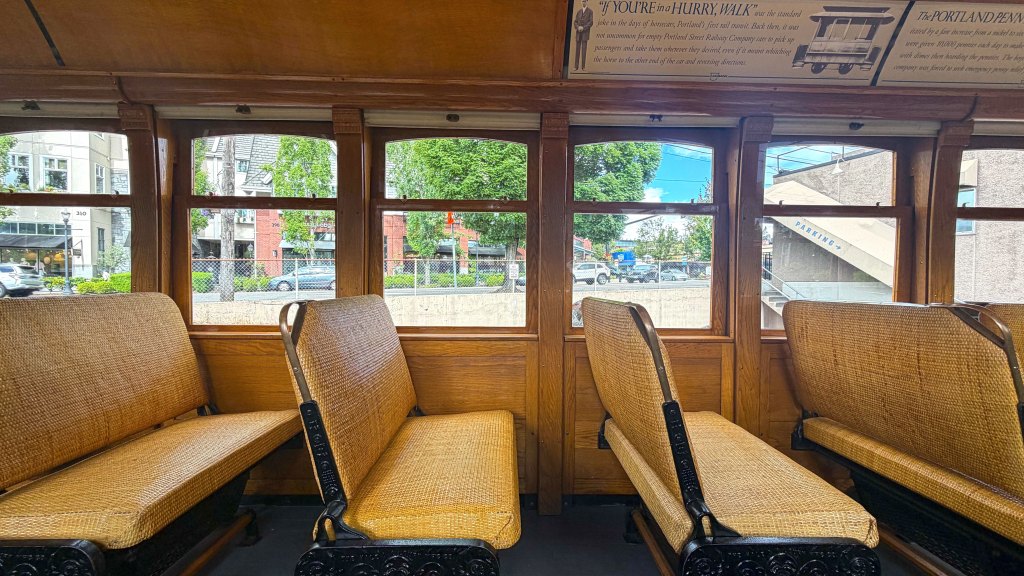
As the trolley moved north toward Portland, volunteer conductors narrated the landscape beyond the windows.
Some of what they pointed out still stands. Other places survive only in fragments, while some exist now only through photographs and stories.
❦
The most memorable stop on the return trip from Portland to Lake Oswego was not a building at all.
It was a staircase.
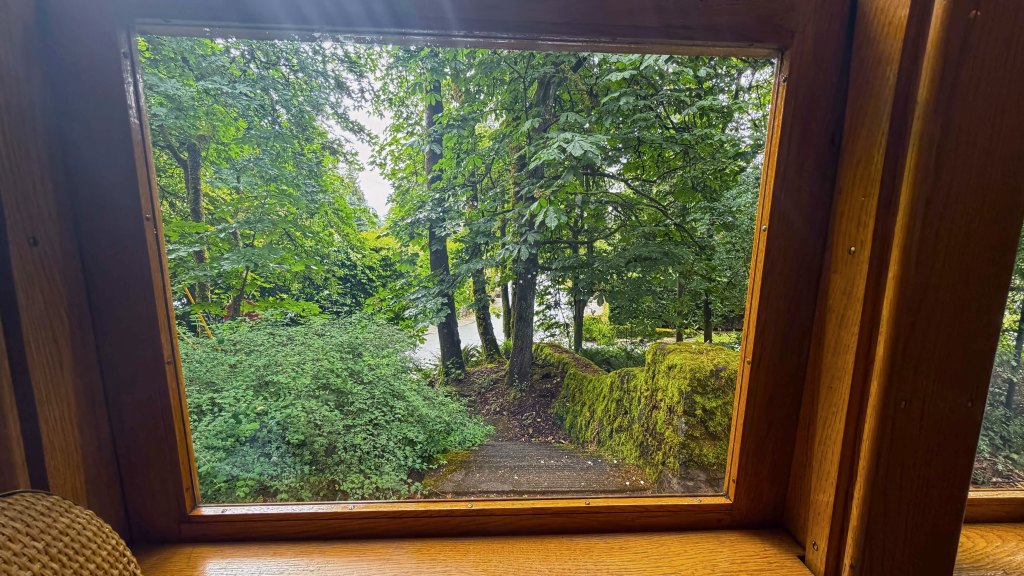
Near Dunthorpe, the trolley slowed beside a moss-covered stone stairway descending through the trees. Today it appears almost accidental, as though it has always belonged to the forest. Yet those stones are the last visible remnant of what was once known as the White House Hotel, a large riverside roadhouse built in the late nineteenth century near the end of Macadam Road.
The conductors passed around a historic photograph from the archives of the Lake Oswego Public Library showing the hotel in its prime. Looking at the image while staring through the trolley window created a strange sensation. In the photograph stood a substantial riverside hotel overlooking the tracks. In reality, only the staircase remained.
The White House Hotel was not known for refinement. It attracted Portland’s sporting crowd, offering horse racing, gambling, drinking, trap shooting, lodging, and what one conductor diplomatically described as “adult entertainment.” A half-mile racetrack stood nearby, transforming the site into a destination for recreation and vice along the lower Willamette.
Then, in 1904, the hotel caught fire. According to local accounts and reports published in The Oregonian, attempts to save the wooden structure failed. Bucket brigades could do little against a fire that quickly spread through the building. As the flames consumed the hotel, attention shifted from saving the structure to rescuing its contents.
The liquor and cigars, apparently, received first priority.
The hotel burned to the ground and was never rebuilt.
More than a century later, the staircase remains.
There was something oddly moving about that realization. The racetrack disappeared. The hotel disappeared. The crowds disappeared. Even the activities that made the place notorious faded into memory. Yet the staircase endured, carrying the memory of an entire vanished destination.
That moment captured something essential about the trolley ride itself. Again and again, the journey revealed traces of places that no longer existed, fragments of stories that could easily have been forgotten. The trolley was not simply carrying passengers between Portland and Lake Oswego. It was moving through a landscape layered with remnants of earlier lives, allowing new riders to notice what remained.
❦
The ride continued north through the Elk Rock Tunnel, another survivor from an earlier age.
The short tunnel, cut through solid basalt along the riverbank, briefly plunged the trolley car into darkness before daylight returned at the opposite end.
It is easy to overlook today, but the tunnel stands as another reminder that pieces of the past often outlive the systems that created them.
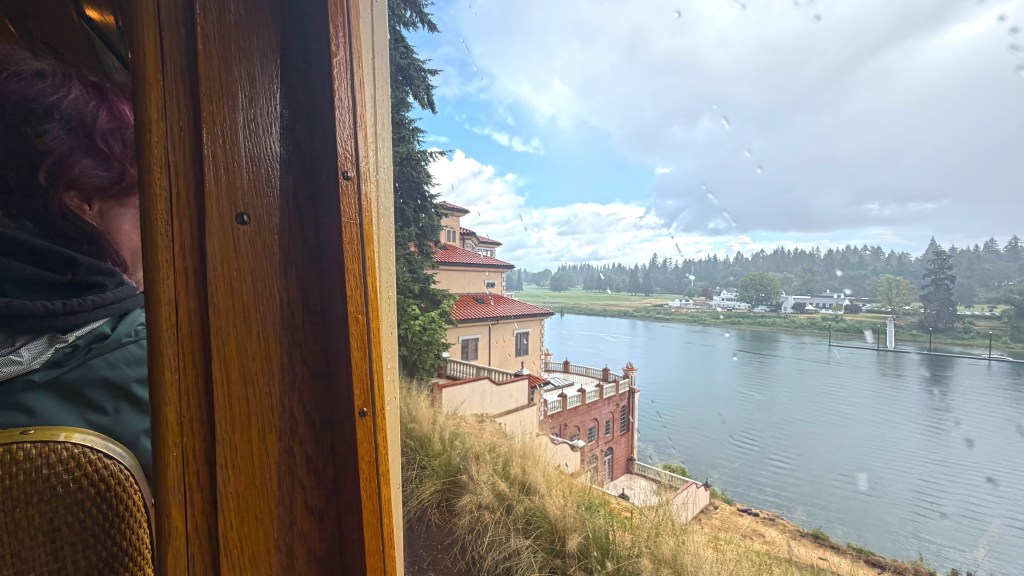
Elsewhere along the route, history appeared in different forms. The conductors pointed out the Sears House hidden among the trees, modern homes perched on valuable riverfront property, and views across the Willamette toward Waverley Country Club. At one point, the Queen of Seattle paddlewheel vessel appeared below through breaks in the foliage, another reminder of how transportation on the river has evolved through successive eras.
What stayed with me, however, was not any single landmark but the accumulation of them.
Again and again, the ride revealed places where the past remains partially visible. A tunnel survives after the transportation network around it changes. A photograph preserves a hotel long after the building itself disappears. A staircase continues descending toward a destination that no longer exists. Even the trolley serves as an example, carrying passengers along tracks that might otherwise have become another forgotten chapter of local history.
The trip lasted only a few hours, yet by the end it felt less like a trolley ride and more like a journey through layers of survival.
History often seems distant when encountered in books or museums. Along the Willamette Shore Trolley route, it appears through windows. Sometimes it takes the form of a preserved tunnel. Sometimes it takes the form of a photograph passed from hand to hand.
And sometimes it is nothing more than a moss-covered staircase disappearing into the trees, quietly marking the place where an entire world once stood.

You must be logged in to post a comment.